
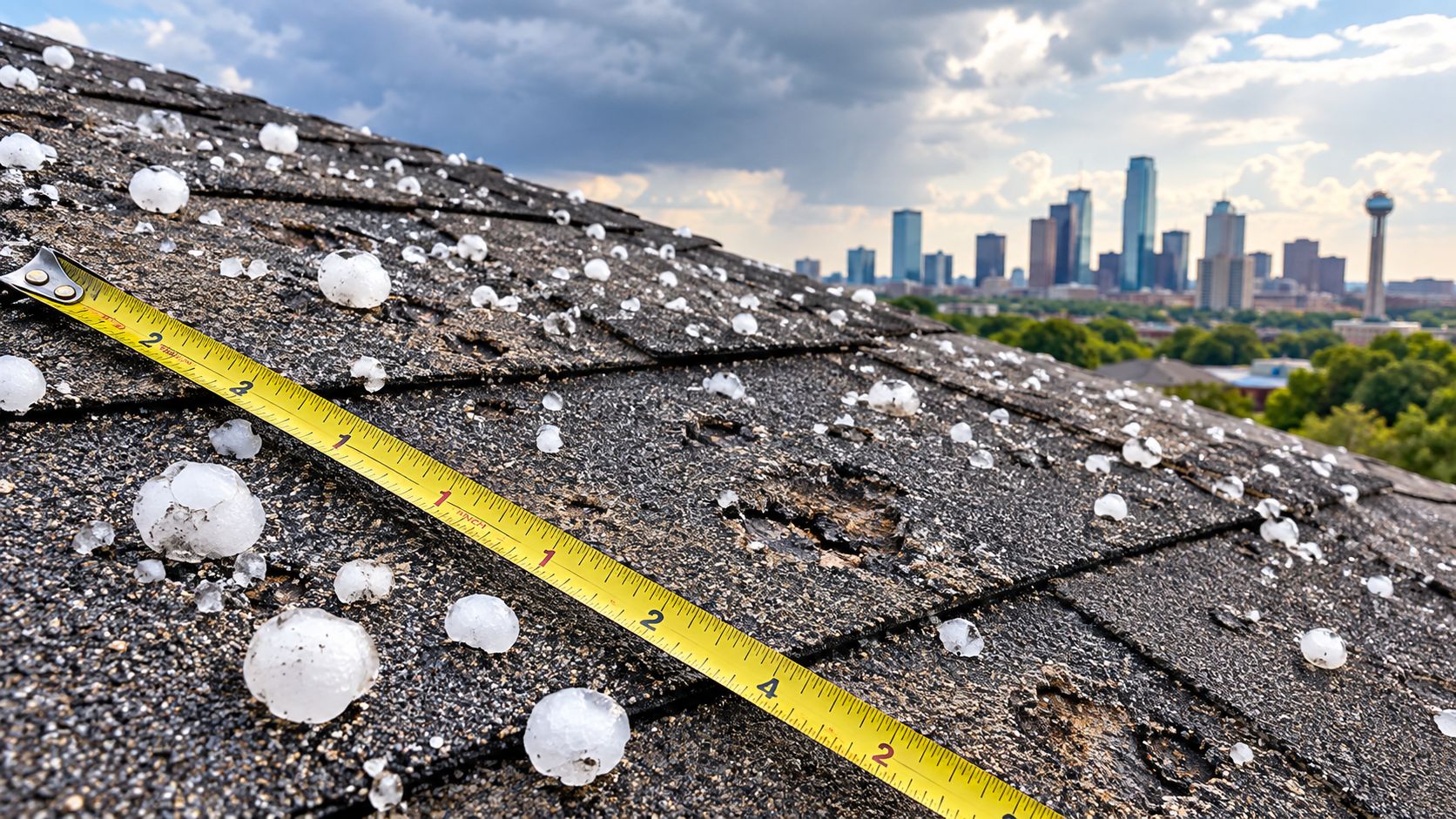
What Size Hail Damages a Roof in Fort Worth
One-inch hail, roughly quarter-sized, is the general threshold where standard asphalt shingles may begin to suffer damage. The actual size that causes functional damage depends on the roofing material, its age, its condition, and the cumulative exposure your roof has already endured.
The storm has moved east over Fort Worth, Arlington, or Mansfield, but you're still hearing granules crunch under your shoes near the driveway. Maybe the gutters are dented, a window screen is torn, or your neighbor is already talking about filing a claim. The question comes quickly: was the hail large enough to damage the roof?
For a standard asphalt shingle roof, 1-inch hail is the practical starting point, but that isn't a verdict. A weathered roof can bruise under smaller stones, while a newer, heavier assembly may tolerate the same storm with little more than surface marks. Wind, roof slope, impact angle, material, and prior wear all change the result.
In the Dallas-Fort Worth Metroplex, that distinction matters. A storm moving across Fort Worth may affect roofs in Benbrook, North Richland Hills, Keller, Grapevine, Dallas, Plano, Frisco, McKinney, or Denton differently, even when homeowners describe the event as “the same hailstorm.” The right question isn't only what size hail damages a roof. It's whether that hail damaged your particular roof system in a way that affects performance.
Table of Contents
- Understanding Hail Damage Thresholds for Fort Worth and Surrounding Cities
- Material-Specific Hail Size Thresholds for Roof Damage
- How Insurance Adjusters Evaluate Storm Damage
- The Impact of Cumulative Hail Exposure on Roof Lifespan
- Distinguishing Functional Damage from Cosmetic Bruising
- Post-Storm Inspection Steps for DFW Homeowners
- Protecting Your Roof with Blue Lake Roofing and Remodeling
Understanding Hail Damage Thresholds for Fort Worth and Surrounding Cities
After a DFW storm, homeowners usually make one of two mistakes. Some assume the roof is fine because the hail looked small from inside the house. Others assume every dent or missing granule means they need a full replacement. Neither conclusion can be made from hail diameter alone.
The widely used benchmark is 1 inch, about the size of a quarter, because the National Weather Service classifies hail at or above that diameter as severe, and roofing guidance commonly associates that size with the beginning of damage on standard asphalt shingles. The benchmark is useful, but it isn't a guarantee of either damage or replacement. Angi's roofing guidance explains why the 1-inch mark is a practical reference while actual damage varies by roof construction and condition.
Why the same storm affects neighboring roofs differently
Consider two homes on the same block in Fort Worth. One has a newer, thicker asphalt shingle assembly with strong granule adhesion. The other has an older roof that has already lost protective granules and flexibility through sun, wind, and previous storms. Quarter-sized hail may leave the newer roof with scattered cosmetic marks while bruising the older shingles and exposing the asphalt mat.
Wind can make the difference even more pronounced. A stone driven across a roof at an angle can deliver a harder blow than the same stone falling with little lateral movement. Roof slope matters, too. A steep slope may deflect some impacts, while a less steep plane can receive more direct strikes.
Practical rule: Treat the reported hail size as a reason to inspect the roof, not as proof that the roof is either damaged or undamaged.
Fort Worth and surrounding cities see recurring hail activity, so a roof's storm history deserves attention. A homeowner in Arlington may have a roof that survived an earlier storm but has less remaining impact resistance today. A homeowner in Plano may see different results on a clay tile roof than a nearby property with lightweight asphalt shingles.
The most reliable assessment combines the storm context with a close inspection of every roof slope, the age and material of the assembly, and the character of the impact marks. A ground-level glance can't reliably identify bruising beneath the granule surface.
Material-Specific Hail Size Thresholds for Roof Damage
Roofing materials don't respond to hail in the same way. Asphalt shingles can develop hidden bruises, wood products can split along the grain, and tile can crack or break at impact points. A single storm can therefore produce functional damage on one property and mostly cosmetic damage on another.
The following comparison uses practical industry thresholds for steep-slope roofing. These are starting points, not automatic replacement rules.
Hail Damage Thresholds by Roofing Material
| Roofing Material | Minimum Hail Size for Damage | Common Visual Indicator |
|---|---|---|
| Lightweight asphalt shingles | About 1 inch | Localized granule loss, bruising, or exposed asphalt mat |
| Heavyweight asphalt shingles | About 1.25 inches | Indented or fractured shingle surface, concentrated granule loss |
| Wood shingles | About 1.25 inches | Splits, cracks, or impact damage along the grain |
| Clay tiles | About 1.5 inches | Cracks, chips, or broken tile edges |
| Concrete tiles | About 1.75 inches | Cracking, chips, or displaced sections |
These thresholds come from material-specific roofing guidance, including the National Roofing Contractors Association's steep-slope damage reference. The practical lesson is simple: harder or heavier materials generally require larger hail to sustain functional damage, but age and pre-existing defects can move the threshold lower.
Asphalt shingles deserve the closest attention because the damage may not look dramatic. Hail can knock away granules and fracture the underlying mat without creating an immediate hole. The roof may continue shedding water for some time while its resistance to ultraviolet exposure and future weather declines. Nebraska's roofing guidance describes how lightweight composite shingles may show damage around 1 inch, while heavier materials often require larger impacts and deteriorated shingles can be damaged below that size.
Wood products also require careful interpretation. The threshold listed for wood shingles doesn't mean every wood roof responds identically. A medium wood shake reference can place damage at a lower threshold than heavier wood products, which is one reason inspectors need to identify the actual roofing assembly rather than rely on a broad “wood roof” label.
Tile creates a different trade-off. A clay or concrete tile roof may resist the same impact that bruises an asphalt shingle, but one cracked tile still needs attention. Walking on tile carelessly can create additional breakage, so homeowners shouldn't try to confirm damage by climbing onto the roof.
InterNACHI's material-specific hail inspection guidance also distinguishes between shingle, cedar, laminated, and concrete tile products. That level of detail matters during an insurance conversation because the relevant question is not whether the storm reached a generic size. It's whether the observed damage is consistent with the material installed on your home.
How Insurance Adjusters Evaluate Storm Damage
An insurance adjuster isn't supposed to approve or deny a roof claim based only on a weather report or the size of hail a homeowner remembers. The adjuster examines the roof for a pattern of impact evidence and separates storm damage from aging, installation issues, manufacturing defects, and ordinary weathering.
The inspection normally begins with the roof's overall condition. An adjuster looks across each slope, checks soft metals and accessories, and compares the distribution of marks. Hail strikes tend to appear as localized, irregular impacts. Sun exposure, oxidation, and general granule loss usually create broader and more uniform deterioration.
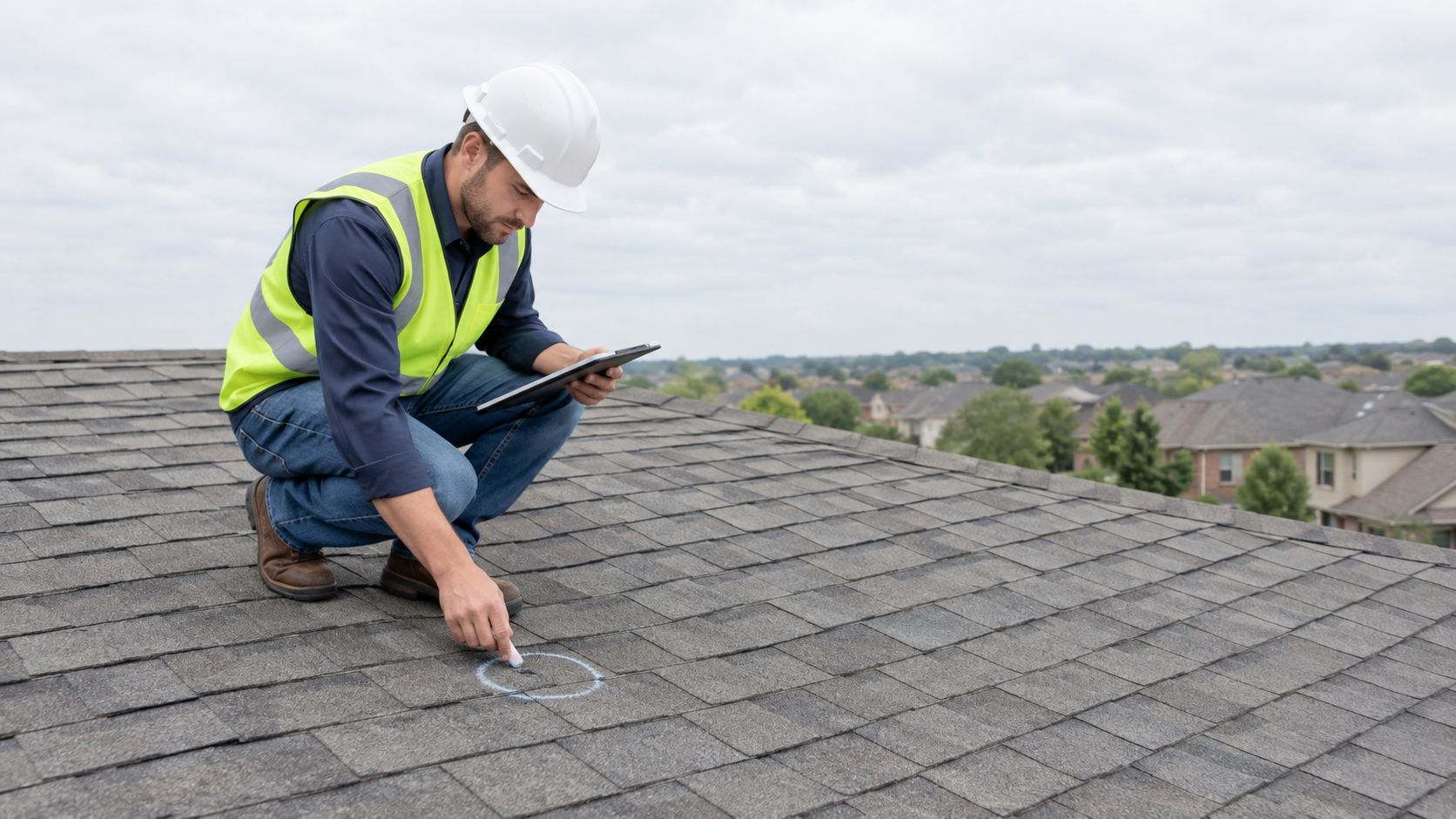
What a credible roof inspection looks for
Inspectors commonly assess the following physical evidence:
- Localized granule loss: A true impact can remove granules in a defined area rather than producing a uniform worn appearance.
- A soft bruise: Pressing the shingle near an impact may reveal a distinct depression or loss of firmness beneath the surface.
- Mat exposure or fracture: If the impact exposes or fractures the asphalt and fiberglass structure, the shingle's protective function is compromised.
- Impact distribution: Adjusters compare the number and character of strikes across representative roof areas, often using a test-square approach.
- Related property evidence: Dented gutters, vents, downspouts, flashing, screens, and other soft metals can help establish that hail reached the property.
A test square isn't a magic formula. It gives the inspector a consistent way to evaluate representative areas instead of selecting only the most damaged shingles. The adjuster still has to consider roof age, material, slope, prior repairs, and whether the marks are actual bruises or just surface irregularities.
Homeowners should also understand the difference between an inspection and a sales presentation. A contractor who immediately recommends replacement without documenting the roof's condition hasn't given you enough information. Ask for photographs of each affected slope, close-ups of representative marks, and a written explanation of whether the damage is functional.
If the storm also caused a fallen tree, roof penetration, or structural opening, document that situation separately and review a resource such as fallen tree claim steps before disturbing the scene. Tree impact claims involve different evidence and safety concerns from ordinary hail damage.
A fair inspection should be able to explain both conclusions, “this roof has functional damage” and “this roof doesn't show claim-level damage,” with photographs and specific observations.
The Impact of Cumulative Hail Exposure on Roof Lifespan
After a DFW storm, a roof may look intact and remain dry while its protective surface has already started to deteriorate. Smaller hail can remove granules and weaken shingles, especially when similar storms strike the property repeatedly. A later storm may expose that accumulated weakness with fewer obvious clues about when the damage began.
The Insurance Institute for Business & Home Safety's hail testing addresses repeated exposure and dent thresholds, not only the effect of one isolated stone. IBHS hail testing shows that shingles weathered by repeated sub-severe hail can be about ten times more susceptible to later severe-hail damage than unweathered shingles. Sub-severe hail below 1 inch can also reduce a roof covering's resistance to later large hail and accelerate natural aging. IBHS explains the role of repeated hail exposure in roof performance.
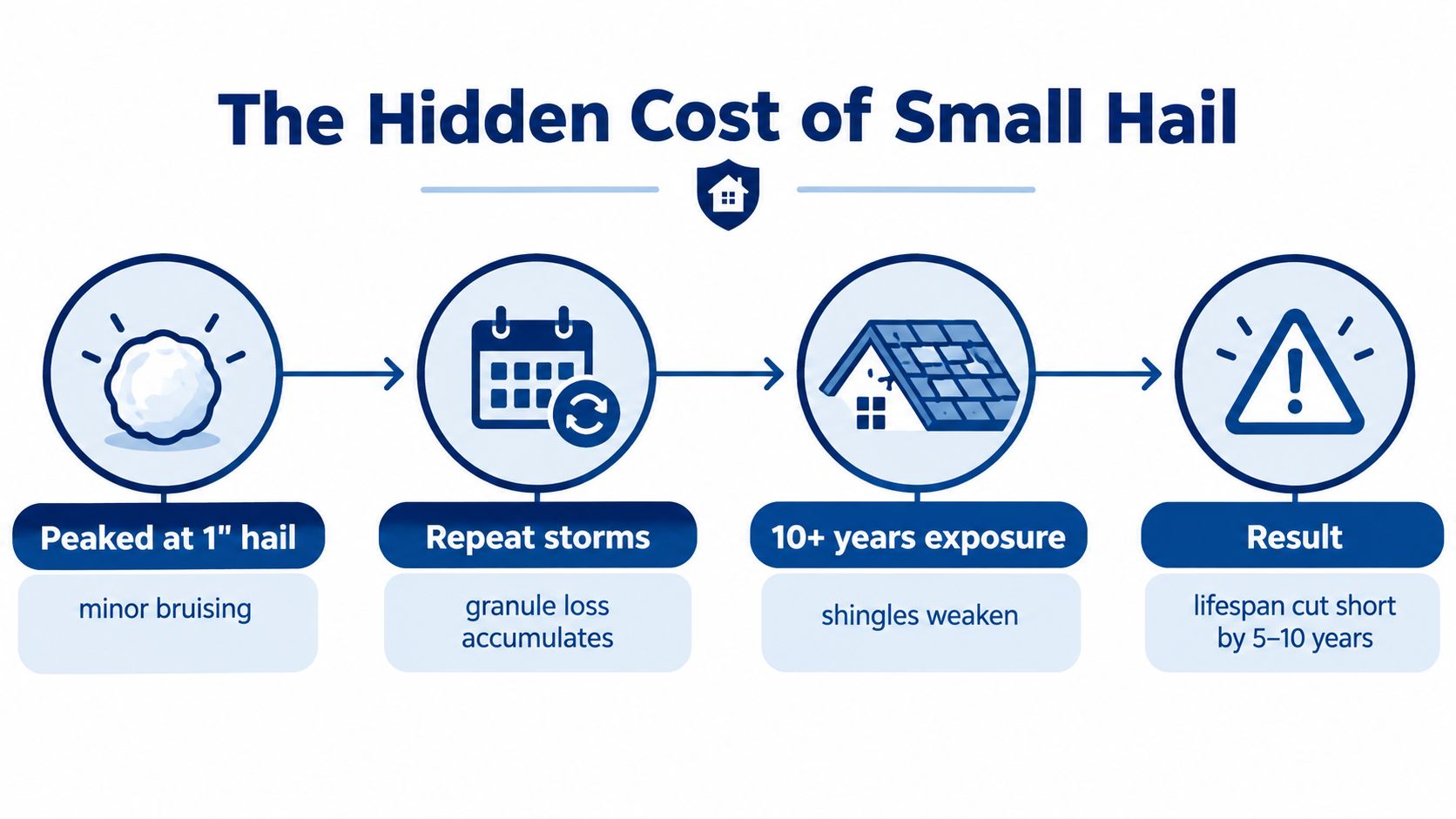
Why a roof can fail during a later storm
The first minor hail event may leave no leak, yet still loosen granules, reduce surface resilience, or weaken the shingle's ability to withstand wind and impact. A larger strike during a later storm can then open a vulnerable area. The resulting leak may appear to come from one storm, even though earlier exposure helped reduce the roof's remaining service life.
Roof history belongs in the inspection. An older asphalt roof with prior granule loss calls for a different assessment than a newer roof with intact surface coverage and seal integrity. Replacing every roof after a small-hail storm is not the right conclusion. Repeated exposure is a reason to document condition, not automatic proof that replacement is warranted.
Verisk's 2026 roofing analysis identifies severe hail at 1 inch or larger as the dominant weather-related threat to roofs. It also reports that exposure to hail between 1 and 2 inches varies substantially by metropolitan area, with 16 states experiencing severe hail impacts on more than 20% of roofs in 2025, compared with 12 states in 2024. Verisk's roofing risk analysis provides the broader geographic context for changing hail exposure.
For DFW homeowners, the practical step is to preserve inspection records after meaningful storms. Repeated hail exposure can affect a claim's evidence and the roof's condition long before a dramatic leak appears.
Distinguishing Functional Damage from Cosmetic Bruising
A roof can show clear hail marks without losing its ability to protect the house. Functional damage changes how the roof sheds water, resists weather, or protects the underlying assembly. Cosmetic bruising affects appearance while the covering continues to perform as designed. That distinction matters during both inspection and an insurance review.
An impact becomes functional damage when it fractures the shingle mat, exposes fiberglass or asphalt, splits tile, or creates another opening that permits water and ultraviolet exposure to shorten service life. Limited granule displacement may remain cosmetic, as may a dent in a metal accessory that still performs its intended purpose. The location, depth, pattern, and material condition determine the result.
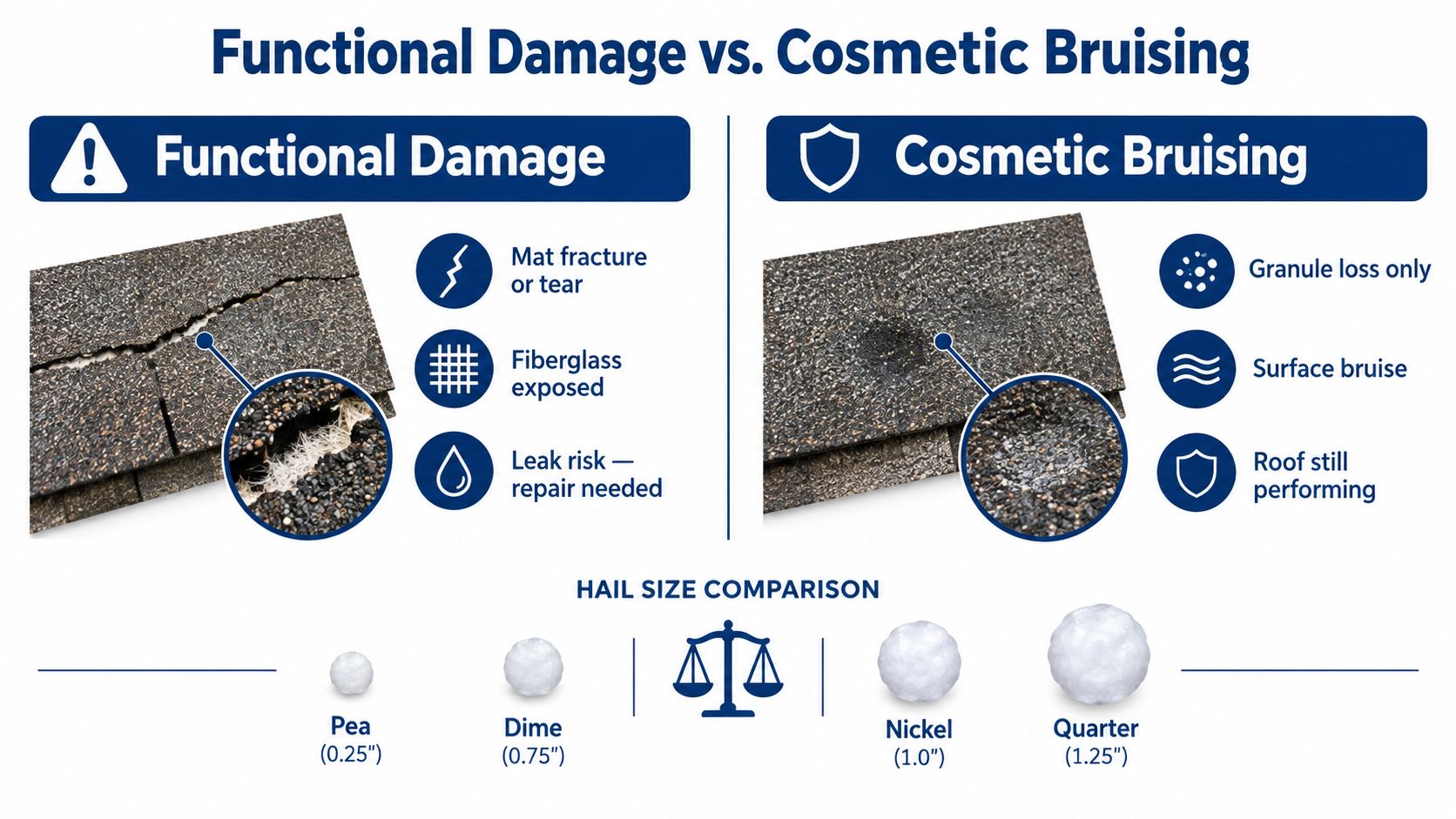
What functional damage looks like
An inspector examines the shingle's structure, not just its color or texture. A soft bruise can indicate a fractured mat even when the surface appears intact. Granule loss carries more weight when it is concentrated around an impact and exposes the material underneath.
Functional damage can include:
- Mat fracture or tear: The shingle's reinforcing structure has been compromised, reducing its ability to remain intact during weather.
- Exposed fiberglass or asphalt: The protective granule layer no longer covers the affected area, leaving the shingle more vulnerable to exposure.
- Cracked or split roofing material: Tile, wood, or shingles may no longer protect the deck from water.
- Punctures or openings: A direct breach creates a path for water and requires prompt attention.
Why cosmetic findings don't automatically mean replacement
Cosmetic damage deserves documentation, but it does not automatically support roof replacement. A dented vent or superficial mark on painted metal may confirm that hail reached the property without showing that the roof covering has failed. Policy language can also treat cosmetic and functional damage differently, so the inspection evidence must be compared with the policy terms.
Roof history should inform the decision, not replace physical evidence. A roof with visible bruising may still be serviceable, while a less dramatic mark can reveal a structural fracture. The storm's size alone cannot settle that question.
A strong claim file connects the storm to the observed condition. Include dated photographs, slope-by-slope findings, material identification, and a clear explanation of how the damage affects performance. If the evidence shows appearance changes only, a responsible contractor should say so rather than turn every mark into a replacement recommendation.
Post-Storm Inspection Steps for DFW Homeowners
DFW homeowners should inspect safely from the ground after the weather clears. Fort Worth-focused storm guidance describes the metro as repeatedly affected by damaging hail, with common hail sizes in the 1- to 2-inch range, a range often associated with bruising, granule loss, and shingle cracking on asphalt roofs. The local DFW hail guide explains why Fort Worth and surrounding cities warrant prompt post-storm inspections.
Start with evidence you can gather without climbing onto the roof.
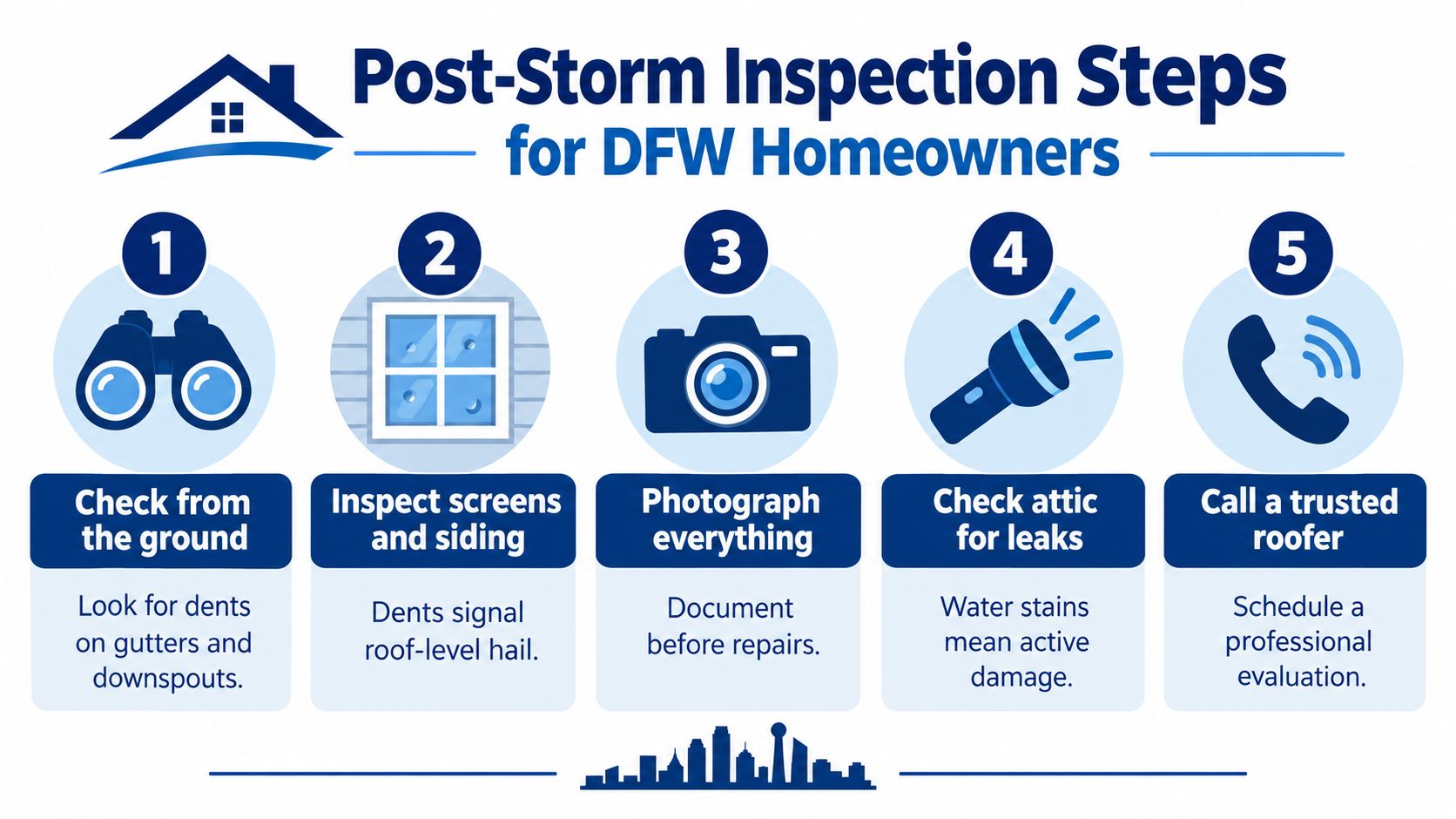
A safe property check
Check from the ground. Use binoculars if you have them. Look for missing or displaced shingles, dents in gutters and downspouts, and visible marks on roof edges. Don't walk on a wet or damaged roof.
Inspect screens and siding. Dents in window screens, siding, painted metal, vents, or outdoor equipment can help establish the storm's direction and intensity. These observations don't prove shingle damage, but they give the inspector useful context.
Photograph everything. Take wide photographs of each elevation, then close-ups of dents, granules, broken pieces, and visible roof marks. If hailstones remain, photograph one beside a familiar object for scale before they melt. Save the date and storm information with the images.
Check the attic for leaks. Look for active moisture, darkened wood, water stains, or daylight through the roof assembly. Don't assume the absence of an attic leak means there isn't functional damage. Some hail damage reduces future performance before it creates an interior symptom.
Call a trusted roofer. Choose an established local contractor who can inspect every slope, identify the roof material, photograph findings, and provide insurance-ready documentation. A company familiar with Tarrant, Collin, Denton, and Dallas county requirements can also account for local permitting and code considerations.
Be cautious with unlicensed storm chasers who arrive before you've had time to document the property. A written inspection should state what was found, what wasn't found, and whether repairs, replacement, monitoring, or no immediate work is appropriate.
Protecting Your Roof with Blue Lake Roofing and Remodeling
Hail decisions become easier when the inspection focuses on roof performance rather than hail size alone. The material, age, previous exposure, slope, impact pattern, and condition of the shingle or tile assembly all belong in the record.
Blue Lake Roofing & Remodeling is a family-owned contractor serving the Dallas-Fort Worth Metroplex since 1995, with local licensed crews working across Tarrant, Collin, Denton, and Dallas counties. Its storm process includes a free on-site inspection, detailed photographs, damage documentation, adjuster coordination, and restoration work designed to meet applicable code requirements.
That approach is useful when a claim is disputed or when the right answer is repair rather than replacement. The company also handles asphalt shingles, impact-resistant roofing, standing seam metal, slate, cedar shake, clay tile, commercial systems, and exterior components. Homeowners comparing protection options for other openings can also review this resource on coastal Texas window protection, particularly when evaluating impact-resistant glass for storm-prone properties.
A sound roof evaluation should leave you with a clear answer. Either the roof has documented functional damage that needs repair or replacement, or it remains serviceable and should be monitored. Both outcomes are more useful than a vague promise based only on the size of the hail.
Blue Lake Roofing & Remodeling offers free on-site hail inspections, photo documentation, storm repairs, roof replacement, and coordination with insurance adjusters for DFW homeowners. If your Fort Worth, Arlington, Plano, Dallas, or surrounding-area roof was exposed to hail, visit Blue Lake Roofing & Remodeling to schedule an evaluation.
