
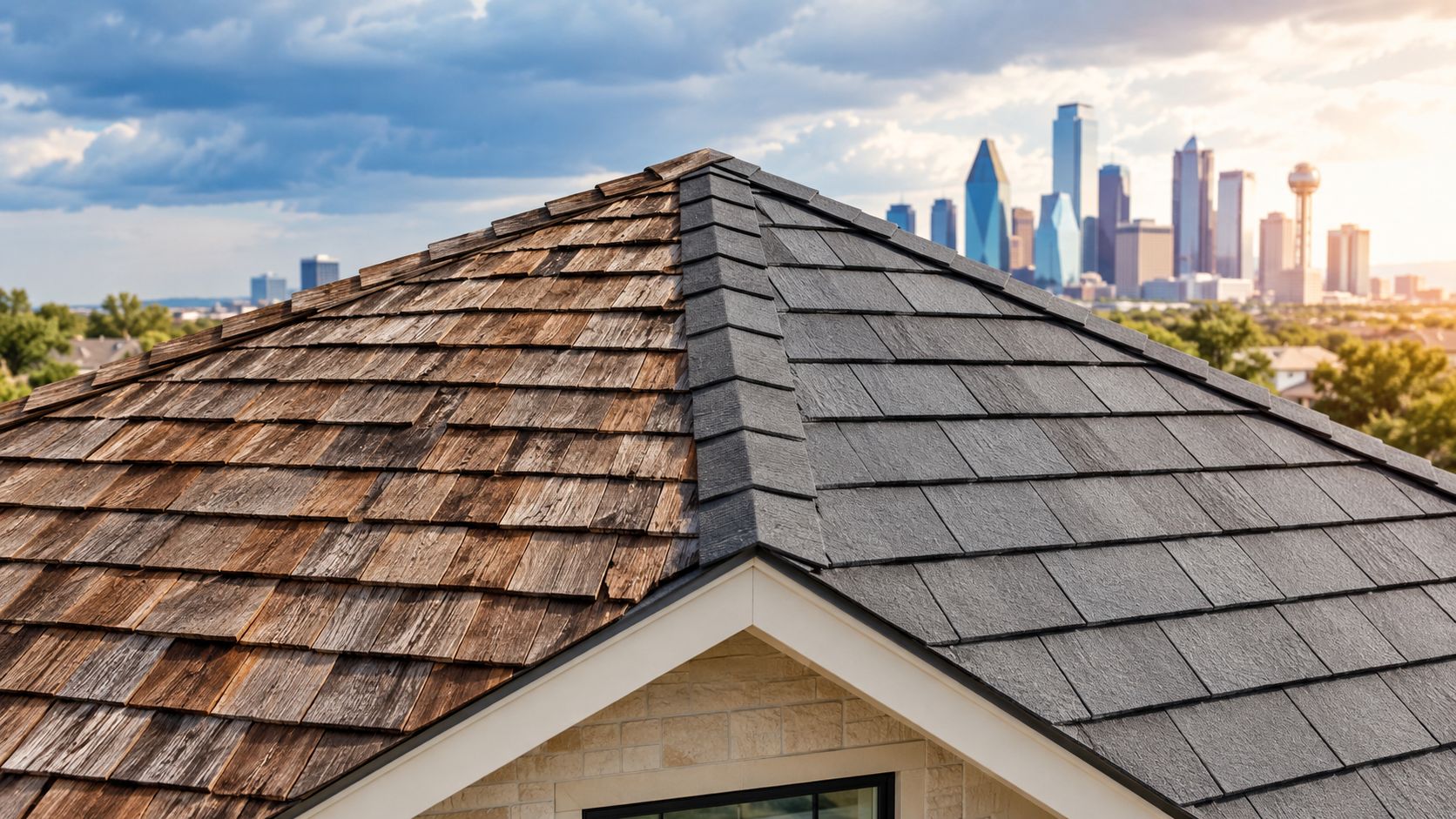
Synthetic Roof Shakes: A Guide for DFW Homeowners
Synthetic roof shakes typically cost about $18,000 for a full synthetic cedar shake roof, while product weights can range from about 170 to 321 pounds per square, so the right choice depends on more than appearance. They mimic cedar while offering Class A fire ratings, potential Class 4 impact protection, and lower maintenance, making them a practical upgrade for Fort Worth and surrounding DFW homes facing storms and changing codes.
A Fort Worth homeowner often reaches this decision after a hailstorm, a roof inspection, or an HOA conversation about preserving a premium architectural style. The cedar may still look attractive from the street, but the split pieces, weathered courses, moisture damage, and maintenance demands become harder to ignore. Replacing it with new cedar preserves the original character, yet it also preserves many of the same vulnerabilities.
Synthetic roof shakes offer another path. They reproduce the grain, shadow lines, and irregular appearance of wood shake with engineered polymer or composite materials. For homes across Tarrant, Collin, Denton, and Dallas counties, the decision is less about choosing a fashionable finish and more about balancing hail exposure, structural capacity, fire performance, maintenance, insurance documentation, and long-term replacement risk.
Table of Contents
- Why DFW Homeowners Are Replacing Cedar With Synthetic Shakes
- What Synthetic Roof Shakes Are Made Of and How They Perform
- Synthetic Shakes vs Natural Cedar and Other Roofing Styles
- Installation Realities and Structural Considerations for DFW Homes
- Warranties, Longevity, and Insurance Implications in Texas
- Choosing Synthetic Roof Shakes for Fort Worth, Arlington, Plano, and Surrounding Cities
Why DFW Homeowners Are Replacing Cedar With Synthetic Shakes
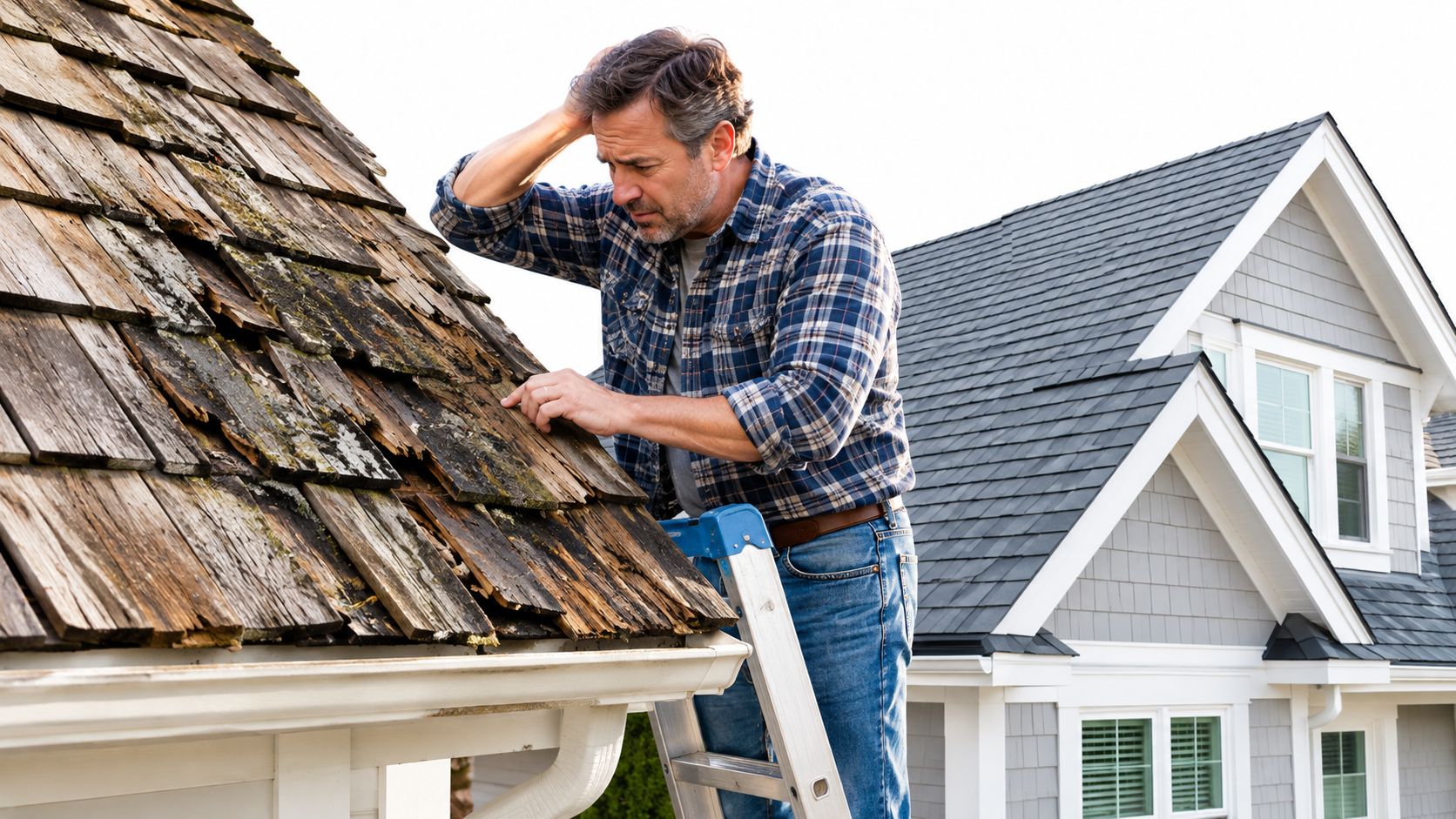
A typical Fort Worth or Arlington homeowner doesn't begin with a product brochure. They begin with a roof that has failed in a visible way. Hail may have exposed weak cedar courses, wind may have loosened pieces around the ridge, or years of moisture may have darkened and deteriorated the wood. An HOA may still require a shake-style appearance, leaving the owner to decide whether to repeat the old system or investigate a more durable substitute.
The practical appeal of synthetic roof shakes is that they keep the architectural language of cedar without requiring the roof to behave like untreated wood. Cedar provides warmth and texture, but it can absorb moisture, split, weather unevenly, and require ongoing attention. Synthetic products are designed to offer a more consistent surface and fewer organic failure modes.
The DFW problem is broader than hail
Hail is the obvious concern in North Texas, but it isn't the only one. Wind-driven rain tests flashing and underlayment. Heat stresses exposed materials. Older homes may have framing that was never evaluated for a new specialty roof assembly. A replacement that looks correct from the driveway can still create problems if the deck, ventilation, fastening pattern, or load assumptions are wrong.
The comparison also matters beyond local weather. Synthetic shakes emerged as a commercial roofing category in the early 1990s, and trade coverage describes how the category developed from early artificial roofing experiments into more code-relevant systems. Professional Roofing's review of synthetic materials provides that historical context, including the industry's movement toward polymer-based products and more demanding performance goals.
Practical rule: Treat a synthetic shake replacement as a complete roofing-system decision, not as a cosmetic change from one shingle shape to another.
The rest of the evaluation should answer several practical questions. Does the selected profile suit the existing framing? Does the product carry the fire and impact classifications relevant to the property? Does the installer know how to detail valleys, penetrations, eaves, and ridges? And does the warranty depend on installation requirements that the estimate includes?
That approach applies whether the property sits in Fort Worth, Arlington, Keller, Mansfield, Plano, or another DFW community. Synthetic shakes can be a sensible resilience upgrade, but only when the material and installation are matched to the building.
What Synthetic Roof Shakes Are Made Of and How They Perform
Synthetic roof shakes are generally made from engineered polymers, composite blends, or molded materials formulated to reproduce the surface texture and dimensional character of cedar. The important distinction is that the material is manufactured for consistency. It isn't relying on a natural wood fiber to resist moisture, insects, splitting, and repeated wetting and drying.
For a DFW homeowner, the useful performance questions are straightforward. How does the product respond to hail? What fire classification does it carry? How does the manufacturer define its expected service life? What installation details must be followed for those ratings to apply?
Fire ratings provide a meaningful comparison
One manufacturer documents a standalone Class A fire rating under ASTM E108 and UL 790, with testing showing the synthetic cedar shakes withstand temperatures exceeding 1,400 degrees Fahrenheit without ignition. The same documentation cites a natural wood ignition threshold of 375 degrees Fahrenheit. Those figures don't predict the outcome of every house fire or wildfire exposure, but they explain why synthetic products are positioned as a safer alternative to cedar in fire-sensitive markets. The manufacturer's 2026 announcement discusses the fire testing and Western code context.
Class A is the highest roof-covering fire classification. Class B and Class C represent lower levels of protection. The rating applies to the tested roof-covering assembly and installation conditions, so a contractor should identify the exact product, underlayment, and installation method rather than treating “synthetic” as a sufficient specification.
Colorado and California wildfire codes were reported as banning wood shakes in 2026, which signals a broader direction in premium roofing. DFW isn't California, but code changes in wildfire-exposed Western markets show how performance classifications can become more important than traditional appearance.
Hail performance needs precise documentation
Some synthetic shake products are sold with Class 4 impact ratings, while others may carry different classifications. That distinction matters in North Texas because a homeowner can't assume every polymer shake provides the same hail resistance. The estimate should identify the tested product and the rating, not just describe the roof as impact-resistant.
A Class 4 rating can strengthen an insurance discussion, but it doesn't automatically guarantee a premium reduction or claim outcome. The carrier, policy language, roof condition, installation records, and local underwriting rules still control.
| Material | Fire Rating | Impact Rating | Typical Lifespan Context |
|---|---|---|---|
| Synthetic shakes | Some products carry standalone Class A ratings under ASTM E108 and UL 790 | Some products carry Class 4 ratings | Premium systems may be sold with longer service-life expectations than traditional wood |
| Natural cedar | Fire performance varies by assembly and treatment | Vulnerable to splitting and impact damage | Requires maintenance and remains exposed to moisture and biological deterioration |
| Architectural asphalt | Product-specific classifications | Product-specific, with ratings varying by line | Common replacement material with broad availability and familiar installation practices |
| Synthetic slate | Product-specific classifications | Product-specific | Engineered alternative where appearance, weight, or budget rule out natural slate |
The table is a starting point, not a substitute for a product data sheet. A contractor should provide the actual classification, installation requirements, and warranty conditions for the selected line.
Synthetic shakes can reduce maintenance and improve fire performance, but no rating eliminates the need for proper flashing, ventilation, fastening, and inspection after severe storms. The material may resist one failure mode while poor installation creates another.
Synthetic Shakes vs Natural Cedar and Other Roofing Styles
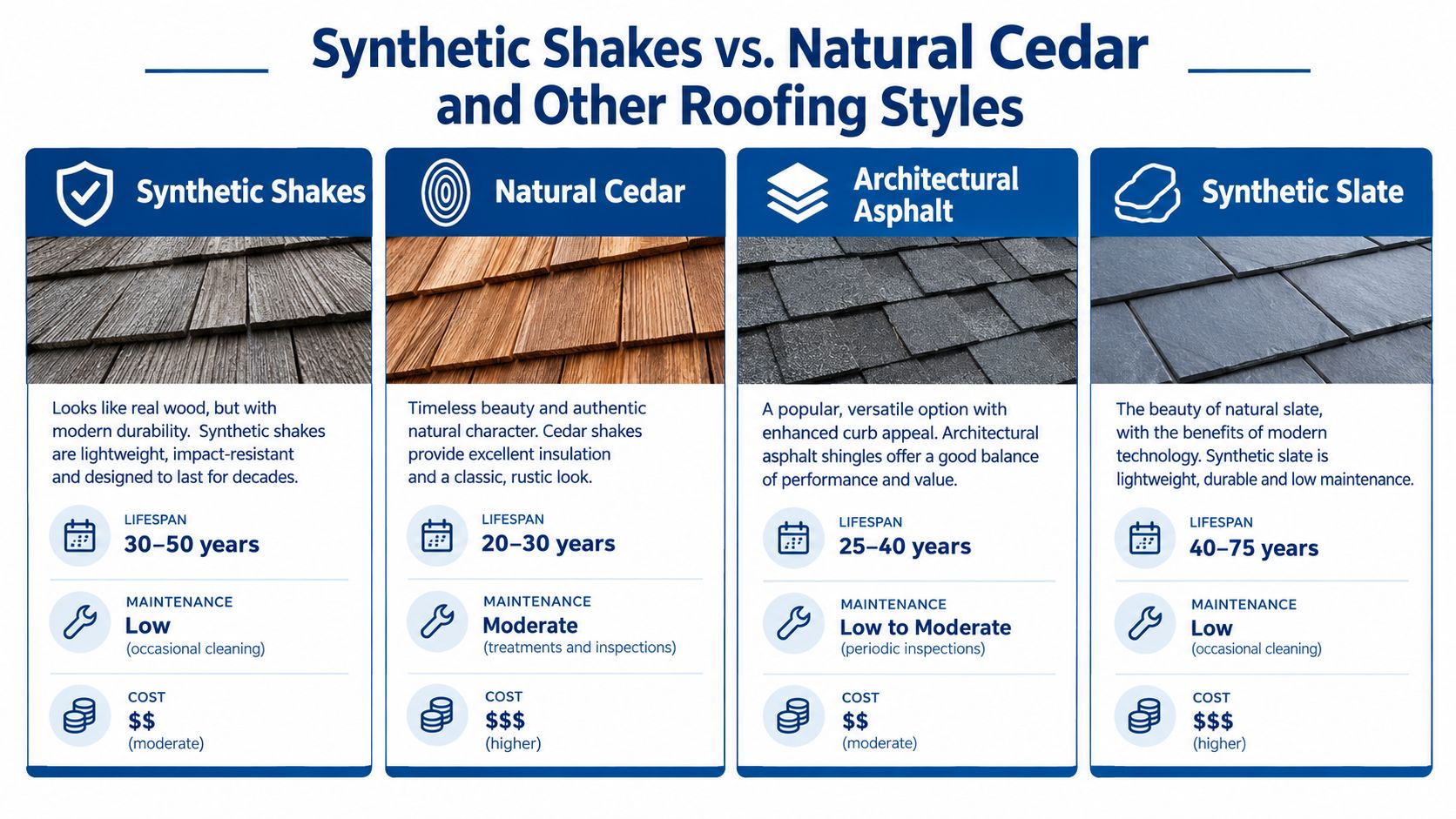
A homeowner comparing roofing styles should separate appearance, system performance, and project cost. Synthetic shakes usually sit above standard architectural asphalt in price and design specificity, but they can offer a closer cedar appearance than asphalt. Natural cedar remains the authentic material, yet it carries organic maintenance concerns that synthetic products are designed to reduce.
Recent consumer pricing content places a full synthetic cedar shake roof at around $18,000 on average. Angi's synthetic cedar shake roofing cost guide gives that pricing context, but the actual project depends on roof size, access, tear-off, deck repairs, flashing, ventilation, product selection, and labor.
Where each material makes sense
Synthetic shakes suit homeowners who want cedar's visual character with more consistent dimensions, lower maintenance, and access to documented fire or impact classifications. They make the most sense when the owner values architectural appearance but also wants to manage storm and fire risk.
Natural cedar remains the choice for genuine wood texture and historical authenticity. It can be appropriate for a carefully maintained specialty property, but the owner should budget for inspections, moisture management, and replacement of weathered pieces. Cedar isn't automatically a poor choice. It does demand a different maintenance commitment.
Architectural asphalt is usually the practical baseline. It offers familiar installation, broad contractor availability, and a wide range of colors. It may be the right answer when the budget is tight or the home's style doesn't require a shake profile. It won't provide the same depth or material character as a high-quality synthetic shake.
Synthetic slate can offer a stone-like appearance without the structural demands of natural slate. The same general principle applies to synthetic shakes. An engineered material can preserve a premium visual effect when weight, budget, or maintenance makes the natural product less suitable.
Price should follow the risk profile
A higher upfront price only makes sense when the homeowner receives a useful combination of appearance, durability, code suitability, and lower maintenance. In a hail-prone area, the relevant comparison isn't just synthetic versus asphalt at installation. It includes how each system handles storm exposure, what documentation exists after damage, and whether the roof's expected service life aligns with the owner's plans.
A synthetic roof also doesn't automatically create better value. An unsuitable product, weak installer, or incomplete estimate can erase the benefits. Ask for a written scope that includes deck preparation, underlayment, flashings, ventilation, ridge treatment, disposal, and the exact product warranty.
The strongest choice is often the one that fits the home's architecture and framing without forcing the owner to accept avoidable maintenance or compliance problems.
Installation Realities and Structural Considerations for DFW Homes
Synthetic shakes aren't installed like ordinary asphalt shingles. The contractor still works on a steep-slope roof, but the material's dimensions, fastening requirements, exposure, underlayment, and flashing details must follow the selected manufacturer's system. A crew experienced with asphalt may not automatically have the same familiarity with specialty shake installation.
The first technical issue is weight. One manufacturer lists a synthetic cedar shake at about 321 pounds per square, while another lists a product at about 170 pounds per square. Brava's cedar shake roofing information shows the product-to-product weight variation. That range is wide enough to invalidate a casual assumption that every synthetic product is a lightweight replacement for cedar.
Questions to resolve before materials arrive
Older homes in Fort Worth, Hurst, Keller, or North Richland Hills may have framing, decking, additions, or previous repairs that deserve closer review. The correct load depends on the selected product and the full assembly, not only the individual shake.
- Confirm the product weight: Ask for the manufacturer's published weight per square and clarify whether the figure includes accessories or only the field material.
- Review the existing structure: Have the contractor inspect rafters, trusses, decking, valleys, and previous alterations before finalizing the material.
- Verify fastening requirements: Synthetic shakes may require specified fasteners, placement, exposure, and course alignment. Substituting a familiar fastening method can affect performance and warranty coverage.
- Detail water movement: Underlayment, step flashing, valley construction, wall intersections, pipe penetrations, and eaves must be included in the written scope.
- Check local requirements: The contractor should identify applicable permitting and product documentation for the property's jurisdiction.
Why the deck still controls the result
Synthetic material won't correct a deteriorated roof deck. If the decking flexes, holds moisture, or has weak fastening points, the finished roof may look excellent while remaining vulnerable underneath. A proper replacement includes a deck inspection and a clear allowance or process for damaged areas.
The same caution applies to ventilation. A new roof covering can last only as well as the roof assembly allows. Intake and exhaust paths, attic moisture, insulation conflicts, and bath-fan termination should be reviewed while the roof is open.
Load comes before color. Choose the profile and blend only after the contractor confirms that the structure, deck, and installation assembly can support it.
The product data sheet should also identify fire and impact classifications, approved underlayments, slope limitations, fastening details, and warranty conditions. If an estimate says only “synthetic shake roof” without identifying those components, it isn't specific enough for a premium replacement.
Warranties, Longevity, and Insurance Implications in Texas
A specialty roof warranty is useful only when the homeowner understands what it covers. Product warranties may address manufacturing defects, while workmanship warranties address installation. Neither should be treated as a promise that the roof will never sustain hail, wind, fire, or maintenance-related damage.
Some trade and contractor sources describe synthetic cedar shake products with 40- to 50-year service-life claims and Class 4 impact ratings. Those figures are product-specific, so the homeowner should connect any service-life statement to the actual manufacturer, installation method, climate exposure, and maintenance requirements.
Ratings help document risk management
Class A fire performance can matter when a homeowner is evaluating a cedar alternative or responding to local code pressure. Class 4 impact performance can matter in hail-prone parts of DFW, including Irving, Mesquite, and Grand Prairie. Neither classification guarantees an insurance discount, but both give the carrier a clearer technical basis for reviewing the roof.
Insurance decisions vary by carrier and policy. Some insurers may request product documentation, installation records, photographs, invoices, or proof of classification. Keep those records with the warranty and permit documents. If a storm damages the roof, the same documentation can help distinguish the installed assembly from an unverified material description.
For broader context on how policies treat fire-related losses, homeowners can review what fire damage does insurance cover. That resource isn't a substitute for reading the policy or speaking with the carrier, but it can help frame questions about covered damage, exclusions, deductibles, and claim procedures.
Use total ownership cost, not a single price
The financial case for synthetic shakes depends on the roof's risk profile. A homeowner who values cedar's look, wants less maintenance, and faces recurring hail concerns may accept a higher initial cost because the system addresses several problems at once. Another homeowner may reasonably choose architectural asphalt if the budget is limited and the property doesn't require a specialty appearance.
Before signing, request these items in writing:
- Product warranty: Identify the manufacturer, term, exclusions, transfer rules, and maintenance conditions.
- Workmanship coverage: Clarify who performs the work, what installation defects are covered, and how service requests are handled.
- Impact and fire documentation: Record the exact product classification instead of relying on a general sales description.
- Insurance records: Keep the invoice, product sheet, photographs, permit information, and final inspection documentation together.
- Maintenance expectations: Ask what the contractor recommends after hail, severe wind, or visible damage.
A long warranty cannot compensate for an assembly installed outside the manufacturer's requirements. True protection comes from matching the product, installer, documentation, and policy expectations.
Choosing Synthetic Roof Shakes for Fort Worth, Arlington, Plano, and Surrounding Cities
Synthetic roof shakes make sense for DFW homeowners who want cedar's character but need a more controlled approach to maintenance, hail exposure, structural planning, or changing fire expectations. That can include properties in Fort Worth, Forest Hill, Arlington, Euless, Grand Prairie, Richardson, and Denton, as well as nearby communities throughout the DFW service area.
Fort Worth sits within a broad metropolitan cluster that includes Dallas, Arlington, Plano, Irving, Denton, Richardson, and Grapevine, while nearby municipalities such as Forest Hill, Haltom City, Benbrook, and Arlington are physically close to Fort Worth. Fort Worth's intergovernmental planning document and the Dallas–Fort Worth metropolitan overview support that service-area context.
Use this checklist during contractor interviews:
- Load: What does this exact product weigh per square, and has the existing framing been reviewed?
- Compliance: Which fire and impact classifications apply to this product and installation?
- Installation: Has the crew installed this synthetic shake system before, including its valleys, ridges, flashings, and penetrations?
- Warranty: Which coverage comes from the manufacturer, and which comes from the contractor?
- Insurance: What documentation will you receive for your carrier and future storm claims?
- Scope: Does the estimate include deck repairs, underlayment, ventilation, flashing, disposal, and final cleanup?
The best choice depends on the home's age, deck condition, framing, architecture, budget, and exposure. Synthetic shakes aren't a universal replacement for cedar, asphalt, or slate, but they can be a strong fit when the homeowner wants premium appearance with more deliberate fire, impact, and maintenance planning.
Blue Lake Roofing & Remodeling provides roof inspections, storm-damage restoration, insurance-claim assistance, and specialty roofing for homes and commercial properties across Fort Worth, Arlington, Plano, Denton, and the surrounding DFW counties. Visit Blue Lake Roofing & Remodeling to request an on-site evaluation and discuss whether a synthetic shake system fits your roof's structure, condition, and risk profile.
