
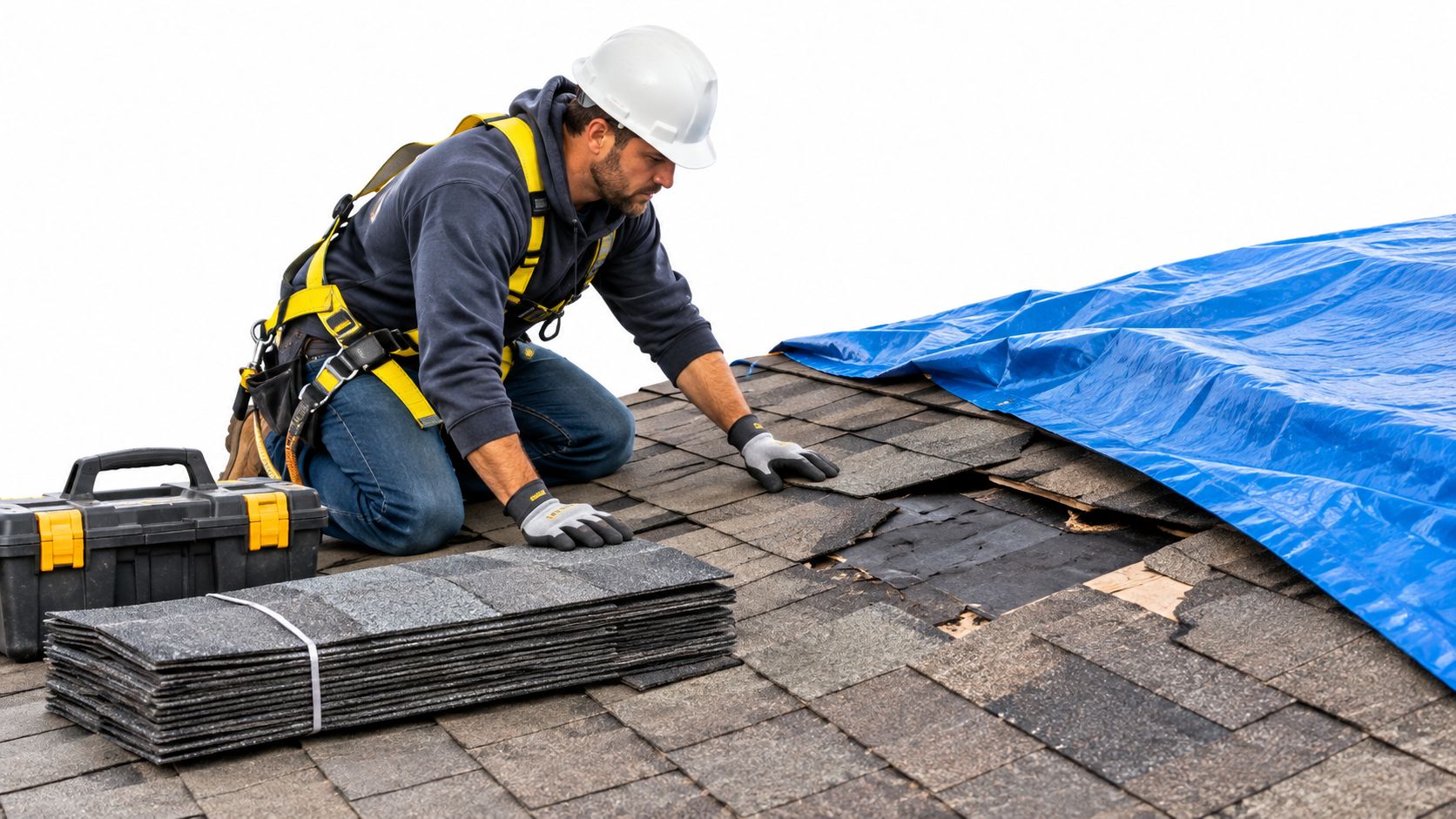
Roof Damage Repair: A Practical Guide for Fort Worth
A hail cell moves across Fort Worth, the gutters fill with granules, and a homeowner starts making decisions before anyone has checked what failed. The roof may have missing shingles, damaged flashing, bruised decking, or no claim-worthy damage at all. The right response protects the home first, preserves evidence second, and separates a localized repair from a system-wide replacement before a contractor presents a contract.
For homeowners across Tarrant, Collin, Denton, and Dallas counties, roof damage repair is rarely just a question of visible marks. It's a question of water entry, roof-system condition, insurance scope, material availability, and whether a patch will hold through the next North Texas storm.
Table of Contents
- After the Storm in Fort Worth
- Inspecting and Documenting Roof Damage Safely
- Repair vs Replace When Damage Is Local
- What Actually Drives Roof Damage Repair Costs
- Working Through an Insurance Claim in DFW
- Choosing a Local Fort Worth Roofing Crew
- Your Next Steps Across the Metroplex
After the Storm in Fort Worth
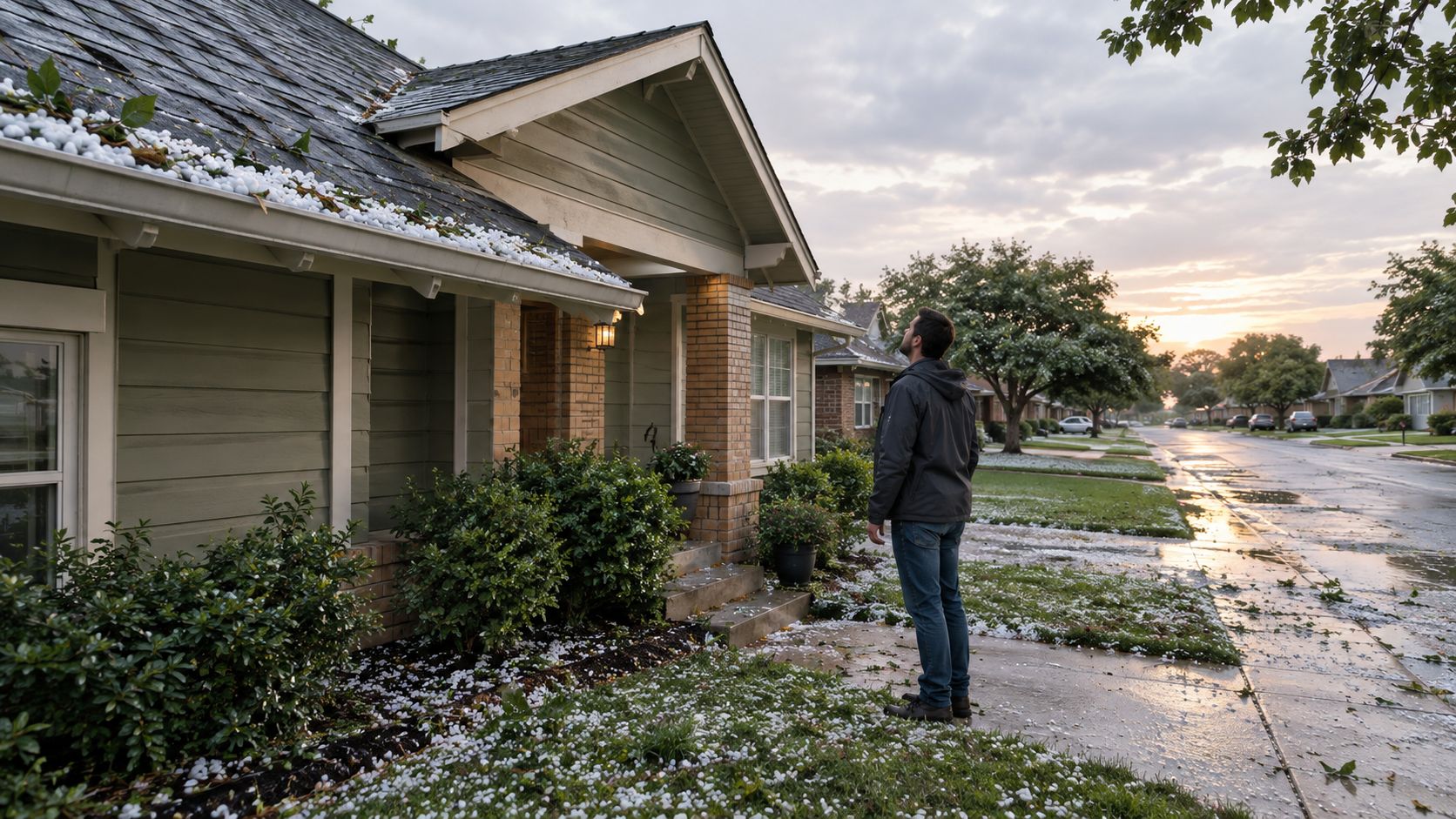
Within the first hour after a hail cell crosses Tarrant County, the safest decisions happen at ground level. A homeowner in a Fairmount bungalow may see shingle granules gathered below a downspout, while a Keller two-story owner notices a bruised tree limb resting across the back slope. Neither observation proves the roof needs replacement, but both justify careful documentation and a professional inspection.
Keep everyone away from windows while the storm is active. Once conditions settle, photograph vehicles, patio furniture, fences, window screens, and AC condensers before moving debris. Save a radar screenshot showing the storm's path and note the approximate time the hail or wind arrived. Those details can help connect exterior evidence to a specific weather event.
What Fort Worth homeowners miss from the ground
Ground-level inspections can reveal more than one might expect.
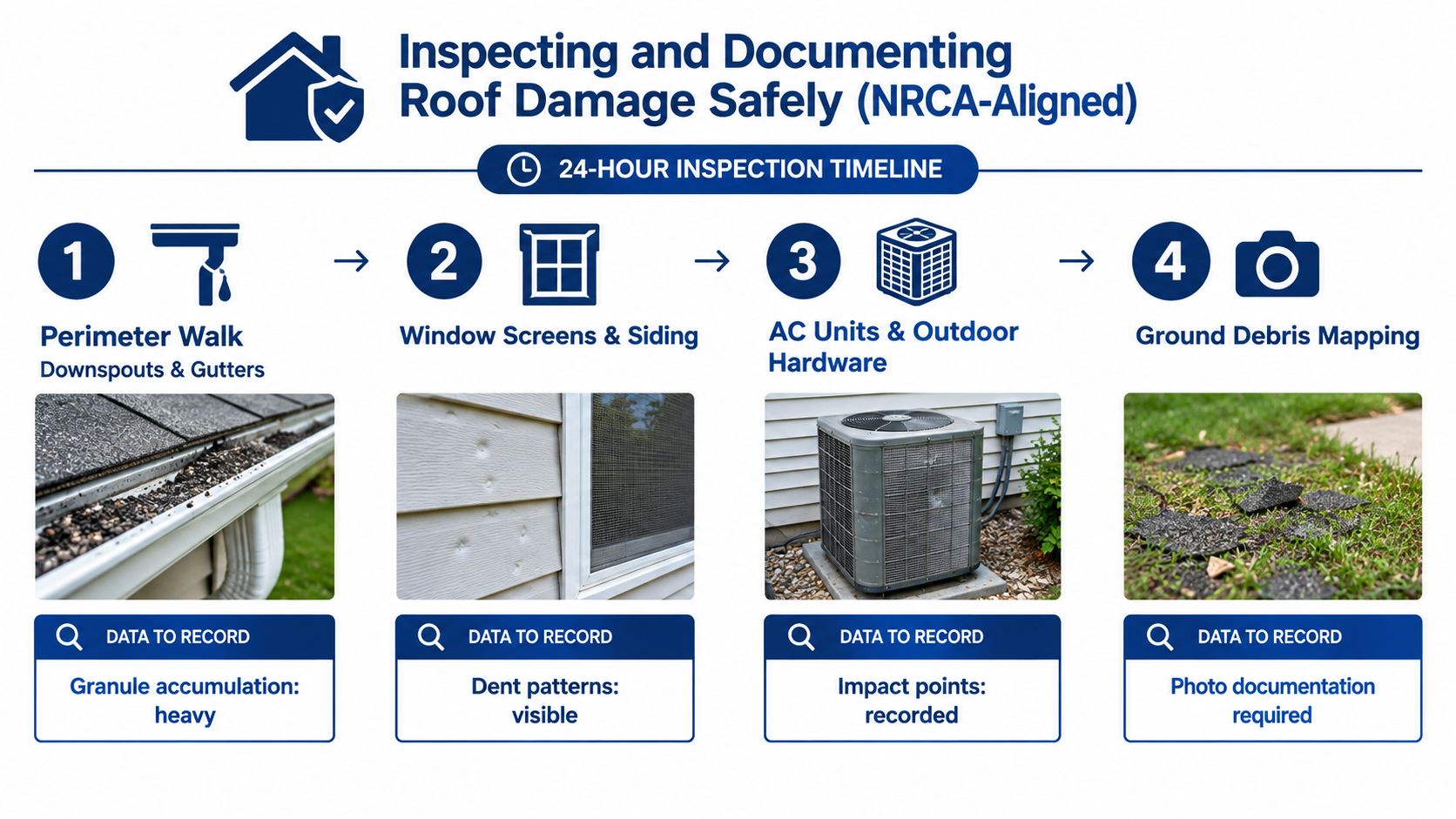
- Downspouts and gutters: Heavy granule accumulation, shingle fragments, or displaced metal can indicate impact or wind damage.
- Window screens and siding: Repeated dents may support the timing and direction of a hail event.
- AC condensers and soft metals: Impact marks on fins, vents, flashing, and fence hardware create useful exterior evidence.
- Roof edges and transitions: Loose fascia, lifted drip edge, exposed underlayment, and displaced ridge material can signal wind entry.
- Interior ceilings and attic areas: Fresh stains, damp insulation, or daylight through the decking require urgent attention.
Call a local crew for emergency tarping before another Texas cell develops. A tarp limits secondary water intrusion, but it doesn't establish that every roof slope requires replacement. For a broader overview of immediate storm-response practices, this guide to storm damage roof repair offers another useful reference.
Verisk's 2025 benchmark shows why the decision deserves care. Average U.S. residential roof replacement costs reached $17,631, while average repair costs averaged $4,699, with both figures above the prior four-year averages. Roofing line items represented more than a quarter of residential claim value in 2024, so roof damage isn't a minor maintenance category in a property-loss claim. Verisk's roofing benchmark provides the underlying figures.
The objective in Fort Worth, Arlington, Saginaw, or Keller isn't to approve a reroof while the yard is still wet. It's to secure the structure, preserve evidence, and obtain a defensible scope.
Inspecting and Documenting Roof Damage Safely
The first 24 hours should follow a simple sequence: ground inspection, documentation, professional emergency protection, then detailed roof assessment. Don't climb onto a wet roof or use a ladder to examine a storm-damaged slope. A damaged roof may have loose decking, unstable flashing, or slick algae and granules that turn a small inspection into an injury.
Start with a perimeter walk. Photograph every elevation, then move closer to downspouts, gutters, window screens, siding, AC fins, vents, fence caps, and outdoor fixtures. Use the same orientation in your photos so an adjuster can understand where each mark appears. Don't clean the gutters or discard loose roofing material before you've recorded it.
Build evidence an adjuster can use
A strong file is organized, not merely large. Capture wide shots of each roof slope from the ground, close-ups of individual impacts with a coin for scale, and time-stamped video showing the property's overall condition. Add a written log with the storm date, observed symptoms, rooms affected, and any temporary action taken.
Then inspect the attic from a safe floor position. Look for daylight, wet decking, damp insulation, darkened wood, or fresh stains around vents and penetrations. A ceiling stain may not sit directly below the entry point, because water can travel along rafters and decking before entering the living space.
Practical rule: Photograph the condition before the emergency work, photograph the emergency work after installation, and keep every invoice.
Emergency tarping should cover the affected area with enough overlap to direct water away from the opening. A professional crew should anchor the tarp to sound framing, not rely on loose nails driven through damaged shingles. The tarp is temporary protection, not a repair, and it shouldn't conceal the underlying damage from the adjuster.
The National Roofing Contractors Association and major roofing manufacturers emphasize this order because DIY repairs often fail at system-specific details. Overdriven nails can damage asphalt shingles, poorly installed flashing can redirect water into walls, and incompatible patch materials can fail on TPO or EPDM membranes. Professional emergency protection preserves both the building and the claim record.
Repair vs Replace When Damage Is Local
The Fort Worth repair-versus-replace line is based on scope and system condition, not on the presence of one bruised shingle. A small number of missing shingles, a single flashing failure, or limited hail impact over a sound deck and underlayment can justify targeted work. Widespread leaks, sagging, repeated wind creasing, or hidden bruising across multiple slopes point toward systemic failure.
Consider two local examples. A five-year-old roof in Saginaw with a concentrated hail-bruised area may need replacement shingles, underlayment repair, or partial decking if the rest of the assembly remains sound. A 2017 three-tab roof in Arlington with wind creasing across several slopes presents a different problem. Even if individual shingles can be replaced, the broader pattern may indicate that patching won't restore dependable performance.
| Damage Pattern | Typical Repair | Triggers Replacement | DFW Example |
|---|---|---|---|
| A few missing shingles | Replace shingles and inspect fasteners | Repeated loss across multiple slopes | Localized wind damage in Benbrook |
| One failed flashing point | Remove, replace, and reseal flashing | Leaks at several transitions or widespread deterioration | Chimney flashing issue in Fort Worth |
| Limited hail impact | Replace affected materials after deck inspection | Bruising across broad slopes or compromised underlayment | Concentrated impact in Saginaw |
| Isolated membrane puncture | Compatible TPO or EPDM patch | Multiple failures, wet insulation, or failing seams | Commercial roof in Dallas |
| Damaged pipe boot | Replace boot and confirm penetration seal | Several failing penetrations with aging roof materials | Vent repair in Keller |
| Partial deck damage | Remove and replace affected decking | Sagging or widespread wet decking | Storm entry in North Richland Hills |
Some carriers use a 25 to 30 percent damage rule, but that threshold can't replace a physical inspection. Matching is another practical constraint. Older shingles may no longer be available, and a visible patch can create a material and appearance conflict even when the damaged area is technically limited.
Repair can still make sense when the damage is isolated, the roof has substantial serviceable life, the deductible makes replacement impractical, or the owner is preparing to sell and needs a properly disclosed, watertight correction. Replacement becomes more defensible when damage crosses several slopes, the roof has hidden moisture, or the proposed repair would leave incompatible materials around the failure.
A contractor should show you the damaged locations, explain what remains sound, and identify what the repair won't address. If the recommendation relies only on a percentage or a sales deadline, ask for a second inspection.
What Actually Drives Roof Damage Repair Costs
A quote for DFW roof damage repair can sit above or below a benchmark for reasons that have little to do with the first visible hole. Verisk's 2025 reporting placed average U.S. residential roof repair costs at $4,699 and replacement costs at $17,631, while the broader roof replacement cost value reached $23 billion in 2025. Those figures describe market conditions, not a fixed Fort Worth price for every property. Verisk's state-of-the-roofs report explains the broader cost pressure.
| Cost Driver | Typical Effect on Price | DFW-Specific Note |
|---|---|---|
| Roof size and pitch | More labor, staging, and material handling | Steep two-story homes in Fort Worth and Keller take longer to access |
| Roofing material | Changes material and installation requirements | Three-tab, architectural shingles, modified bitumen, and standing seam metal require different methods |
| Decking condition | Adds tear-out and replacement work | Hidden storm moisture can appear after shingles are removed |
| Flashing and penetrations | Increases detail labor | Skylights, chimneys, walls, and pipe boots need individual evaluation |
| Code-related work | Adds required assembly components | Fort Worth permitting and adopted requirements can affect the scope |
| Disposal and access | Raises logistics costs | Tight Tarrant County lots can complicate tear-off and dumpster placement |
| Storm-period labor and supply | Can affect scheduling and availability | Hail events increase demand for crews and impact-resistant materials |
The roof assembly matters more than the shingle alone
A standard asphalt shingle repair may be straightforward when the underlayment, deck, flashing, and ventilation remain sound. Architectural shingles require correct exposure and replacement materials. Modified bitumen and TPO or EPDM systems depend on compatible membranes, adhesives, seams, and patches. Standing seam metal work requires careful panel and fastening decisions rather than a generic sealant.
Decking, eave protection, drip edge, ridge components, pipe boots, skylight flashing, chimney counterflashing, and ventilation can each change the final scope. A low quote that omits these items may look attractive until the crew discovers wet wood or leaves a transition vulnerable.
Permit handling through the City of Fort Worth, disposal, roof height, landscaping, fences, detached garages, and narrow driveways also affect the job. After a widespread hail event, labor availability and Class 4 impact-resistant shingle supply can shift the total substantially.
To sanity-check a quote, ask for a measured roof diagram, material specification, tear-off assumptions, decking allowance, flashing details, ventilation plan, permit responsibility, disposal line, and warranty terms. Compare scopes, not just totals. A detailed estimate that explains each component is more useful than a lower number with no assembly description.
Working Through an Insurance Claim in DFW
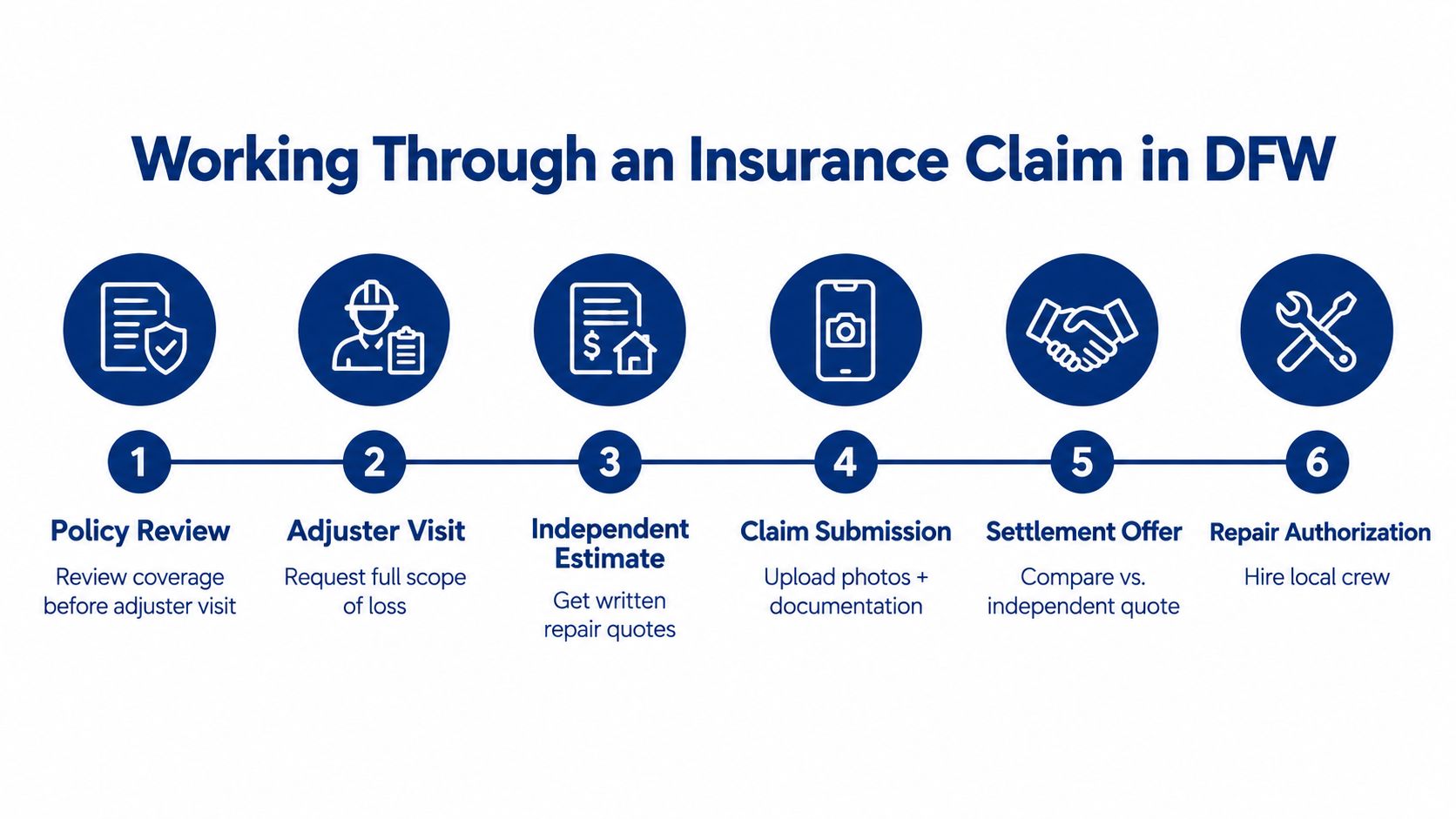
Begin with the policy, not the contractor's sales presentation. Confirm whether the policy uses actual cash value, replacement cost value, a separate wind or hail deductible, matching provisions, exclusions for cosmetic damage, and reporting requirements. Ask the carrier who has been assigned as the adjuster and keep a record of every call, upload, inspection, and payment.
At the adjuster visit, provide organized photos, storm timing, interior observations, emergency-tarp invoices, and your written damage log. Request the complete scope of loss, not only the first summary. The scope should identify roof slopes, materials, flashing, ventilation, decking assumptions, interior damage, gutters, and code-related work required under applicable Fort Worth and International Code Council adoption.
Compare the scope line by line
The first estimate may omit starter strip, drip edge, ridge cap, flashing replacement, ventilation, steep-slope labor, or damaged decking. That doesn't automatically mean the adjuster acted improperly. It means the homeowner should compare the carrier's scope with an independent inspection and submit a documented supplement where the roof assembly requires additional work.
A contractor's supplement should explain what was found, where it was found, why the original scope doesn't cover it, and which photographs or code references support the request. Avoid submitting a vague demand for “more money.” Insurers respond better to a location-specific scope with measurements, material descriptions, and photographs.
On an RCV policy, the carrier may initially hold back depreciation and release recoverable depreciation after completed work and proof of payment. Some depreciation may not be recoverable, depending on the policy and item. On an ACV policy, the settlement generally reflects the depreciated value rather than the full replacement cost, so the repair-versus-replace decision must account for the homeowner's out-of-pocket share.
For information about documenting exterior conditions and navigating related homeowner coverage questions, this exterior cleaning insurance info can provide useful background, although it isn't a substitute for reading your own policy.
NOAA hail-witness maps and weather records can help establish that a qualifying event occurred, but they don't prove every mark came from that event. If a claim remains disputed, consider a licensed public adjuster for scope assistance or an appraiser where the policy's appraisal process applies. Don't sign an assignment or settlement document you don't understand.
Choosing a Local Fort Worth Roofing Crew
Storm chasers often arrive quickly after major hail, then leave when warranty questions appear. That pattern matters in DFW, where the 2021 winter storm and recurring spring hail outbreaks create repeated demand across Fort Worth, Arlington, Keller, Plano, McKinney, Denton, and surrounding cities.
An established crew should be able to verify its business identity, insurance, physical location, and local work history. Ask for completed projects in neighborhoods such as Tanglewood, Ridglea, or Keller, and speak with references who can discuss both installation and post-project service.
Verify the company before signing
- Texas registration and insurance: Ask for current documentation and verify the business information independently.
- Local address: Confirm a physical address in Tarrant or Dallas County rather than relying only on a temporary storm office.
- Manufacturer credentials: GAF Master Elite and CertainTeed ShingleMaster certifications can show that the company maintains specific manufacturer relationships, although credentials don't replace workmanship references.
- Permit familiarity: Ask who handles Fort Worth permits, inspections, and closeout documentation.
- Crew structure: Find out whether the company uses its own local crews or rotating subcontractors.
- Warranty service: Get the process and responsible contact in writing, including what happens if a leak appears after completion.
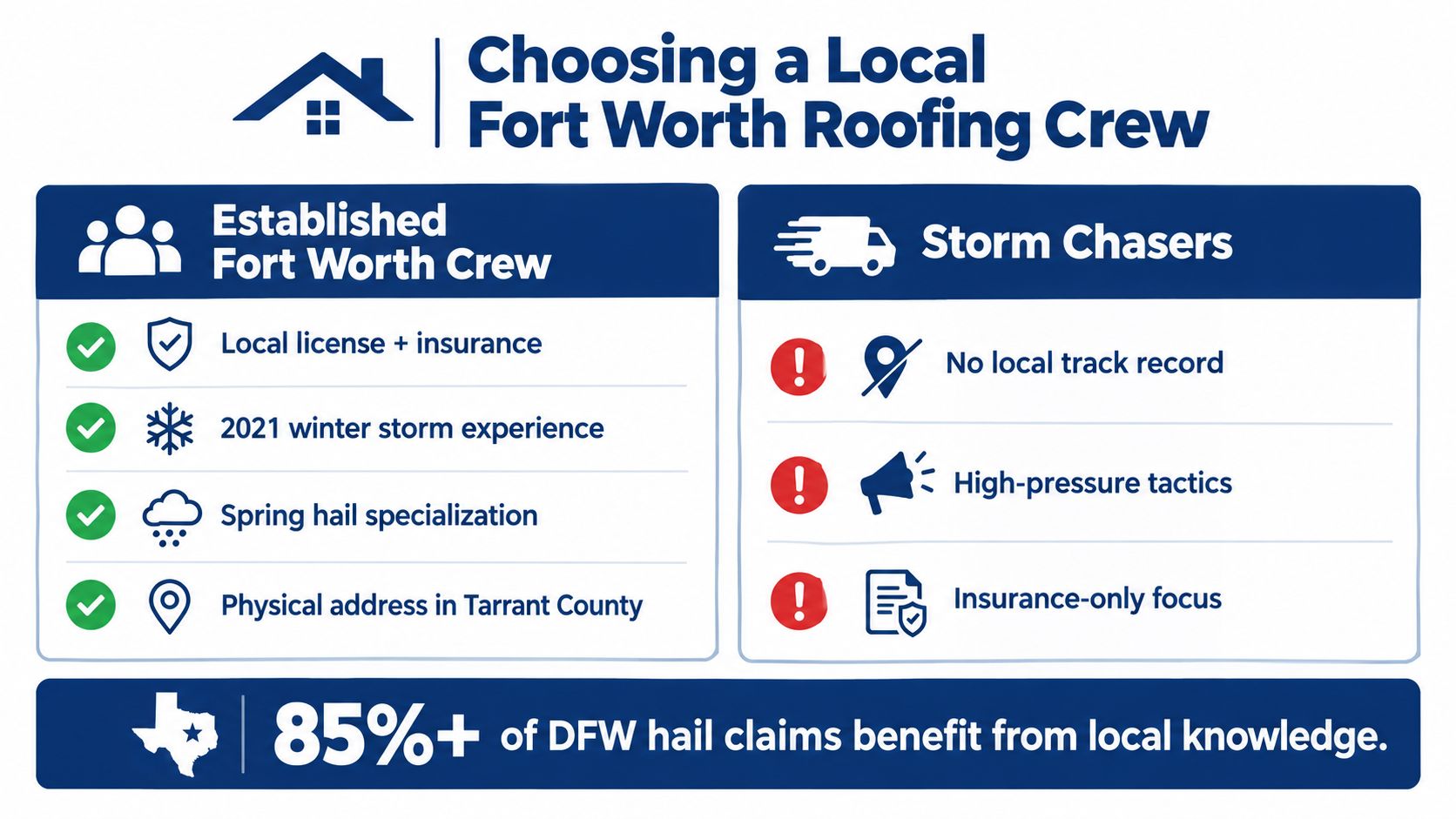
Be cautious with high-pressure signing incentives, door-knock contracts, unclear cancellation terms, and large deposits. Don't accept a contractor's promise that insurance will “cover everything” before the roof has been inspected and the policy reviewed.
A trustworthy conversation sounds practical. The contractor should explain which elevations show damage, which materials can be matched, whether the deck has been tested, what the carrier included, what remains uncertain, and how emergency protection will be handled. They won't need to frighten you into signing before you have time to compare the scope.
Your Next Steps Across the Metroplex
The same decision process works in Fort Worth, Benbrook, White Settlement, Burleson, North Richland Hills, Keller, and the wider DFW market. Start with safety and documentation, then verify the insurance process and the contractor before deciding whether the roof needs a targeted repair or complete replacement.
Use this checklist:
- Confirm the claim contact. Verify the Texas Department of Insurance information relevant to your adjuster or carrier, and keep the claim number, adjuster name, and inspection date together.
- Protect the opening. Arrange professional emergency tarping when water can enter. Keep the invoice and photographs of the protected area.
- Document the property. Save exterior photos, attic findings, interior stains, damaged vehicles, AC condenser marks, radar evidence, and a dated damage log.
- Verify the contractor. Check registration, insurance, physical address, local references, crew structure, manufacturer credentials, and warranty procedure.
- Request a second opinion. If the carrier's scope feels low, compare it with a written independent estimate and ask for a documented supplement.
- Confirm material lead times. Class 4 impact-resistant shingles may require advance ordering after a major hail event. Ask whether the proposed product is available and whether the contractor has a confirmed delivery path.
- Clarify permitting. Fort Worth projects may involve municipal permitting through city hall, while work in unincorporated Tarrant County can follow a different process. Ask who obtains permits and who schedules inspections.
- Save rebate documentation. Retailer rebates for impact-resistant products generally require proof of installation, so retain invoices, product information, and completion records.
Use this decision tree before signing:
- If damage is limited to a few components and the deck and underlayment remain sound, ask for a targeted repair scope.
- If damage appears across multiple slopes, leaks are widespread, the roof sags, or hidden bruising is likely, ask for a replacement scope.
- If materials can't be matched, ask how the contractor will address appearance and system compatibility.
- If the carrier and contractor disagree, request location-specific evidence rather than relying on a verbal opinion.
- If the contract doesn't identify materials, permits, payment stages, warranty terms, and change-order rules, don't sign it yet.
Blue Lake Roofing & Remodeling provides inspections, emergency leak repairs, storm-damage restoration, residential and commercial roof work, specialty roofing, and insurance-claims assistance across Tarrant, Collin, Denton, and Dallas counties. If your Fort Worth-area roof has hail or wind damage, visit Blue Lake Roofing & Remodeling to request an inspection and discuss whether a documented repair or replacement plan fits the actual condition of your roof.
