
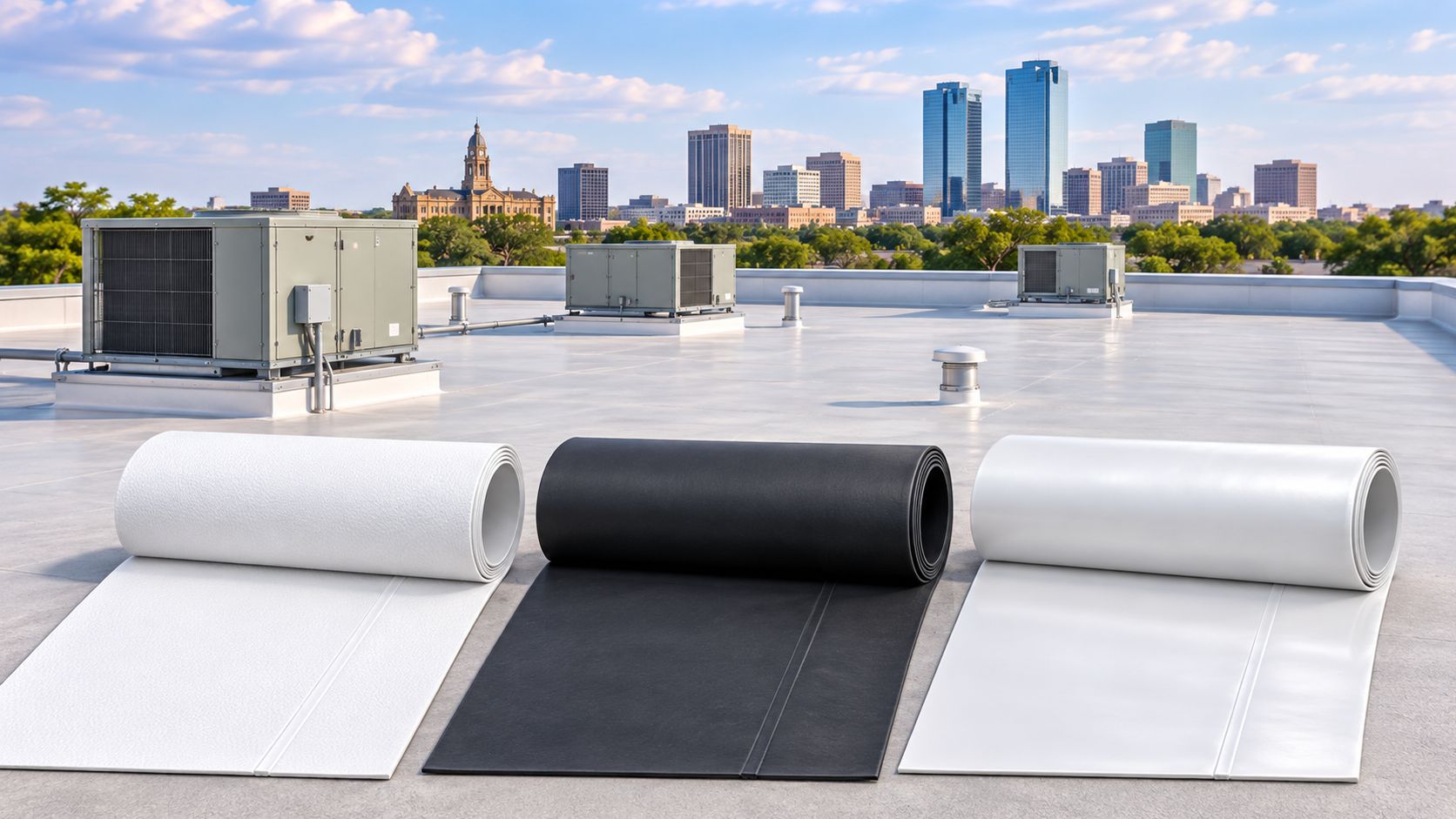
Membrane Roofing Material: TPO, EPDM and PVC in Fort Worth
An EPA cool roof can run 50 to 60°F cooler than a conventional roof under the same conditions, according to the U.S. Environmental Protection Agency's cool roof guidance. Sales decks use that number to sell white membrane. It describes surface temperature on a sunny afternoon, not the figure on your utility bill, and the distance between those two things is where most membrane decisions go wrong.
A membrane roofing material is one factory-made sheet of polymer, not a stack of layers. What it does on a Fort Worth building depends on the seams, the attachment, the insulation beneath it and how the building is used. Change any one of those and the same 60-mil sheet behaves like a different product.
What follows is a specification-level comparison of TPO, EPDM and PVC for low-slope commercial roofs, written for owners and facility managers in Fort Worth, Arlington, Forest Hill and the surrounding DFW suburbs who have to pick one system and live with it for the next two decades.
Table of Contents
- Membrane Roofing Material Defined and Compared
- TPO Membrane Roofing Properties, Pros and Cons
- EPDM Membrane Roofing Properties, Pros and Cons
- PVC Membrane Roofing Properties, Pros and Cons
- Cool Roof Performance and Membrane Cost Factors
- How to Install Membrane Roofing Material Step by Step
- Maintenance Schedule and Expected Lifespan
- Repair or Replace After Hail and Storm Damage
- Choose and Specify Your Membrane for a Fort Worth Roof
Membrane Roofing Material Defined and Compared
A membrane roofing material is a flexible, factory-manufactured sheet delivered in rolls, unrolled across a low-slope deck, and joined at the seams into one continuous waterproof layer. There's no hot-kettle asphalt fusing three plies together and no gravel ballast doing the waterproofing. The sheet is the roof, and the seams decide whether it stays that way.
The market moved to that model fast. Industry survey data reported by Professional Roofing puts single-ply systems at 39.5% of new-construction roofing and 35.8% of reroofing in 2000. By 2010 those shares had climbed to 63.4% for new construction and 59.3% for reroofing, gains of 23.9 and 23.5 percentage points in a single decade.
For an owner in North Texas, the practical meaning is straightforward. Membrane isn't the challenger technology on warehouses, retail centers, schools or multifamily buildings. It is the technology, and the decision in front of you is which polymer, which thickness, which attachment and which detailing.
Three membrane families at a glance
| Property | TPO | EPDM | PVC |
|---|---|---|---|
| Polymer type | Thermoplastic polyolefin | Vulcanized synthetic rubber | Plasticized polyvinyl chloride |
| Common thicknesses | 45, 60 and 80 mil | 45 and 60 mil | Governed by ASTM D4434, commonly 40 to 60 mil |
| Seam method | Heat welded | Field-applied tape or adhesive | Heat welded |
| Reinforcement | Fabric or scrim reinforced (ASTM D6878) | Nonreinforced, reinforced or fabric-backed (ASTM D4637) | Typically scrim reinforced |
| Typical manufacturer-rated service life | About 20 to 25 years | About 20 to 30 years | About 20 to 30 years |
| Reflectance tendency | High in white; dark colors lower | Black standard; white available | High in white; check color options |
Read the table as a shortlist, not a specification. Polymer name and thickness describe the sheet; the ASTM product standard and the manufacturer's tested assembly describe how the finished roof will perform under wind uplift, hail and thermal cycling.
Pick the two materials that fit your building type, then read the matching sections below before you take a bid from anyone.
TPO Membrane Roofing Properties, Pros and Cons
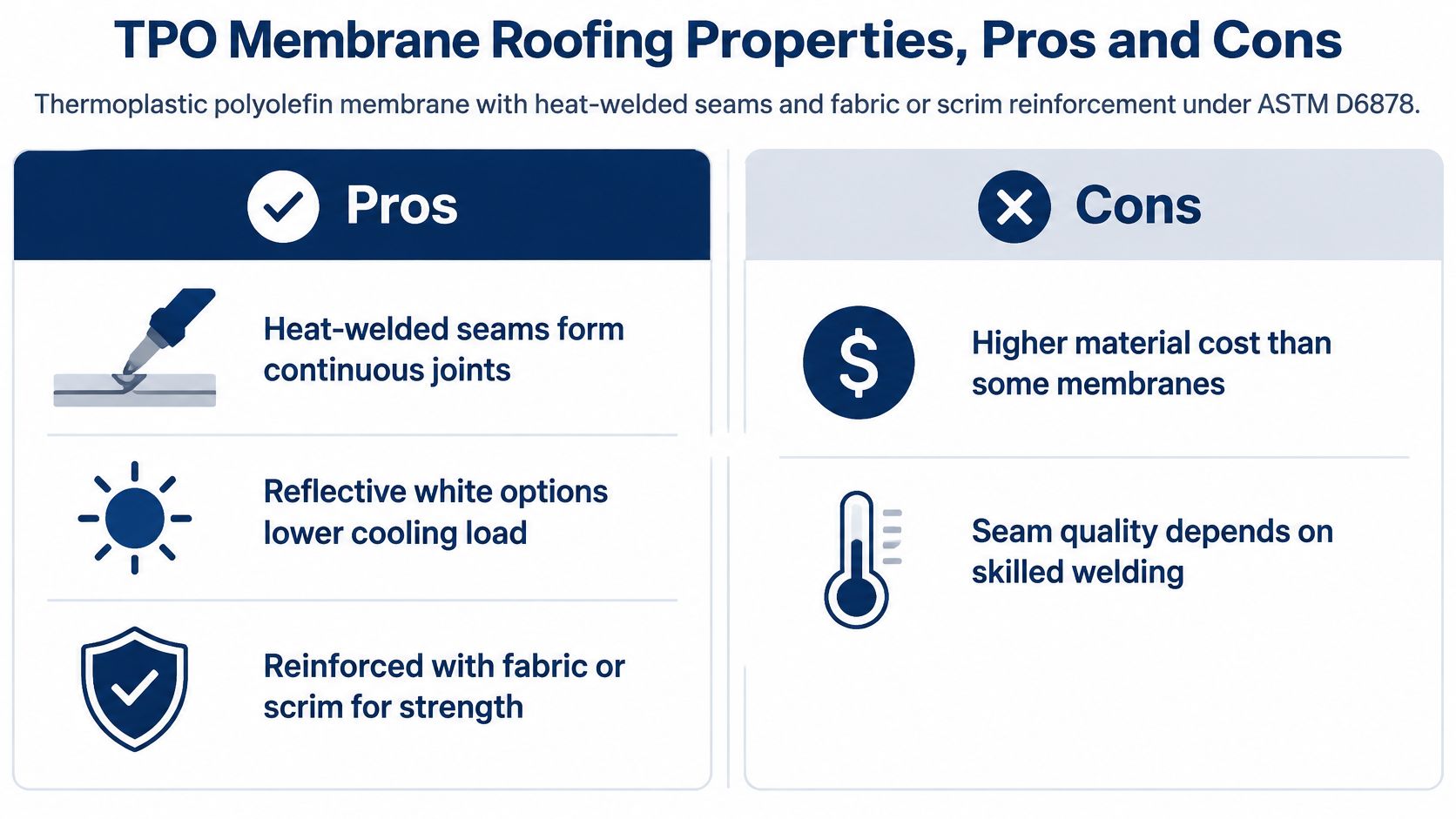
TPO's defining feature isn't the polymer. It's the seam. Thermoplastic polyolefin softens under heat, so a crew can weld two sheets into one continuous joint with a hot-air tool and a silicone roller. A properly made weld is stronger than the sheet around it, which is why a TPO repair usually means cutting out a section rather than peeling a lap apart.
TPO went from novelty to default in roughly two decades. The NRCA roofing guidelines document records TPO products in the 1980s, the first sheets intended for membrane roofing in 1989, and the replacement of non-reinforced sheets with fabric-reinforced versions by 1993. In the 2001-02 NRCA market survey TPO held 11.6% of low-slope roofing sales; by 2012 it represented 31.39% of new-construction low-slope materials.
That climb happened mostly in new construction. Replacement work moves slower, because an owner with a functioning roof has less reason to change systems. The split matters when you're comparing TPO against whatever is on your building now: a market's preference is not the same thing as evidence about your roof.
What TPO gets right
- Welded seams that can be tested: a cooled weld can be probe-tested on the roof, so quality is verifiable rather than assumed.
- Reflectance where cooling dominates the load: white TPO keeps its color well, and that matters on a large air-conditioned box with ductwork running through the plenum.
- Dimensional stability: reinforced sheets resist the expansion and contraction of a Texas summer better than the early non-reinforced products did.
- A deep installer bench: the membrane is widely stocked and widely installed, so finding a qualified crew and replacement material in year eight is realistic.
Where TPO costs you
Seam quality is a skill, not a property of the sheet. Welding temperature and speed have to sit inside the manufacturer's window, and a cold weld can look closed and pass a casual glance before it fails two winters later. That's why probe testing and closeout photographs belong in the contract, not in the punch list.
Dark colors give up most of the reflectance advantage white TPO provides. Oils and solvents are the other exposure to check: grease from an exhaust fan, hydraulic fluid from a dock leveler, or contact with asphalt and bitumen products can attack the sheet, so ask the manufacturer about compatibility before you assume the assembly is fine.
A 40,000-square-foot warehouse in Fort Worth
Picture an open warehouse roof in Fort Worth with few penetrations, a wide clear span and a priority on keeping summer cooling loads down. A 60-mil white TPO in a fully adhered assembly suits that layout and budget: the roof plane is uninterrupted, so welding moves quickly, and the white surface works with the cooling-dominated load.
TPO is the stronger choice on open roof plans with few penetrations, where reflectance matters and a welded seam is the priority. It's the weaker choice where grease and oil land on the roof, where penetrations are dense and detailing will dominate the labor, or where a dark membrane is required for design reasons.
EPDM Membrane Roofing Properties, Pros and Cons
EPDM buys its flexibility with a harder seam. The material is vulcanized synthetic rubber, and the vulcanization is the whole point: the sheet stays supple across a wide temperature range, moves with the deck instead of fighting it, and takes a patch without drama. In the United States it's governed by ASTM D4637/D4637M, which covers nonreinforced, scrim- or fabric-reinforced, and fabric-backed sheets and tests thickness, tensile and breaking behavior, elongation, puncture and tear resistance, ozone exposure, heat aging, dimensional change, water absorption, factory-seam strength and weather resistance.
NRCA lists 45- and 60-mil sheets as the common EPDM thicknesses and separates Type I unreinforced, Type II reinforced and Type III fabric-backed material used for flashing. Those are three different products doing three different jobs, so a specification that names only "60-mil EPDM" has left the flashing system undefined.
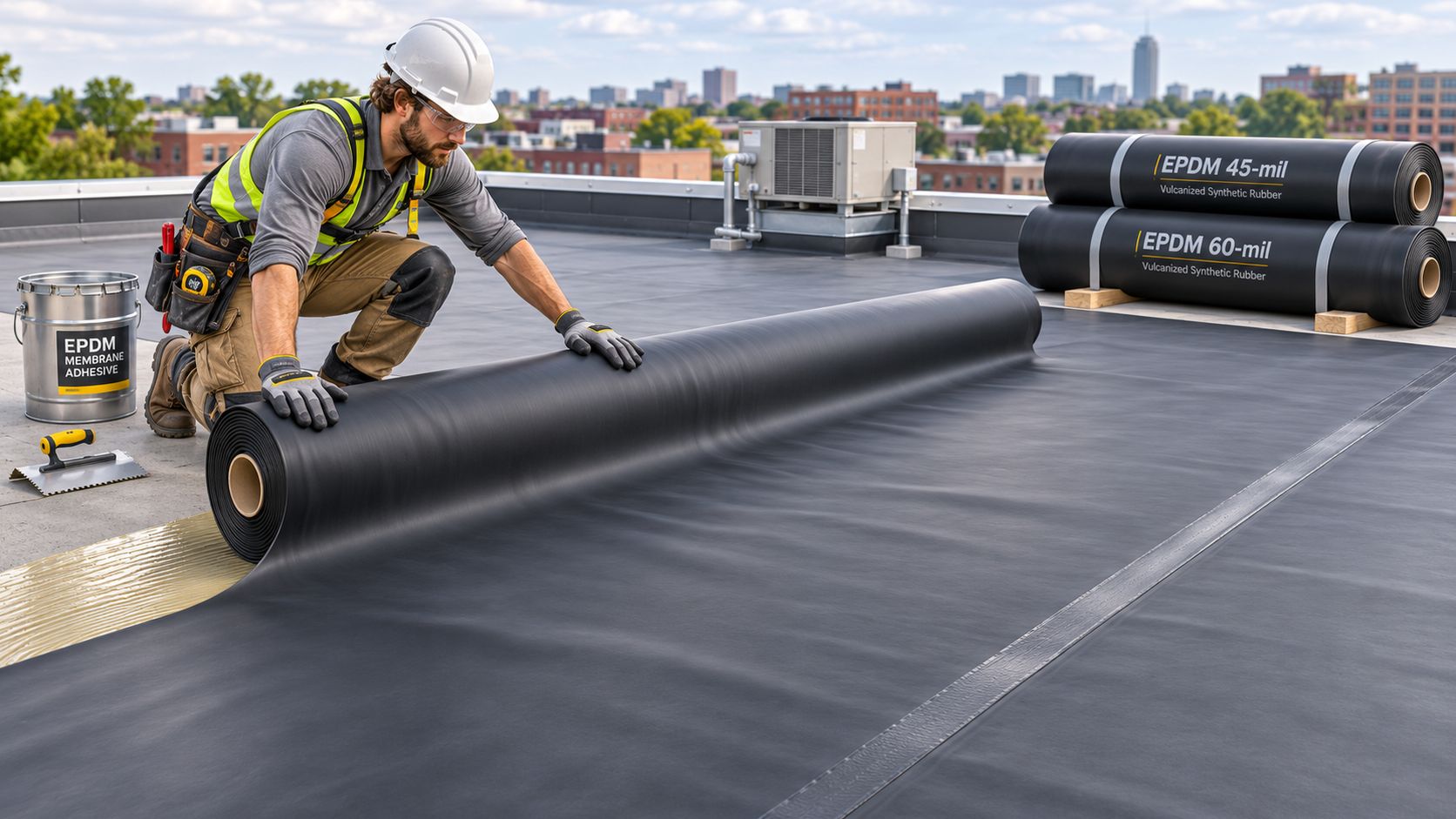
Field seams are where the trade-off lands. EPDM laps are joined with compatible tape or adhesive rather than heat, so cleanliness, primer activation, lap pressure and weather during installation decide watertightness. A dusty deck, a cold morning or a primer coat applied too thin shows up as a lifted lap two winters later. Sheet compliance alone never establishes the performance of the installed assembly.
Repairs are the compensation. A compatible patch and a roller fix most local damage in minutes, which is why EPDM holds up on roofs with heavy mechanical traffic. The specification should still state membrane thickness and reinforcement type separately, then define the flashing system: factory-laminated or field-applied uncured flashing, primer and tape compatibility, splice width, termination bars, pipe boots, corners and drains. Keep incompatible materials off the sheet, including certain oils, solvents and uncured sealants.
Say a Dallas-area multifamily building carries a dozen rooftop condensers and a maintenance crew that walks the roof monthly. A 60-mil fully adhered EPDM roof makes sense there: the flexibility absorbs the movement around curbs, and a punctured sheet gets patched the same day instead of waiting for a welding crew.
EPDM wins in three situations: heavy condenser traffic, frequent penetrations that will need patching, and substrates that move.
PVC Membrane Roofing Properties, Pros and Cons
PVC earns its price on roofs where grease and chemicals land. Polyvinyl chloride sheet is a thermoplastic, plasticized to stay flexible, typically scrim reinforced and joined by heat-welded seams. At the welder it behaves much like TPO. Everywhere else it behaves differently, and the difference is resistance to oils, fats and cleaning chemicals that would shorten the life of a standard polyolefin sheet.
Commercial kitchens are the clearest case. Restaurant exhaust deposits grease across a wide fan of the roof, not just at the hood curb, and the membrane under that fan takes the exposure year after year. PVC handles it. TPO generally doesn't, at least not without a manufacturer's written compatibility statement.
The plasticizer question
Flexibility in PVC comes from liquid plasticizers, and those plasticizers can migrate out of the sheet over the life of the roof. A sheet that loses them stiffens, then cracks at stress points, welds and edges. That single behavior explains two specification rules that catch people out.
- Separator sheets: PVC usually needs a compatible separator over polyisocyanurate and other insulation it can react with. Skip it and the assembly can fail from underneath, with a membrane that looks intact.
- Color and formulation: ask what plasticizer system the manufacturer uses and whether the warranty covers the sheet's flexibility, not just its watertightness.
What the premium buys
Expect higher material and installation cost than TPO, and expect the welding to demand a trained crew. The premium isn't buying a longer rated life by default. It's buying chemical resistance and fire performance, and fire ratings belong to the whole assembly (membrane, insulation, cover board and deck), not to the sheet by itself.
Put a restaurant rooftop near a grease exhaust hood in Fort Worth in front of that logic. The roof area under the fan sees continuous grease deposition, the kitchen runs six days a week, and a membrane failure means a shutdown. PVC's chemical resistance justifies the premium over TPO in that specific spot, while TPO may still be the right answer on the clean half of the same building.
Specify PVC when grease or chemical exposure is real, when fire-resistance performance drives the assembly, or when you want a heat-welded seam with a stronger chemical profile than TPO offers.
Cool Roof Performance and Membrane Cost Factors
A white membrane is a reflectance product, not an energy guarantee. Two properties drive cool-roof performance: solar reflectance, which is how much sunlight bounces off the surface, and thermal emittance, which is how efficiently the surface sheds the heat it absorbed. A membrane can score well on one and poorly on the other, and the building only benefits when both work with the insulation below.
The economics depend on the load. Where cooling dominates, a highly reflective roof reduces the heat gain through the assembly and helps the HVAC equipment keep up. Where winter heating is significant, the same membrane reduces useful solar gain, and the net benefit can shrink or disappear. Insulation level, roof orientation and occupancy schedule often matter more than membrane color, and a heavily insulated roof leaves the membrane with less to contribute either way.
What actually drives the installed price
- Membrane thickness and reinforcement: 80-mil reinforced sheet costs more than 45-mil, and the labor to install it doesn't drop.
- Color and product premium: white or custom-colored product can carry a surcharge over standard black or white stock.
- Insulation and cover board: often a larger line item than the membrane itself, and the layer that determines most of the thermal performance.
- Seam and flashing scope: every curb, penetration and drain termination is hand work.
- Perimeter and corner attachment: extra fastening and edge metal for wind zones.
- Tear-off versus overlay: disposal, deck repair and the condition of what's underneath.
- Warranty terms: a no-dollar-limit labor and material warranty costs more than a materials-only document.
Equipment sizing and long-term maintenance differences belong in the same comparison. A cooler roof deck can change how hard the units work, and different membranes carry different cleaning and repair routines over twenty years.
Ask for an itemized bid that lists membrane, insulation, seams, flashing, edge metal, fasteners and warranty as separate lines. A low number that omits perimeter fastening or drain rebuilds is visible before award, not after the first leak.
Compare total cost across the service life, not price per square at the bid table.
How to Install Membrane Roofing Material Step by Step
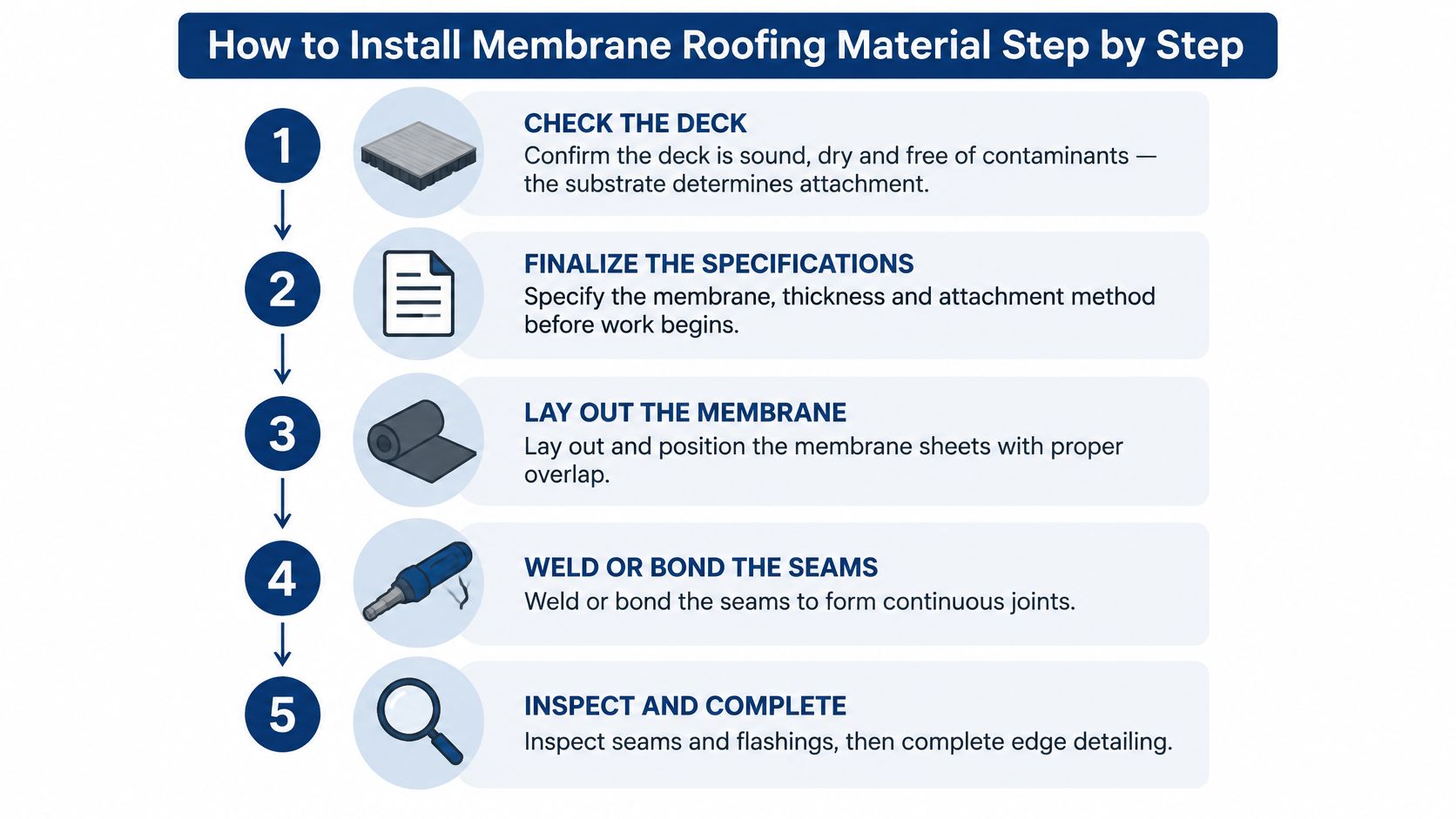
A membrane is the top sheet of an assembly, not the assembly. Deck condition, insulation and cover board, attachment, seams, and edge metal decide whether that sheet stays watertight when wind loads the roof. Crews that treat the polymer name as the whole job skip the layers that carry the load.
Work in this order. Each step has a reason, and a bid that drops the reason usually drops the work.
Confirm the deck is sound, dry, and clean. Fasteners and adhesive only hold what they grip. Wet gypsum, delaminated lightweight concrete, or an oil-soaked metal deck will undermine every layer above it. Take moisture readings and put them in the report before materials land.
Set the insulation and cover board before the membrane. The board is the surface the adhesive or fastener has to hold. Where the sheet needs a separator over polyisocyanurate or another reactive board, put that layer on the drawings. Do not leave it to the crew the morning of the install.
Specify to the ASTM standard and the tested assembly. ASTM D6878 covers reinforced TPO sheet for exposed single-ply use, requires TPO-based polymer content exceeding 50% of total polymer content, calls for fabric or scrim reinforcement, and requires seams that form watertight joints by heat welding, fusion, or adhesive bonding. Its compliance testing runs through thickness, breaking strength, elongation, tear resistance, brittleness, ozone resistance, heat aging, dimensional change, water absorption, factory-seam strength, and weather resistance. Thickness alone does not stand in for that standard or for the manufacturer's tested assembly.
Fix the attachment method in writing. Fully adhered, mechanically fastened, and ballasted systems behave differently under uplift, and perimeter and corner zones concentrate the load in DFW wind events. Fully adhered systems are commonly specified in storm-exposed areas. Write the method into the specification before bidding so no crew chooses it on the roof.
Weld or bond the seams under controlled conditions. TPO and PVC welds stay inside approved temperature and speed ranges, checked against test welds at the start of each day. EPDM laps get primer and tape on clean, dry surfaces inside the manufacturer's temperature window. Dirt, or a turn in the weather, breaks both methods the same way.
Detail penetrations, curbs, drains, and edge metal to the manufacturer's drawings. These are the places water enters. Pipe boots, corner wraps, scupper liners, and termination bars each have an approved detail. Substitutions need written approval.
Probe-test cooled seams and fix what fails. A probe or a rounded awl run along the weld finds voids and fishmouths while the crew is still on the roof. Cut out and re-weld. Do not cap a bad seam with sealant.
Close out with documentation. Dated photographs of every seam section, flashing, and penetration, the warranty submission, and a signed inspection report. That file is what an adjuster and a later contractor will both ask for.
Maintenance Schedule and Expected Lifespan
The service-life ratings manufacturers publish assume three things: water drains, small defects get repaired before they spread, and somebody looks at the roof. None of those are automatic. A membrane on a roof with blocked drains and no inspection history will not reach the number on the data sheet.
| Task | Frequency | What to Check |
|---|---|---|
| Visual roof walk | Twice a year and after storms | Punctures, blisters, debris and surface wear |
| Seam and flashing check | Twice a year | Open or lifted seams, failed sealant and edge terminations |
| Drain and scupper clearing | Quarterly and before storm season | Blockage that causes ponding |
| Ponding check | After heavy rain | Standing water, how deep it pools and how long it lingers after the rain stops |
| Penetration and curb inspection | Annually | Cracked pipe boots, sealant gaps and loose curbs |
| Edge metal and fastener check | Annually | Loose fasteners, bent edge metal and exposed fastener heads |
| Professional inspection and record | Annually | Written report with dated photographs and a roof plan |
Why drainage outranks everything else
Standing water is the accelerant. It loads the assembly, drives moisture toward every seam and termination, and warms and cools the membrane differently than the dry field around it. Water that sits for days after a rain, not hours, is telling you the drainage or the deck slope is wrong. Clear the drains first, then evaluate whether tapered insulation is the correct fix.
Foot traffic is the second-largest cause of avoidable damage on all three membranes. Mark a path to the units, the hatch and the drains, and keep the trades on it. A membrane that gets walked edge to edge every month for HVAC service will show it in the welds and the field long before the rated life is up.
Rooftop equipment and grease exposure shorten the interval between checks. A roof with a dozen condensers, a kitchen exhaust and regular filter changes needs eyes on it more often than a bare warehouse roof. Commercial clients here receive warranty documentation, inspection reports and insurance-ready records, and that habit makes a claim or a sale far easier years later.
Keep a roof plan marking every penetration, seam direction and drain, plus dated photographs from each inspection. When a warranty or insurance question arrives, that file answers it in an afternoon instead of a week.
Repair or Replace After Hail and Storm Damage
A membrane can be repaired when the damage is localized and the insulation and deck underneath stay dry. Patching becomes the riskier choice when repairs cover a large share of the roof, when the sheet has gone brittle, or when the same failure keeps returning in different places. At that point you're paying replacement prices in installments and carrying a leak risk between them.
| Symptom | Likely Cause | Response |
|---|---|---|
| Circular bruising or cracked surface | Hail impact | Photograph, map and probe for punctures |
| Blisters or raised areas | Trapped moisture or poor adhesion | Monitor, then cut and repair if soft or wet |
| Open seam or lifted edge | Failed weld, tape or weathering | Re-weld or reseal per manufacturer detail |
| Ponding water | Blocked drains or deck deflection | Clear drains and evaluate tapered insulation |
| Interior leak with no visible hole | Water traveling beneath the membrane | Moisture or infrared scan, then trace the source |
| Punctures or tears | Foot traffic, debris or hail | Patch with a compatible material |
| Brittle or cracked membrane | UV aging and heat exposure | Plan replacement if widespread |
How to verify a roof after a storm
Photograph and map every impact rather than counting them from memory. Hail bruising on a single-ply membrane can look cosmetic and still have fractured the surface or bruised the insulation beneath, so probe suspicious spots and check the seams and perimeter attachments that carry the wind load. Curbs, drains and edge metal get the same treatment, because that's where a storm finds the weak point first.
When water shows up inside and there's no obvious hole outside, the membrane isn't necessarily torn. Water travels along the deck and finds a seam, a fastener or a curb it can drip through. A moisture survey or infrared scan traces it back to the entry point instead of guessing at the stain on the ceiling.
The decision rule is short. Repair isolated damage on a dry roof with a compatible patch. Plan a full replacement when the insulation is wet, when the membrane has gone brittle across the field, or when failures keep appearing in new locations after each storm. Document the condition before any repair starts, since an insurance claim is much harder to support once the evidence has been cut out and hauled away.
Choose and Specify Your Membrane for a Fort Worth Roof
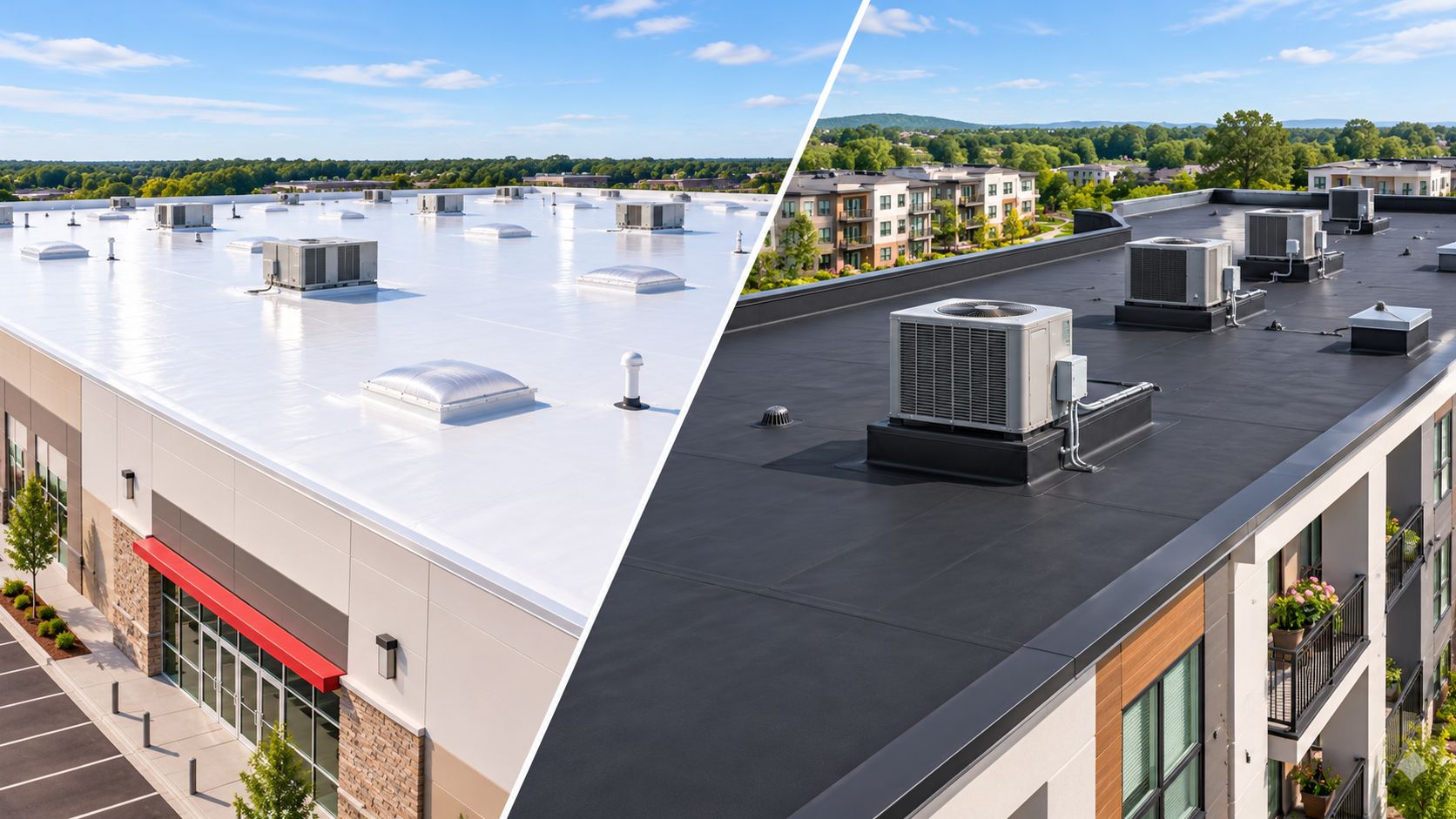
The building type usually decides the polymer before the budget does. TPO suits open-roof warehouses and retail buildings where welded seam quality and reflectance carry the most weight. EPDM suits multifamily and HVAC-heavy roofs where flexibility and same-day patchability matter more than a white surface. PVC suits restaurant and grease-exposed roofs where chemical resistance justifies the premium.
Now place those rules in the metro. Start with Fort Worth, then work outward to the communities an owner is likely to be comparing: Arlington, Forest Hill, Watauga, Grapevine, Carrollton, Frisco, Weatherford, Highland Park and Dallas. The Census Bureau's Dallas–Fort Worth–Arlington urban area reference map identifies those same cities and communities and ties the urbanized area to counties including Collin, Dallas, Denton, Ellis, Johnson, Kaufman, Parker and Rockwall, which matches the county footprint most DFW roofing work covers.
A city name doesn't change the membrane choice. Wind exposure, hail history, deck type and building use do, and those vary by site rather than by postal code. A Forest Hill retail strip and a Frisco restaurant row may sit twenty miles apart and need different membranes for reasons that have nothing to do with geography.
What does change city to city is the detailing and the permit path. Local wind requirements, elevation and the condition of the existing deck drive the attachment schedule and edge metal, so the specification should be written against the actual roof, not copied from the last job.
Blue Lake Roofing & Remodeling installs TPO, EPDM and metal roofing systems for commercial properties and offers a free roofing estimate. Send the roof plan, the building type and the details of the existing membrane, and ask for a written assessment that names the polymer, the thickness, the attachment method and the warranty terms before anyone orders material.
A membrane roof lasts because the assembly is right, not because the brochure was persuasive. Blue Lake Roofing & Remodeling installs TPO and EPDM systems for commercial buildings across Fort Worth and the surrounding DFW suburbs, and schedules that work around your operating hours so a replacement doesn't shut the doors. Every commercial project closes with warranty documentation, inspection reports and insurance-ready records you can hand to an adjuster or a buyer, and the first visit costs nothing. Send your roof plan and building details to Blue Lake Roofing & Remodeling and get a written assessment and estimate before storm season sets the schedule for you.
