
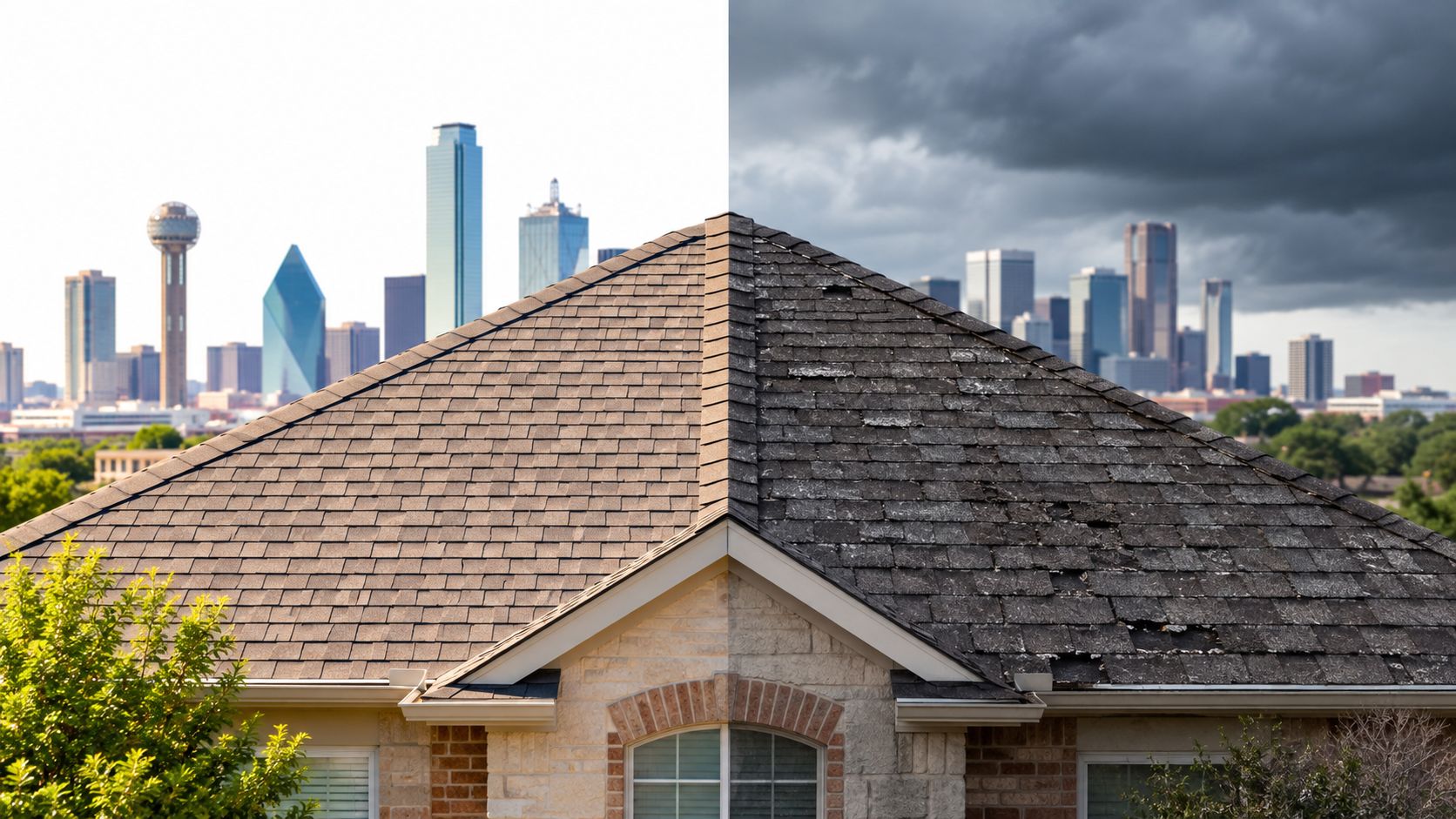
How Long Does a Roof Last in DFW
Standard asphalt shingle roofs in North Texas usually last about 12 to 16 years in real DFW conditions, even though a national planning benchmark puts a basic asphalt roof closer to 20 years. That gap comes from heat, hail, wind, and sun, and it's why a roof in Fort Worth can look fine from the street long after its useful life has started shrinking.
A lot of homeowners across Fort Worth, Arlington, Dallas, Forest Hill, and the rest of the Metroplex are looking at the same question right after a storm or after another summer of brutal attic heat. The honest answer is that roof age matters, but it's only part of the story. The true test is how the whole roof has been treated by weather, ventilation, installation quality, and maintenance.
Table of Contents
- What DFW Homeowners Need to Know About Roof Longevity
- Roof Lifespan by Material in Texas Conditions
- How Storms Change Your Remaining Roof Life
- Why the Roof Assembly Matters More Than the Shingles
- Long-Life Materials and Their Hidden Failure Points
- Weighing Replacement Frequency Against Whole-Life Cost
- Planning Your DFW Roof Replacement with Local Requirements
What DFW Homeowners Need to Know About Roof Longevity
A roof in west Fort Worth can still look decent after a decade and already be on a shorter track than the owner expects. That is common here. Heat, hail, wind, and repeated sun exposure wear on a roof in ways that do not show up the same way in milder climates.
The NAHB's 20-year benchmark for a standard asphalt-shingle roof is a planning guide, not a guarantee, and the same study points to weather, design, material quality, installation, and maintenance as the main factors that change actual service life. Its material breakdowns also show the same pattern, local conditions matter enough to cut lifespan sharply in southern climates (NAHB life expectancy study). Earlier federal building research reached a similar conclusion for asphalt shingles, with shorter average service life in southern states than in northern ones, which matches what we see on homes across Tarrant and Dallas counties when heat and weather keep working on the roof (Roofing in the United States).
The age on paper is only a starting point
A shingle box or warranty card does not tell you how many hail hits the roof has already taken. It also does not show whether the attic has been running hot every summer, whether the flashing was set correctly, or whether wind has been lifting edges at the ridges and eaves.
A roof can be older and still serviceable if it has been installed cleanly and maintained with care. A newer roof can fail early if storms have loosened shingles, the attic is poorly ventilated, or moisture has been getting into weak points since the first year.
That is the decision framework I use on inspections. After a storm, cosmetic wear is one question, functional failure is another. A few bruises or scuffs may leave the roof doing its job, but missing shingles, lifted tabs, cracked seals, and damaged flashing change the picture fast.
Roof Lifespan by Material in Texas Conditions
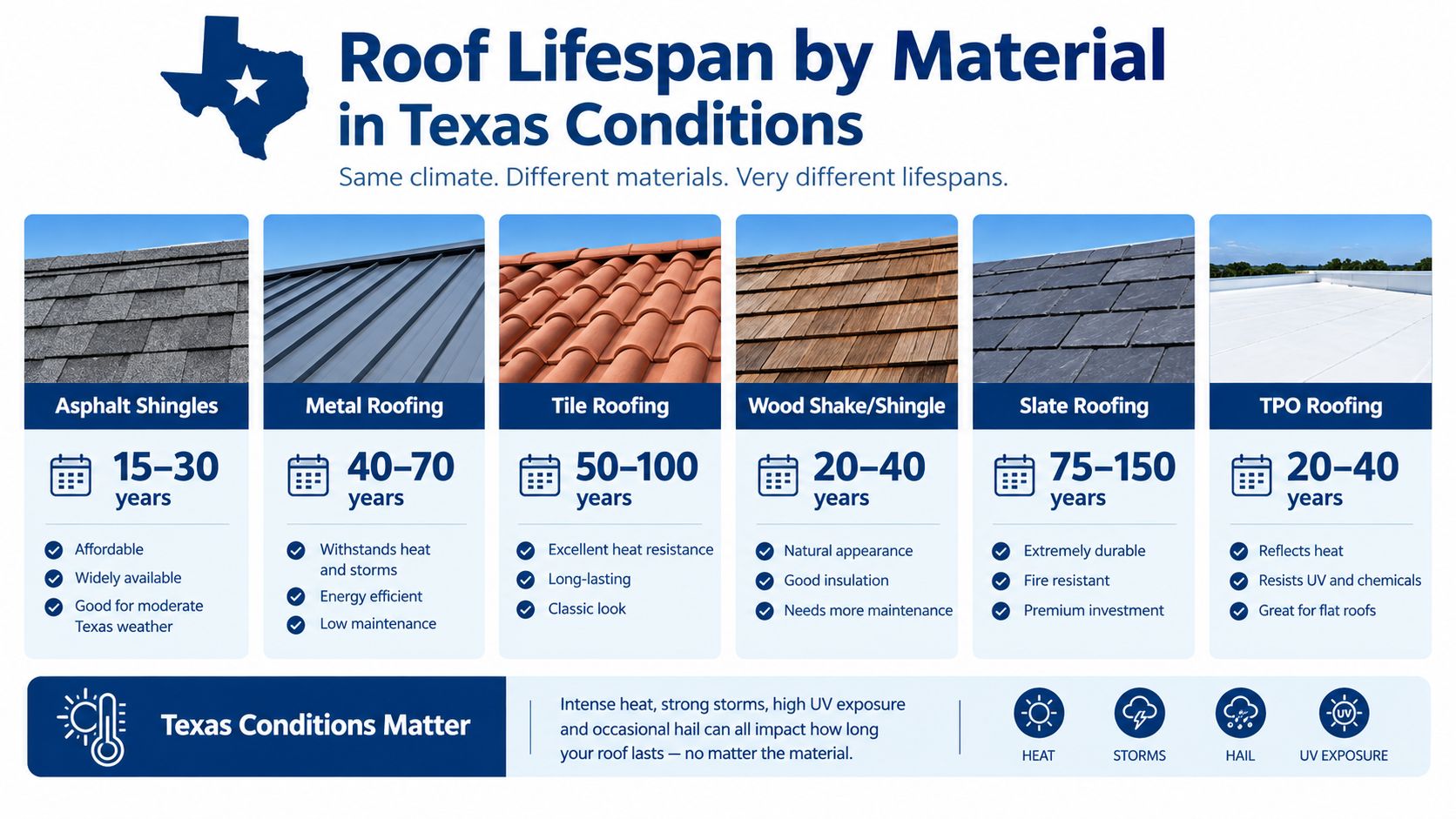
Homeowners usually want a simple chart, and the chart matters. In Texas, though, the material only makes sense when you factor in heat, hail, wind, and how well the roof was installed.
The common materials and what Texas conditions do to them
A basic asphalt roof is still the shortest-lived common choice. The NAHB study puts standard asphalt-shingle roofs at about 20 years, fiber-cement shingles around 25 years, and wood shakes around 30 years. Premium materials go much farther, with slate, copper, and clay or concrete tile exceeding 50 years when the assembly is designed and maintained properly (NAHB).
Field guides in the roofing trade show a similar spread: 3-tab asphalt shingles around 15 to 20 years, architectural shingles around 20 to 30 years, standing-seam metal around 40 to 70 years, and natural slate around 75 to 150 years under favorable conditions (roof lifespan by material). Architectural shingles also carry different wind ratings by climate zone, and that rating matters in North Texas. A shingle that is rated for one wind exposure in a milder region may need a higher-rated version once it is going onto a roof that takes more lift and storm stress.
Why Texas knocks the numbers down
Older federal building research showed shorter service life in southern states than in northern ones, and that matches what we see on houses across Tarrant and Dallas counties (Federal building research). Heat dries out asphalt. UV breaks down the surface. Hail bruises the mat. Wind works at the edges, ridge caps, and flashing.
A roof can be made from a long-lived material and still age early if the underlayment, flashing, ventilation, or fasteners were handled poorly. A roof can also age faster after repeated storm exposure even when the product itself is decent. That is why the better question is not only what the material should last on paper, but how much of that life is left after Texas weather has already taken its cut.
How Storms Change Your Remaining Roof Life
A storm changes more than what you can see on the roof. In DFW, hail, wind, and heat all shorten the useful life that is left after a roof has already taken years of wear.
A roof with limited life left is far more vulnerable. Verisk reports that about 29% of U.S. homes with asphalt shingles have fewer than four years of remaining useful roof life, and roofs with less than five years remaining can sustain 50% more severe-weather damage than roofs with eight or more years left (Verisk report).
That matches what I see after storms across Tarrant and Dallas counties. A roof that looked serviceable before the hail may come out of the next event with enough stress to tip it into failure. Once shingles have lost flexibility, the next hit does more than bruise the surface. It can open seams, weaken seals, and push a tired roof past the point where repairs make sense.
Cosmetic wear and functional failure aren't the same thing
Granule loss can start as surface wear. Creased shingles, exposed mat, lifted edges, damaged flashing, cracked seals, and attic moisture are different. Those are functional problems, and they tell you the roof is no longer just aging.
A post-storm inspection has to separate those conditions. If the damage stays limited to isolated wear, repair may be the right call. If the roof shows widespread impact marks, repeated lift, or water intrusion, the remaining life is usually much shorter than the age on paper.
A roof can still look decent from the driveway while hail and wind have already cut years off its useful life.
That is the trade-off homeowners face in North Texas. After a storm, the key question is not just how old the roof is. It is whether the shingles, flashing, underlayment, and fasteners are still doing their job.
Why the Roof Assembly Matters More Than the Shingles
A roof is a system, and the weakest layer usually decides how long it lasts. I've seen roofs in Tarrant and Dallas counties where the shingles still looked serviceable, yet the assembly underneath was already failing.
The hidden parts wear out before the shingles do
As noted in the material comparison above, 3-tab shingles typically last 15 to 20 years and architectural shingles 20 to 30 years under ordinary conditions. Those numbers mean less once heat, ventilation, slope, and installation quality enter the picture.
Attic ventilation often starts the decline before visible shingle wear shows up. Poor airflow keeps the deck hotter, dries out the asphalt faster, and shortens the life of seals and fasteners. Hail and wind then hit a roof that has already lost some flexibility, so damage shows up sooner and spreads faster.
What I check first after a storm
A real inspection starts with the parts that keep water out.
- Granular loss: Bald patches and grit in gutters can show aging, but they do not always mean the roof has failed.
- Flashing condition: Chimneys, valleys, vents, and roof transitions need tight metal and sound sealant.
- Shingle movement: Creased, lifted, or missing shingles point to more than surface wear.
- Attic moisture: Stains, damp decking, or a musty smell usually mean the problem has been active longer than the ceiling damage suggests.
That is the decision framework I use. Cosmetic wear can stay on the repair side of the line. Functional failure starts when the roof stops shedding water the way it should, or when storm damage opens paths for leaks through flashing, underlayment, or fasteners. In North Texas, the age on the shingle package matters less than whether the whole assembly can still handle heat, wind, and the next storm.
Long-Life Materials and Their Hidden Failure Points
Premium roofing materials can last a long time, but they do not make the whole roof immune to age. The visible surface may outlast several rounds of weather, while the smaller parts underneath wear out first.
Durable surfaces still depend on vulnerable components
As shown in the material comparison table, standing-seam metal, clay or concrete tile, and natural slate all have long service lives in the field, but the hidden failures usually show up in the parts you do not see. On metal roofs, I look hard at fasteners, clips, sealants, coatings, and flashings, because thermal movement in DFW works those details loose over time. Manufacturers may stand behind the panel longer than the sealant or fastener package that holds the system together.
Tile roofs have a different weak spot. The tile can stay intact while the underlayment underneath is already worn out, so a roof can look fine from the street and still leak at penetrations, valleys, or edges. In practice, underlayment often needs attention long before the tile itself does.
Slate usually ages slowly, but it still depends on correct flashing, solid decking, and careful repair work. If those parts fail, the roof can leak long before the slate reaches the end of its service life.
Matching the material to the assembly
A long-lived roof only works when the full assembly fits the material. Slate and tile need proper slope, sound decking, and flashings built for the system. Low-slope commercial roofs need seams, penetrations, drainage, and rooftop equipment managed with the same level of care.
That is why I treat roof life as a part-by-part question. A covering can still have years left on paper while the underlayment, fasteners, or flashings are already due for replacement.
Weighing Replacement Frequency Against Whole-Life Cost
A roof that lasts longer is not always the cheaper roof, and a low upfront price does not always mean a smarter purchase. Whole-life value comes down to replacement frequency, maintenance burden, and how the building is used.
Maintenance and replacement carry real whole-life weight
A life-cycle study found that maintenance averaged 9.5% of embodied global-warming potential across roof alternatives, while replacement averaged 37% and reached as high as 86% in some cases. The same study compared steel and aluminum roofs at about 50 years with TPO at about 20 years, and extending TPO life by five years reduced global-warming impact by 9.5% because fewer replacements were needed (life-cycle study).
That does not mean every roof should be pushed to the longest possible lifespan. It means tear-offs carry real material, labor, and disposal costs, and those costs add up each time a roof is replaced.
A practical planning lens for DFW properties
For homeowners, HOAs, and small commercial owners, the key question is whether repair, recoating, or selective replacement can extend useful life without forcing an early full tear-off. The answer depends on the roof's current condition, access, drainage, repair history, and how long you expect to own the property.
A roof with isolated damage and solid remaining life can often be repaired and watched. A roof near the end of its field life, with widespread damage or repeated leaks, usually points toward replacement instead of another patch.
A good roofer should say that plainly. A short-term repair can buy time, but only when the system still has enough life left to justify it.
Planning Your DFW Roof Replacement with Local Requirements
Fort Worth has clear rules that matter once you move from roof age to actual replacement planning. Replacing shingles alone on a single-family or two-family home does not require a permit, but replacing any decking does, and roof-covering installations must satisfy either the manufacturer's instructions or International Residential Code Section R905, whichever is more restrictive (Fort Worth roofing FAQ).
What to check before you schedule work
Start with age, then layer in storm history, inspection findings, and whether you've already had repeated repairs. In Fort Worth, Arlington, Dallas, and nearby communities, that combination matters more than a shingle brochure ever will.
If the roof is still serviceable, repair may be the right move. If decking is compromised, if leaks keep returning, or if storm damage is widespread, replacement starts making more sense. When insurance is involved, documentation matters just as much as the physical condition.
Blue Lake Roofing & Remodeling handles roof replacement, leak repair, storm damage documentation, and insurance-claims assistance across the DFW area, so homeowners can compare repair versus replacement with an actual field inspection instead of guessing from the driveway.
If your roof is getting close to the end of its useful life, or a recent hailstorm left you unsure what's cosmetic and what's structural, Blue Lake Roofing & Remodeling can inspect the system, document the damage, and lay out the repair or replacement options clearly. Visit Blue Lake Roofing & Remodeling to schedule a roof evaluation for your Fort Worth, Dallas, Arlington, or nearby DFW property.
