
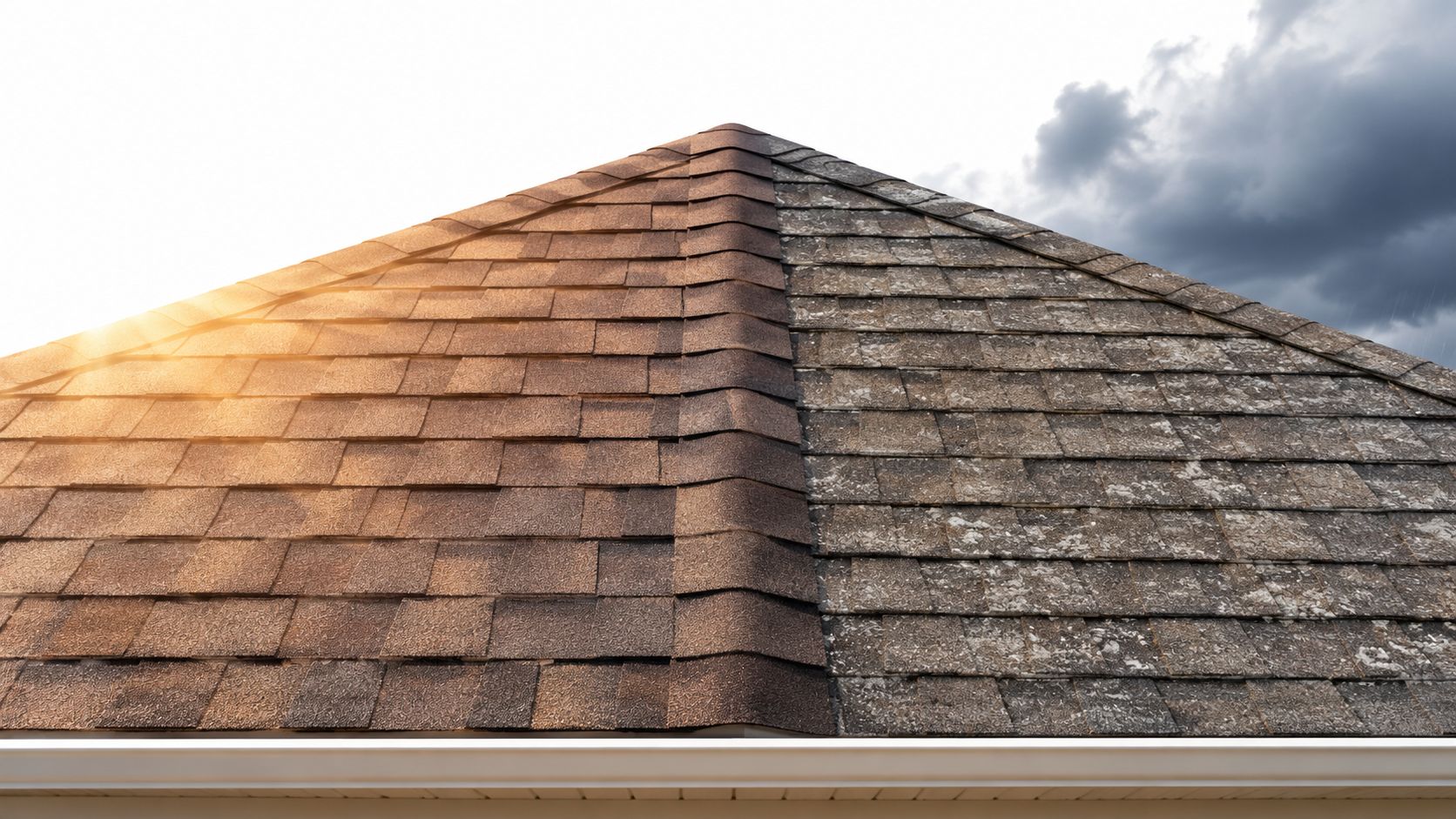
How Long Do Architectural Shingles Last? DFW Lifespan Guide
A well-installed architectural shingle roof typically serves about 24–30 years under favorable conditions, but in hot, storm-prone North Texas, the realistic range is closer to 18–22 years. The “30-year” or “lifetime” warranty label isn't a guarantee that your roof will reach that age.
That answer challenges the most popular advice homeowners hear. A bundle marked “30-year” doesn't contain a timer that stops at year thirty, and a lifetime label doesn't mean the shingles will protect your house indefinitely. In Fort Worth and across DFW, heat, attic ventilation, roof orientation, installation quality, and repeated hail exposure decide how long the roof performs.
Table of Contents
- The Realistic Answer for Fort Worth and DFW Homeowners
- What Makes Architectural Shingles Different
- Why a 30-Year Shingle Rarely Lasts 30 Years
- How Texas Heat and Ventilation Shorten Shingle Life
- The Hidden Threat of Small Hail and Aging Wind Resistance
- How to Judge Your Roof's Remaining Life
- Comparing Architectural Shingles to Other Roofing Options
- Making a Smart Roofing Decision in North Texas
The Realistic Answer for Fort Worth and DFW Homeowners
For a favorable installation and moderate exposure, architectural shingles can provide a practical service life of roughly 24 to 30 years. The technical roofing report distinguishes that range from conventional three-tab shingles, which typically provide about 15 to 18 years under comparable conditions.
DFW is a tougher test than the product label suggests. For many homeowners, a realistic planning range is closer to 18 to 22 years, especially when the roof faces prolonged heat, poor attic ventilation, south or west sun exposure, recurring hail, or high wind. That doesn't mean every roof fails at year eighteen. It means a homeowner shouldn't budget around the most optimistic warranty number.
Treat the roof as a system
The shingles are only the outer layer of a roofing assembly. The deck, underlayment, flashing, penetrations, ventilation, fasteners, sealant strips, and installation details all affect whether the roof remains watertight and storm resistant.
A well-installed roof in Fort Worth may outlast a poorly ventilated roof in a nearby subdivision, even when both use the same product line. The same principle applies in Arlington, Keller, Southlake, Plano, Frisco, and surrounding communities. Local exposure matters more than the name printed on the wrapper.
Practical rule: Use the warranty for understanding coverage, not for predicting replacement day.
Homeowners should start paying closer attention as a roof approaches twenty years, but age alone shouldn't make the decision. Granule loss, cracking, blistering, exposed fasteners, missing or lifted shingles, and failing flashing provide a better picture of remaining life than the original installation date.
This guide explains what architectural shingles are, why warranty labels mislead, how Texas heat and ventilation affect asphalt, and why repeated small hail deserves more attention than it receives. It also gives you a condition-based way to decide whether repair, monitoring, or replacement makes sense.
What Makes Architectural Shingles Different
Architectural shingles are also called laminated or dimensional asphalt shingles. Unlike a basic three-tab shingle, they use multiple fused asphalt layers with a fiberglass reinforcement mat and a varied tab pattern. That layered construction creates more thickness, visual depth, and resistance to ordinary weathering.
Think of the difference as a plywood sandwich compared with a single sheet of cardboard. The laminated shingle has more substance under the exposed surface, while the three-tab design is flatter and more uniform. Architectural shingles distribute wind forces across a more substantial profile and offer more material around the adhesive and fastening areas.
Why the construction matters
The added layers don't make the shingle indestructible. Hail can still bruise the asphalt, remove granules, and weaken the weathering surface. Poor installation can still leave tabs vulnerable to uplift. But the dimensional build generally gives the product a stronger starting point than a single-layer three-tab roof.
That combination of appearance and durability explains why architectural shingles became the default choice for many DFW subdivisions. They provide shadow lines that resemble wood shake or slate without requiring those specialty materials, and they fit a wide range of brick, stone, siding, and stucco exteriors.
They also outlast conventional three-tab shingles in practical service life. The important distinction is that the longer life comes from material design and installation quality, not from a marketing number alone.
A thicker shingle can resist normal stress better, but DFW weather still sets the terms. Sun-facing slopes age differently from shaded slopes. A roof with sound ventilation ages differently from one that traps heat beneath the deck. A roof repeatedly exposed to hail may lose serviceable weathering margin long before a homeowner sees missing pieces from the ground.
The right conclusion is simple. Architectural shingles are usually the sensible asphalt choice for a primary residence, but their construction improves the odds of a long service life. It doesn't override the climate or erase storm damage.
Why a 30-Year Shingle Rarely Lasts 30 Years
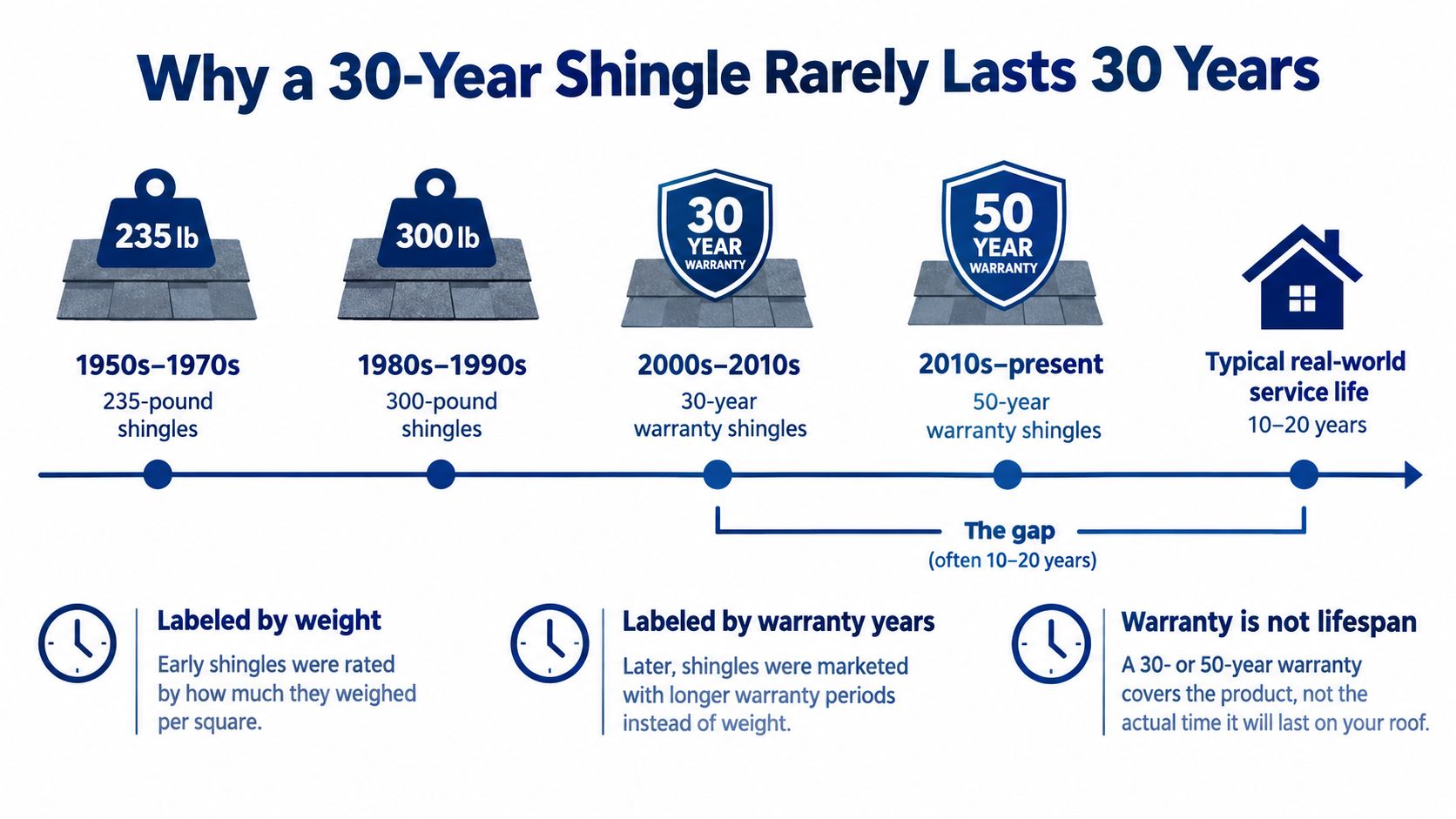
A “30-year” label is not a 30-year field-performance promise. Manufacturers moved from describing asphalt shingles mainly by weight to labeling them by warranty duration, even though the warranty period does not directly determine useful service life, as documented in the historical roofing report.
The category changed more than the roof did. In 2011, major manufacturers began replacing the “30-year laminated shingle” designation with “lifetime shingles,” according to the history of asphalt shingles. A new label did not make the material immune to DFW heat, hail, ventilation problems, or installation defects.
Read the coverage schedule, not just the headline
Most shingle warranties use stages. Early protection may be non-prorated, meaning the manufacturer contributes under the stated terms without reducing that contribution for age. Later protection becomes prorated, so the manufacturer's share declines as the roof gets older.
That difference matters during a late-life claim. A roof can still have warranty coverage on paper while the payment covers only part of replacement costs. The final result depends on the document's exclusions, installation requirements, transfer rules, and labor provisions.
Warranty labels have changed independently of field conditions. CertainTeed extended the stated warranty on a leading laminated product from 25 to 30 years in January 2002, as recorded in the asphalt shingle history. That revision did not change the roof's exposure to heat, hail, poor ventilation, or installation mistakes.
A 1993 contractor survey cited in the roofing technical report found that shingles labeled “20-year” averaged about 8 years. That result does not predict every modern architectural roof, but it shows why a printed warranty year should never determine when you replace the roof.
Before treating warranty coverage as a measure of value, check:
- Coverage stages: Find when non-prorated protection ends and prorated protection begins.
- Transfer rules: Confirm whether coverage changes after a property sale.
- Installation conditions: Review requirements for approved components, ventilation, and registered installation.
- Labor coverage: Separate material protection from roof removal and installation costs.
- Exclusions: Check treatment of hail, wind, maintenance, ventilation, and installation defects.
The practical answer to “how long do architectural shingles last” requires separating warranty duration from useful service life. The warranty is a contract category. Service life is the years the roof can still protect your home under North Texas conditions.
How Texas Heat and Ventilation Shorten Shingle Life
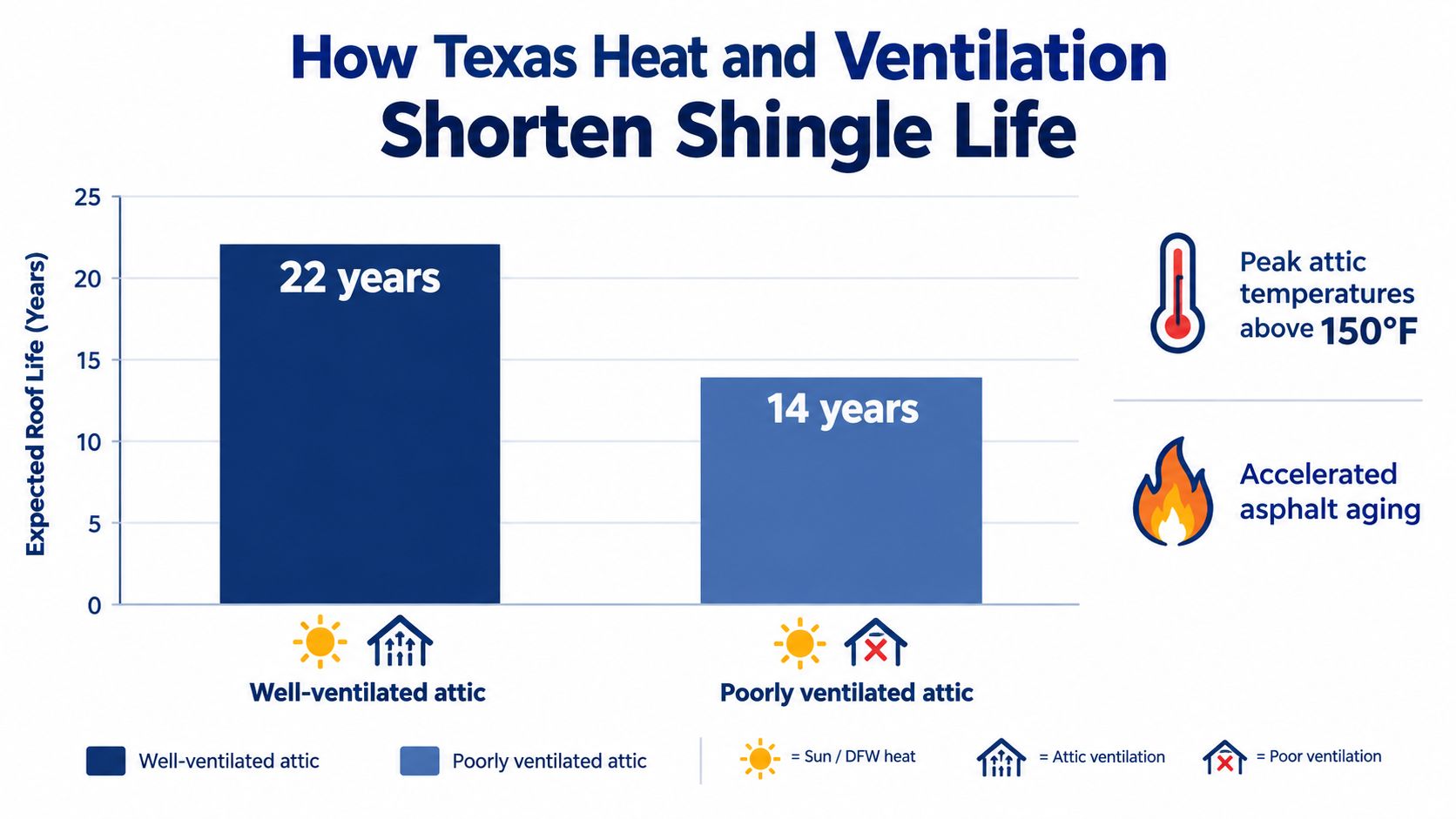
Prolonged high temperatures accelerate asphalt aging. Inadequate attic ventilation adds stress from below by allowing roof-deck and shingle temperatures to rise, especially beneath dark shingles and sun-facing slopes.
A building-science analysis gives homeowners a useful climate comparison. Under unfavorable heat conditions, asphalt shingles may last about 10 years in Houston, while they may last 20 years or more in Minneapolis. The difference isn't a warranty issue. It's the result of climate and assembly conditions.
The same source reports that reducing shingle temperature by 20°F with a cool-roof shingle in a hot-humid climate could double projected service life from 10 to 20 years. DFW isn't Houston, but the lesson applies: controlling heat can change the aging curve.
The choices that matter in DFW
You can't control every storm, but you can control several contributors to roof temperature and moisture movement.
- Ventilation: Intake and exhaust paths should work together so hot attic air can leave and replacement air can enter. Adding a vent without correcting the overall airflow pattern may not solve the problem.
- Shingle color: Darker surfaces generally absorb more solar heat than lighter options. Product selection should balance appearance, neighborhood requirements, and heat exposure.
- Roof orientation: South- and west-facing slopes receive demanding sun exposure. They may show fading, granule loss, or surface aging before less exposed slopes.
- Deck and insulation condition: A roof assembly with moisture problems, compressed insulation, or blocked airflow can perform differently from a properly balanced assembly.
- Installation quality: Poor alignment, exposed fasteners, weak flashing details, and improperly sealed penetrations create failure points that heat and storms exploit.
Heat doesn't need to destroy a shingle in one season. Repeated high-temperature cycles gradually reduce the material's margin against cracking, granule loss, and seal failure.
That is why a roof can look acceptable from the driveway while aging faster on a particular slope or inside the attic. A DFW evaluation should look at the whole assembly, not just the color and pattern of the shingles.
The practical recommendation is to have ventilation assessed during replacement or inspection, particularly if the attic runs hot, the roof has dark shingles, or the home has extensive south and west exposure. Managing heat won't make a roof immune to hail, but it can prevent avoidable stress from shortening the service window.
The Hidden Threat of Small Hail and Aging Wind Resistance
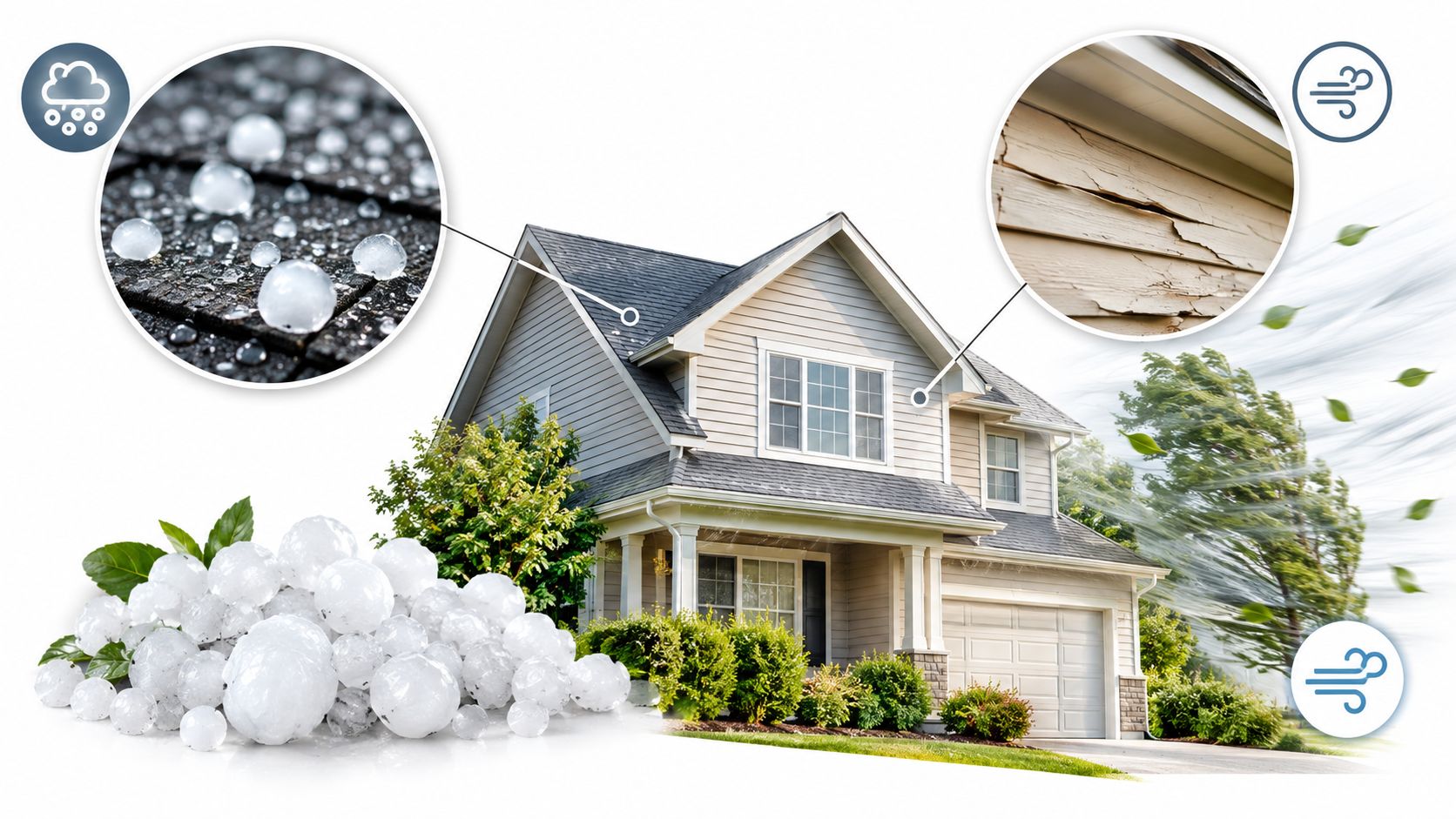
Large hail gets attention because it leaves obvious marks. Repeated small hail can be more difficult to recognize, yet it may remove granules and weaken the surface over time.
A 2025 peer-reviewed study found that repeated small-hail impacts can accelerate natural aging and reduce resistance to later severe hail. In controlled testing with 44 sub-severe impacts per square foot, previously weathered asphalt shingles were approximately 10 times more susceptible to subsequent severe-hail damage. The study also found that cumulative granule loss from repeated smaller impacts exceeded the loss from a single 2-inch hailstone impact, as reported in the Frontiers in Materials research.
That finding changes how I think homeowners should assess a roof in Forest Hill, Mansfield, and other storm-exposed neighborhoods. A roof doesn't need dramatic punctures or rows of missing shingles to lose durability. Repeated impacts can bruise the asphalt, loosen granules, and reduce protection before the damage becomes obvious from the ground.
Wind resistance changes with age
The Insurance Institute for Business & Home Safety's Roof Aging Farm research found that many shingle products gain wind resistance during the first several years as factory-applied sealant bonds. Most products then begin declining between approximately years 5 and 10, although the rate varies by product and location.
Unsealing is a leading driver of wind vulnerability. A shingle can remain physically present while its adhesive strip loses the bond that helps resist uplift. Creased shingles, lifted tabs, exposed fasteners, edge damage, and ridge damage deserve attention even when the roof still looks complete.
After a storm, document the roof and surrounding property. Photograph gutters, downspouts, siding, vents, ridge caps, and visible granule accumulation. A professional inspection can identify conditions that a homeowner can't safely see from the ground, while dated records help establish what changed after the event.
The right mindset is not “the hail wasn't large enough to matter.” It is “the roof needs a condition check after unusual exposure.” Small impacts, aging sealant, heat, and prior weathering can work together.
How to Judge Your Roof's Remaining Life
Calendar age gives you a starting point, not a verdict. A roof approaching 20 years deserves a professional condition evaluation even if it still looks serviceable, because remaining life depends more on surface condition, seal integrity, flashing, and storm history than on the number of years since installation.
Start with observations you can make safely from the ground and from accessible attic areas. Don't walk a questionable roof yourself. Asphalt granules in gutters, visible cracking, blistering, exposed fasteners, missing tabs, and failing flashing all provide useful clues.
Use a condition-first checklist
- Check the gutters: Loose granules can indicate surface wear or storm impact. A small amount may occur over time, but recurring accumulation deserves evaluation.
- Study the roof edges: Missing, lifted, or creased shingles can expose the assembly to wind-driven rain.
- Inspect flashing: Valleys, walls, chimneys, vents, and other penetrations need intact metal or compatible flashing details.
- Look in the attic: Moisture staining, daylight, damaged decking, and unusual heat patterns can reveal problems hidden above the ceiling.
- Review storm records: Repeated hail or high-wind events matter even when no leak followed immediately.
- Check sealant condition: Unsealed adhesive strips can reduce uplift resistance before shingles disappear.
| Roof Age | What to Check | Why It Matters |
|---|---|---|
| Newer roof | Installation details, flashing, ventilation, and visible sealing | Early defects can shorten the entire service window |
| Mid-life roof | Granule loss, lifted edges, cracking, and storm history | Weather exposure may reduce resistance before obvious failure |
| Roof approaching 20 years | Surface wear, exposed mat, blistering, fasteners, and flashing | Condition becomes more useful than the original warranty label |
| Older roof | Leaks, brittle shingles, widespread granule loss, and deck condition | Repair may address symptoms while the assembly nears replacement |
Routine inspections are useful, but certain events should trigger an additional review. Schedule one after hail or high wind, before selling or refinancing, and whenever interior staining or attic moisture appears. Documented findings help separate normal wear from storm-related damage and support accurate insurance discussions.
Ventilation deserves its own review because attic moisture and temperature problems can affect more than shingle aging. Homeowners researching insulation and roof moisture management may also find this Airtight Spray Foam Insulation roof guide useful for understanding how roof assemblies respond to changing conditions.
A condition report should tell you what is damaged, what is wearing normally, what needs immediate repair, and whether the roof has enough remaining margin to justify continued monitoring. That is more useful than a contractor merely repeating the number printed on the shingle package.
Comparing Architectural Shingles to Other Roofing Options
Architectural shingles are the practical middle ground for many DFW homes, but the choice depends on the property, not the label on the package. Three-tab shingles cost less and suit limited applications. Premium materials can make sense when the roof's design, storm exposure, or ownership horizon justifies higher installation complexity.
Three-tab shingles generally provide about 15 to 18 years of practical service, while architectural shingles may provide roughly 24 to 30 years in favorable conditions. Those figures are planning ranges, not promises. North Texas heat, poor attic ventilation, hail, wind, and installation defects can shorten either type's service life.
Compare the right trade-offs
| Roofing option | Best fit | Decision point |
|---|---|---|
| Three-tab asphalt | Sheds, detached structures, or short-term projects | Lower service expectation and a flatter appearance |
| Architectural asphalt | Primary residences seeking a balanced asphalt system | Practical fit, but performance still depends on the roof assembly |
| Standing seam metal | Homeowners choosing a long-term metal system with clean lines | Requires different detailing, installation skill, and maintenance expectations |
| Slate | Premium or historic homes | Weight and structural planning may control the decision |
| Cedar shake | Homes designed around a natural, textured exterior | Requires maintenance suited to local weathering |
| Clay tile | Homes that support a tile profile and masonry character | Existing structure and installation requirements must be reviewed |
The table's main lesson is simple: material selection changes the installation and inspection demands. It does not remove them. A higher-cost roof can still perform poorly if the design, flashing, ventilation, or workmanship is wrong.
Blue Lake Roofing & Remodeling installs standing seam metal, slate, cedar shake, clay tile, copper details, and architectural asphalt shingles across Tarrant, Collin, Denton, and Dallas counties. That range matters when the decision turns on historic character, roof geometry, storm exposure, or a planned exterior renovation rather than shingle price alone.
Insurance should be part of the comparison after a North Texas storm. Ask whether the selected material was installed to applicable requirements, how damage will be documented, and whether repair records are clear. No roofing material removes the need for inspection or makes small hail damage irrelevant.
Some homeowners are evaluating integrated solar products instead of adding separate equipment later. rooftop solar tiles explained offers a basic explanation of that category.
For most DFW homeowners replacing a standard residential roof, architectural shingles remain the sensible asphalt choice. Use three-tab shingles where the property's purpose and budget support a shorter service expectation. Select a premium system when the building's design, ownership horizon, or performance goals justify the added cost and installation demands.
Making a Smart Roofing Decision in North Texas
The answer to “how long do architectural shingles last” should determine what you inspect, document, and budget for next. The National Roofing Contractors Association guidance summarized in a current roofing lifespan report identifies about 20 years as a useful-service benchmark for many asphalt roofs, emphasizing climate, design, material quality, installation, and maintenance. In DFW, use that benchmark to set inspection timing, not to promise a replacement date.
Use four rules when planning
First, document the roof before you need to make a claim. Keep the installation invoice, product information, warranty document, repair records, and dated photographs together. After hail or high wind, record visible conditions promptly and arrange an inspection that checks granule loss, bruising, creasing, unsealed tabs, flashing, edges, and ridge areas. Clear records give you a stronger basis for deciding whether storm damage, deferred maintenance, or ordinary aging is involved.
Second, treat ventilation and heat management as controllable variables. Ask whether intake and exhaust ventilation work together, and have the attic assembly checked rather than judging it from the roof surface alone. Shingle color and roof orientation also matter, especially on south- and west-facing slopes. Poor airflow can reduce the roof's remaining margin in North Texas heat.
Third, document every storm, including storms that appear minor. Repeated small hail can affect the roof without leaving dramatic damage from the ground. Save photographs, note the storm date, and request an inspection before washing away evidence or authorizing unrelated repairs.
Fourth, switch from age-based decisions to condition-based decisions as the roof gets older. Check for cracking, blistering, exposed mat, loose granules, exposed fasteners, missing tabs, lifted edges, and deteriorated flashing. A roof with severe warning signs deserves attention sooner than one of the same age with limited exposure and sound maintenance.
Make the recommendation specific to your home
A homeowner in Fort Worth may need a different answer from a homeowner in North Richland Hills, Saginaw, Grapevine, or Colleyville, even when the houses were built around the same time. Roof orientation, tree cover, attic design, storm exposure, and prior repairs change the evaluation.
The same applies across Denton, Frisco, McKinney, Arlington, and the wider Metroplex. DFW includes multiple counties and city clusters, including Collin, Dallas, Denton, Ellis, Hood, Hunt, Johnson, Kaufman, Parker, Rockwall, Tarrant, and Wise counties, as identified by the North Central Texas Council of Governments. Your contractor should define the actual service area and inspect the actual property rather than treating every regional roof as interchangeable.
If the roof has experienced repeated storms or shows any warning signs listed above, get a documented on-site inspection. The report should identify observed conditions, explain likely risks, separate repairable damage from normal aging, and recommend a clear next action. “Replace” or “wait” alone is not enough.
A free inspection is a practical next step because online lifespan ranges cannot account for your roof's slope, ventilation, flashing, storm history, and surface condition. Have the roof evaluated before a minor problem becomes interior damage or a replacement decision is made under pressure.
Blue Lake Roofing & Remodeling provides free on-site inspections, roof repair, replacement, storm-damage documentation, and insurance-claims assistance across Tarrant, Collin, Denton, and Dallas counties. Visit Blue Lake Roofing & Remodeling to request an inspection and get a condition-based assessment for your North Texas roof.
