
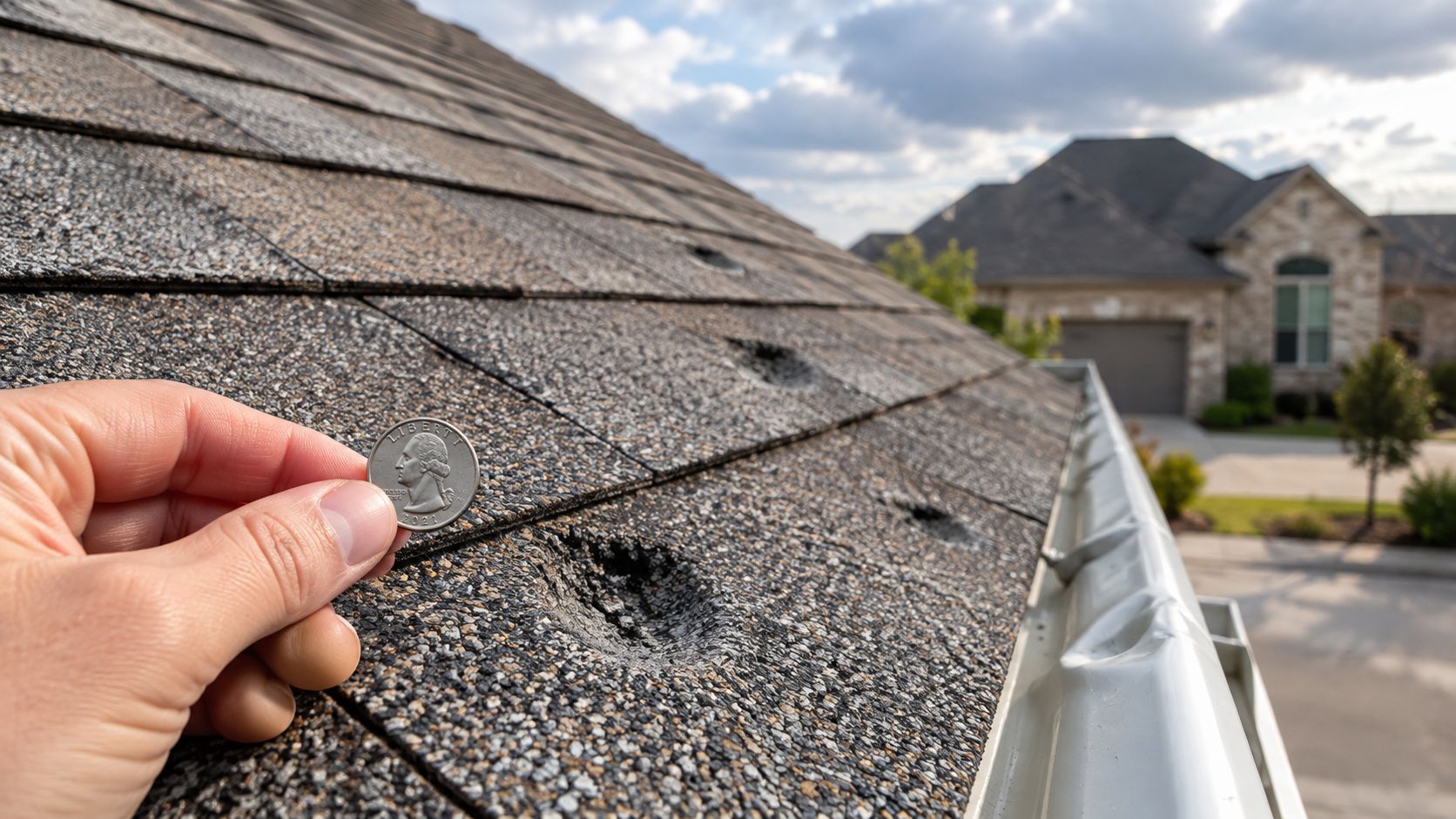
Hail Damage Roof Inspection: A Fort Worth Homeowner Guide
The storm has moved east, the hail has stopped, and your driveway is scattered with leaves and small branches. You can see dents in the gutter from the ground, but the roof looks fine. Before climbing a ladder or calling your insurer, take a breath: a sound hail damage roof inspection starts with safety, careful observations, and a record of what you find, not a rushed conclusion about replacement.
That matters across Fort Worth, Arlington, Mansfield, Plano, Frisco, McKinney, Denton, and Irving, where one storm can leave different slopes with very different evidence. Wind and hail were the largest category of U.S. homeowners-insurance losses in each year from 2018 through 2022, representing between 38.3% and 48.3% annually; the series excludes Alaska, Texas, and Puerto Rico, so it's a national benchmark, not a DFW loss rate (wind and hail homeowners-insurance loss data). The useful question isn't whether hail fell. It's whether the roof has documented, functional damage that can be distinguished from aging and other causes.
Table of Contents
- The First Hour After a Fort Worth Storm
- Exterior Collateral Checks Around the House
- Slope-by-Slope Roof Inspection Protocol
- Attic and Interior Moisture Signals
- Hail Versus Normal Wear and Other Damage
- Building a Claim-Ready Documentation Package
- Smart Next Steps for DFW Homeowners
The First Hour After a Fort Worth Storm
Hail has stopped, but the roof may still be wet, loose debris may be overhead, and power lines may be down. Stay off the roof and don't use a ladder until the area is safe. From the ground, check for hazards and whether water is entering the house.
If there's an active leak, move people and belongings away from it. Catch dripping water if it's safe, and photograph the affected area before cleaning up or covering it. If temporary roof protection is needed, arrange a safe dry-in. Avoid permanent repairs until the damage has been assessed.
Record what you can see safely
Take a wide photo of the property, then photograph visible damage to exterior components from the ground. Note the storm date and when you first noticed each condition. These details help an inspector compare what's visible with later roof findings, without assuming every mark came from the same storm.
Document promptly. A homeowner in Tarrant County who waits six weeks may find that weathering or another storm has made a slope harder to assess. A Plano homeowner who records conditions soon after the storm gives an inspector a clearer starting point. Neither timing guarantees an insurance outcome, but a timely, dated record can help clarify what was present and when.
Safety first: Leave roof access to a qualified inspector. Address falls, electrical hazards, and worsening interior leaks right away.
Use the first hour to make the property safe and preserve what you can see, not to decide that the whole roof needs replacement. Cosmetic marks and functional roof damage are different findings; each slope needs a proper inspection before conclusions are drawn. A calm, dated record gives the inspector and insurer evidence to review, while a rushed claim declaration can get ahead of what the roof shows.
Exterior Collateral Checks Around the House
The strongest early evidence of hail may be on the house's exposed metal and exterior finishes, not on the shingles. A ground-level walk-around can help establish whether the storm affected the property and which side took the brunt of it, without putting you on a ladder.
Walk the perimeter in a consistent direction
Begin at one corner and move around the house, photographing each elevation. Check siding, window screens, window frames, painted trim, gutters, downspouts, and metal fascia wraps. Look at the elbows and lower ends of downspouts, where dents may be easier to spot, and inspect gutter runs for a pattern of small impact marks.
Then check nearby exposed items: mailbox tops, fence caps, patio furniture, and the metal fins on an outdoor AC condenser. In Tarrant County, aluminum-wrapped porch columns can make impact marks easy to see. Dented gutter aprons in Southlake or Colleyville can also provide useful context, though a dent by itself doesn't prove what happened to the roof.
Photograph each mark twice: once in a wider view showing its location, then close up with a ruler or coin beside it for scale. Avoid scratching, scraping, or bending anything to make a mark more visible. Note which elevations show marks and whether they appear concentrated on one side of the home.
Record direction, not just dents
The location and pattern of spatter or dents can help an inspector compare exterior evidence with the roof's slopes. Make a simple note such as “marks on the west-facing wall and south gutter run,” rather than guessing at a precise storm path. An inspector can use that context to decide which roof areas merit particular attention.
Use this quick list as a first pass:
- Gutters and downspouts: Look for repeated dents along a run or at elbows.
- Window screens and frames: Check for punctures, dimpling, or bent mesh.
- Siding and trim: Note chipped paint, dents, or impact marks.
- Metal fascia wraps: Photograph marks on porch columns or roof edges.
- AC condenser fins: Look for bent or flattened fins without touching them.
- Mailbox and fence tops: Check exposed metal for a matching impact pattern.
- Patio furniture: Record dents on exposed metal surfaces.
- Windows: Photograph any broken glass or damaged exterior beads from a safe distance.
These checks don't replace a roof inspection. They give the inspector a property-wide record to compare against roof findings and help separate a coherent storm pattern from isolated wear.
Slope-by-Slope Roof Inspection Protocol
A defensible roof assessment follows a repeatable process across every slope, rather than relying on a few dramatic close-ups. A homeowner can record visible conditions from the ground, but roof access and hands-on testing belong to a qualified professional using safe equipment and appropriate precautions.
Set up a representative test area
For each slope, an inspector can establish a 10-by-10-foot test square, or 100 square feet, in the most heavily damaged representative area. The square shouldn't be placed under protective tree cover if a more exposed area better represents the slope. The inspector then counts only impacts that meet the applicable definition of functional damage, rather than treating every dimple or patch of granule loss as a qualifying hit. This protocol is described in hail inspection guidance from InterNACHI.
Eight qualifying impacts within a test square is described as a common industry threshold, not a universal coverage rule. Policy wording, carrier guidelines, roof material and condition, installation quality, and local adjustment practice can all affect how findings are interpreted. A report should record what was observed and avoid presenting a threshold as an automatic guarantee of coverage.
Storm-facing slopes in Arlington, Mansfield, and Denton may show more evidence than leeward slopes. The contrast matters: document both the more affected faces and those with no apparent damage, then identify each slope on a simple roof sketch. This helps an adjuster in Arlington or Plano compare the evidence with the proposed repair scope.

Capture the parts that determine performance
A useful slope record goes beyond counting marks. The inspector should identify the roof covering, test-area location, observed impact, and photo reference, then assess how each condition affects the assembly.
| Component | What to record |
|---|---|
| Shingles | Bruising, deformation, cracks, or exposed substrate |
| Ridge caps | Impact marks and any fracture or displacement |
| Valleys | Displaced material or damage along the drainage path |
| Flashing | Dents, bends, or separation at joints |
| Vent hoods | Deformation or impact damage |
| Chimney counter-flashing | Gaps or separation |
| Gutters at the roof edge | Dents that provide exterior context |
| Representative undamaged areas | Location and clear reference photos |
A field report should connect each finding to its slope and image. That traceable record is more useful than a photo collection with no location labels.
Attic and Interior Moisture Signals
A roof can have a leak without producing an obvious ceiling stain right away. Interior evidence helps determine whether water has entered, but it doesn't automatically identify the storm or the roof defect responsible. The goal is to record what you see and connect it to the corresponding area above.
If attic access is safe, use a flashlight from the established walkway or a stable platform. Don't step onto loose or compressed insulation, and don't enter if the access area is wet, unstable, or affected by electrical hazards. Look at the underside of the roof decking for darkened patches, water tracks, and daylight around penetrations.
Read the pattern before assigning a cause
A fresh, localized water mark may align with a roof penetration or flashing issue, while widespread discoloration or rusted nail tips can point to a longer-running moisture condition. Insulation that's matted or discolored can help locate water movement, but attic airflow and past condensation can create misleading clues. Note the location of each observation and whether it appears damp now or only stained.
From the living space, photograph ceiling or wall stains before cleaning or repainting. If water is actively dripping, take dated photos and keep a record of any temporary mitigation. A moisture-meter reading can be useful if you have access to a suitable meter, but record where it was taken and don't treat a single reading as proof of cause. If a stain is below an HVAC system, note the condition of the drip pan as well, since condensation or drainage issues can resemble roof leakage.
A stain tells you where moisture appeared, not necessarily where it entered. Trace it to a roof feature before assigning a cause.
A homeowner in McKinney, Frisco, or Carrollton can mark the room on a simple floor plan and compare it with the roof sketch. A bedroom stain near a chimney or vent may warrant a closer look at that feature, but water can travel along decking before it reaches the ceiling. When a leak is active, these steps to handle a roof leak offer practical guidance on protecting the interior while arranging an assessment.
Don't cross an attic by walking on insulation. It can conceal ceiling joists and unsafe footing, and compressed insulation can lose effectiveness. If the attic is difficult to access, a professional check is often the sensible option, even when you've completed the ground-level documentation yourself.
Hail Versus Normal Wear and Other Damage
A dark spot isn't automatically hail damage. Neither is a dent, a patch of granule loss, or a shingle that looks different from its neighbors. A credible assessment considers the impact pattern, the roof's condition, and whether the mark has impaired the roof's ability to shed water.
Look for a coherent pattern
Hail impacts may be randomly distributed and more concentrated on slopes exposed to the storm. The finding is more persuasive when it aligns with impact marks on exposed metal or other exterior components. By contrast, repeated marks in the same position on multiple shingles may point to foot traffic, tool contact, manufacturing variation, or another mechanical cause.
Inspectors should also record spatter direction and shape, and treat scratches inside a depression cautiously because hail doesn't typically create scratch marks. A roof's age and the appearance of older exposed material can affect how visible a mark looks, so visual contrast alone isn't a reliable clock. Damage at an edge or unsupported area deserves attention because those areas are more vulnerable, but an edge mark by itself doesn't establish hail as the cause.
The Insurance Institute for Business & Home Safety categorizes impact outcomes as soft impact, hard shatter, or hard bounce, with damage that may include dents or ridges, granule loss, or tears, cracks, and ruptures (IBHS hail-impact inspection guidance). The practical distinction is whether the shingle shows deformation or a breach that compromises performance, not merely whether the surface looks different.
Separate cosmetic evidence from functional damage
Granule loss alone doesn't prove that a shingle has lost its water-shedding function. InterNACHI notes that a few missing granules don't establish functional damage, and an academic conference paper cited in its guidance reports that long-term testing found no reduction in water shedding when shingles remained covered despite substantial granule loss (asphalt-shingle inspection guidance). That doesn't mean a hidden fracture should be ignored. It means the inspector needs to examine the impact, the mat, the surrounding shingle, and the overall distribution.
A useful report classifies findings as cosmetic, repairable, or functionally compromised and explains why. For example, an inspector might find superficial granule displacement on one area and a fracture with exposed substrate elsewhere. Keeping those findings separate avoids treating every visible blemish as a replacement case or dismissing a serious defect because it's hard to see from the ground.
Building a Claim-Ready Documentation Package
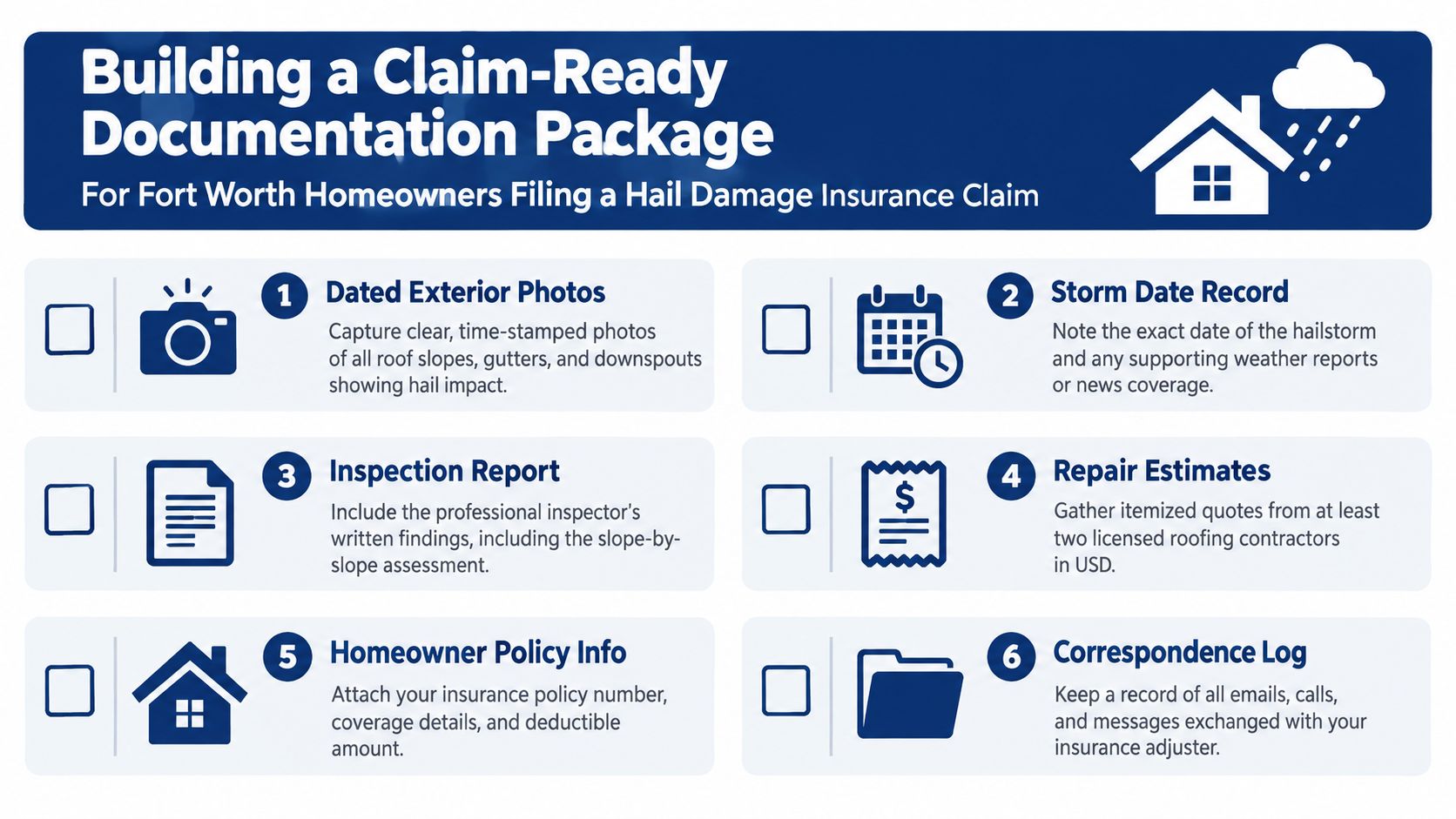
After a storm, a close-up of a dent means little if nobody can tell which building, side, or slope it shows. Label evidence so a Fort Worth homeowner, contractor, or adjuster can trace each finding to its location without guessing. Keep observations factual and separate storm-related evidence from existing wear.
Assemble one folder before the claim call
Gather dated photos of the exterior and interior, labeled by elevation, roof slope, and room. Add a simple roof diagram naming each slope and marking visible findings or inspection areas. Keep notes on what you observed, plus receipts for temporary tarping or dry-in work.
Include the written inspection report and contractor estimates with itemized scopes. A one-page storm summary can record the storm date and approximate time, reported hail size from a reliable local source, and collateral damage you observed. Preserve original photos and relevant communications. If a professional or insurer asks to inspect damaged materials, keep them available.
Use labels that identify the building, side or slope, and room where relevant. “South slope, ridge cap, close-up” gives a reviewer more to work with than “roof damage.” For multifamily or commercial properties, identify the structure in each record so findings cannot be assigned to the wrong building.
Keep the evidence intact
Photograph affected areas before cleanup or repair, as long as it is safe to do so. If the insurer arranges mitigation, retain the work order and photos taken before and after temporary work. Protect the property promptly when needed, then document the condition and work performed.
A claim folder can contain:
- Storm record: Date, approximate time, and a weather report or local coverage.
- Property photos: Dated images labeled by elevation and roof slope.
- Inspection findings: Written observations, including areas with no observed damage.
- Interior record: Room locations, stains, active moisture, and mitigation.
- Cost records: Receipts for temporary work and itemized repair estimates.
- Communication log: Notes from calls, emails, and meetings about the claim.
A clear record helps reviewers compare the inspection findings with the proposed scope and distinguish storm evidence from age-related wear. It also gives you a dated reference for repair planning if the claim is disputed. Keep the folder organized by building and location, and make copies of the original files before sharing them.
Smart Next Steps for DFW Homeowners
A sensible order of operations is simple: make the property safe, arrange temporary dry-in if needed, document what's visible, and get an independent inspection before permanent repairs alter the evidence. Then meet with the adjuster, compare the written scope with the slope-by-slope findings, and keep each decision in writing.
Don't choose a contractor solely because someone knocked on the door after a storm. Ask how the inspection will document damaged and undamaged areas, whether the written estimate separates storm findings from existing wear, and who will coordinate with the adjuster. A local contractor familiar with Tarrant, Dallas, Collin, and Denton counties can help interpret the roof and exterior evidence without treating every mark as a claim item.
Use the written scope as your check
Request an on-site adjuster meeting when practical. Walk through the roof diagram and photo labels together, and compare each proposed repair with the documented slope and component. A scope that doesn't account for observed damage needs clarification; a recommendation to replace everything without explaining functional impairment deserves questions too.
Homeowners reviewing their coverage can also consult an insurance professional about policy terms and claim responsibilities. Duncan & Associates Insurance Brokers provides information about home insurance for families, which can be a useful starting point for understanding coverage before a storm claim arises.
Warning signs of an oversold assessment include a replacement recommendation based only on dark spots, pressure to sign before you've reviewed the report, or no explanation of how findings connect to storm damage. Warning signs of an undersold assessment include no slope-by-slope review, no photos of undamaged areas, or a refusal to discuss interior moisture and collateral evidence.
FAQ: Should you file a claim if you see only cosmetic marks? First establish whether there's functional damage and compare the likely repair scope with your policy before deciding. How long will a DFW hail claim take to settle? There's no reliable single timeline; it depends on the policy, evidence, inspection scheduling, and whether the scope is disputed. For any claim, a clear record and prompt communication help keep the process grounded in the property's actual condition.
The goal isn't a fast payout. It's a watertight, code-compliant roof and a defensible paper trail. Blue Lake Roofing & Remodeling offers storm-damage inspections, photo documentation, repair and replacement work, and adjuster coordination across the DFW area. If your roof needs a closer look after a storm, visit Blue Lake Roofing & Remodeling to request an on-site inspection.
