
Cost Roof Tiles in Fort Worth and DFW: 2026 Price Guide
The global roofing tile market was valued at $34.08 billion in 2024 and was forecast by SkyQuest's roofing tiles market report to reach $35.61 billion in 2025. That scale doesn't tell you what your roof will cost in Fort Worth. Your framing, your roof surface area, and the line items inside the quote will. Tile can be the right long term system, but only after you price the whole conversion, not just the cost roof tiles carry per square foot.
Table of Contents
- Roof Tile Cost per Square Foot at a Glance
- Why Tile Costs More Than Asphalt Shingles
- Structural Upgrades That Change the Final Price
- Quote Line Items That Protect Your Budget
- Sample Budgets for a 2,000 Square Foot Roof
- Local Price Factors in Fort Worth and Nearby Cities
- Confirm Your Tile Budget Before You Sign
Roof Tile Cost per Square Foot at a Glance
Installed tile costs roughly two to three times asphalt per square foot, and that gap carries into every whole roof total. Recent market estimates in The Roofing Brief's asphalt shingles guide place concrete tile at approximately $7 to $19 per square foot installed and clay tile at roughly $11 to $25 per square foot installed, compared with architectural asphalt shingles at $5 to $8 per square foot. For a 2,000 square foot roof area, that's about $14,000 to $38,000 for concrete tile, $22,000 to $50,000 for clay tile, and $10,000 to $16,000 for asphalt.
| Material | Installed cost per sq ft | 2,000 sq ft roof | Expected service life |
|---|---|---|---|
| Architectural asphalt shingle | $5 to $8 | $10,000 to $16,000 | About 20 years |
| Concrete tile | $7 to $19 | $14,000 to $38,000 | 50+ years |
| Clay tile | $11 to $25 | $22,000 to $50,000 | 50+ years |
| Natural slate | Several times asphalt, site quote only | Itemized after on-site assessment | 75 to 100 years or more |
| Standing seam metal | Site quote only | Site quote only | Confirm in written warranty |
| Copper detailing | Site quote only, per detail | Itemized per detail | 60 to 100 years |
Walk the table in order. Asphalt is the baseline most DFW homes were built for, which is why its range is narrow and predictable. Concrete overlaps asphalt at the bottom of its range, but that low end assumes a simple roof, easy access, and a structure that already supports tile. Clay sits above concrete because the material and its firing process cost more, and profiles vary more.
Slate doesn't belong in a phone range. It's typically several times the cost of architectural asphalt roofing, and thickness, stone source, and copper or stainless flashing change the number too much for a generic range. Standing seam metal and copper detailing work the same way here. Without a site measurement, panel layout, and detail count, any per square foot figure would mislead you.
Apply the Rate to Your Own Roof
Multiply roof surface area, not house footprint, by the per square foot rate. Pitch adds surface, so a steep roof over a 2,000 square foot home can measure well above 2,000 square feet. For example, 2,400 square feet of roof surface at $12 per square foot comes to $28,800.
Practical rule: If a contractor prices from your home's floor area instead of a measured roof surface, ask for the measurement before you compare the total.
Treat every range above as a planning benchmark, not a bid. Roof geometry, tear-off requirements, underlayment, structural reinforcement, access, regional labor rates, and tile profile all move the final figure. In the Dallas and Fort Worth market, storm damage evaluation, code compliance, and insurance documentation can also change the project scope before a single tile is ordered.
Why Tile Costs More Than Asphalt Shingles
Tile labor can represent about 60% of total cost because tile installation requires sorting, layout, cutting, fastening, ridge and hip detailing, penetrations, and breakage management, according to RoofVista's clay versus concrete tile guide. That guide also frames installed pricing as a system cost rather than a tile only price. Using the same ranges as above, concrete at $7 to $19 and clay at $11 to $25 per square foot, you're mostly buying hours and detailing, not just product.
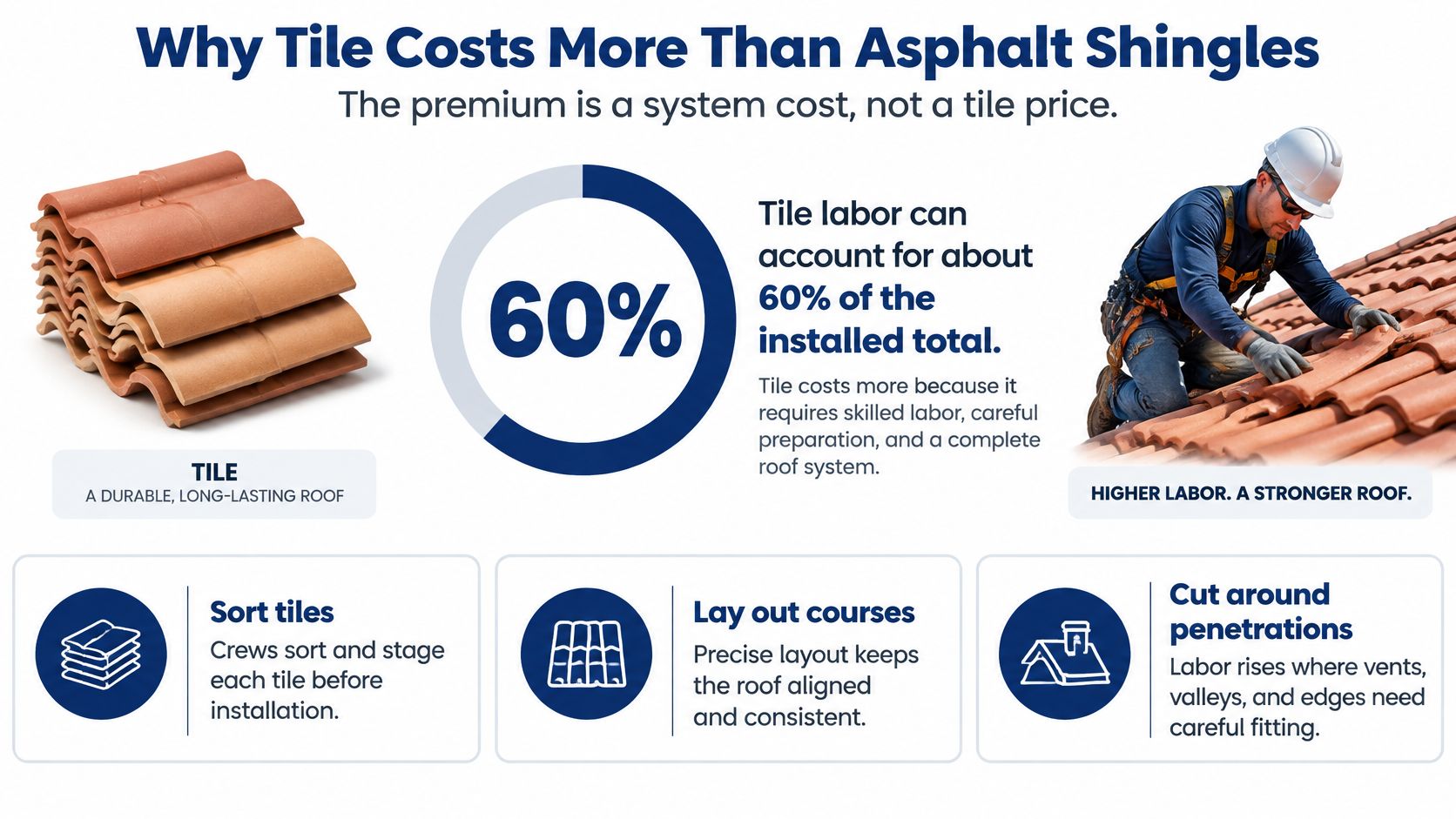
Buying tile is like buying bricks. The wall price includes mortar, scaffolding, and the mason's hours, and nobody budgets a wall from the brick price alone. A tile roof works the same way. Crews stage and sort individual pieces, snap layout lines so courses stay aligned, cut tile around vents and valleys, fasten each piece, then hand detail hips, ridges, eaves, and rakes. Asphalt shingles arrive in bundles and go down in large, forgiving courses. Tile doesn't forgive sloppy layout, so crews move slower and charge more per hour for that skill.
The Four Cost Drivers
- Heavier installation work: Every square requires more handling, staging, and lifting than shingles, which adds crew time before installation even starts.
- Specialized labor: Tile layout, cutting, and ridge work need trained installers, and fewer crews do this work well.
- Breakage allowance: Crews order extra tile for cutting waste and breakage, and every broken piece is a replacement cost you fund upfront.
- Detailing at edges and penetrations: Valleys, wall flashings, vents, and ridge caps take disproportionate time compared with open field tile.
Breakage deserves a plain explanation. Tile is rigid. It cracks when it's cut wrong, dropped, or walked on carelessly, and a cracked tile can't be patched like a shingle tab. Your quote should carry a waste factor for cuts and breakage, and you should keep a small stock of matching tile after the job for future repairs. Profiles and colors get discontinued, and hunting for a match years later costs more than storing a few pieces now.
Where quotes differ is scope. Underlayment grade, battens or direct deck attachment, valley metal, wall flashings, vents, disposal, and tear-off are often included in one bid and excluded from another. Our roof replacement covers a full tear-off and replacement for shingle, tile or metal roofs, built to code, so those items belong in the number from the start.
When two tile quotes differ sharply, the gap usually sits in labor hours and missing scope, not in the tile itself. Ask each contractor how many crew hours the price assumes and which details are included. A contractor who can't answer that hasn't really estimated your roof.
Structural Upgrades That Change the Final Price
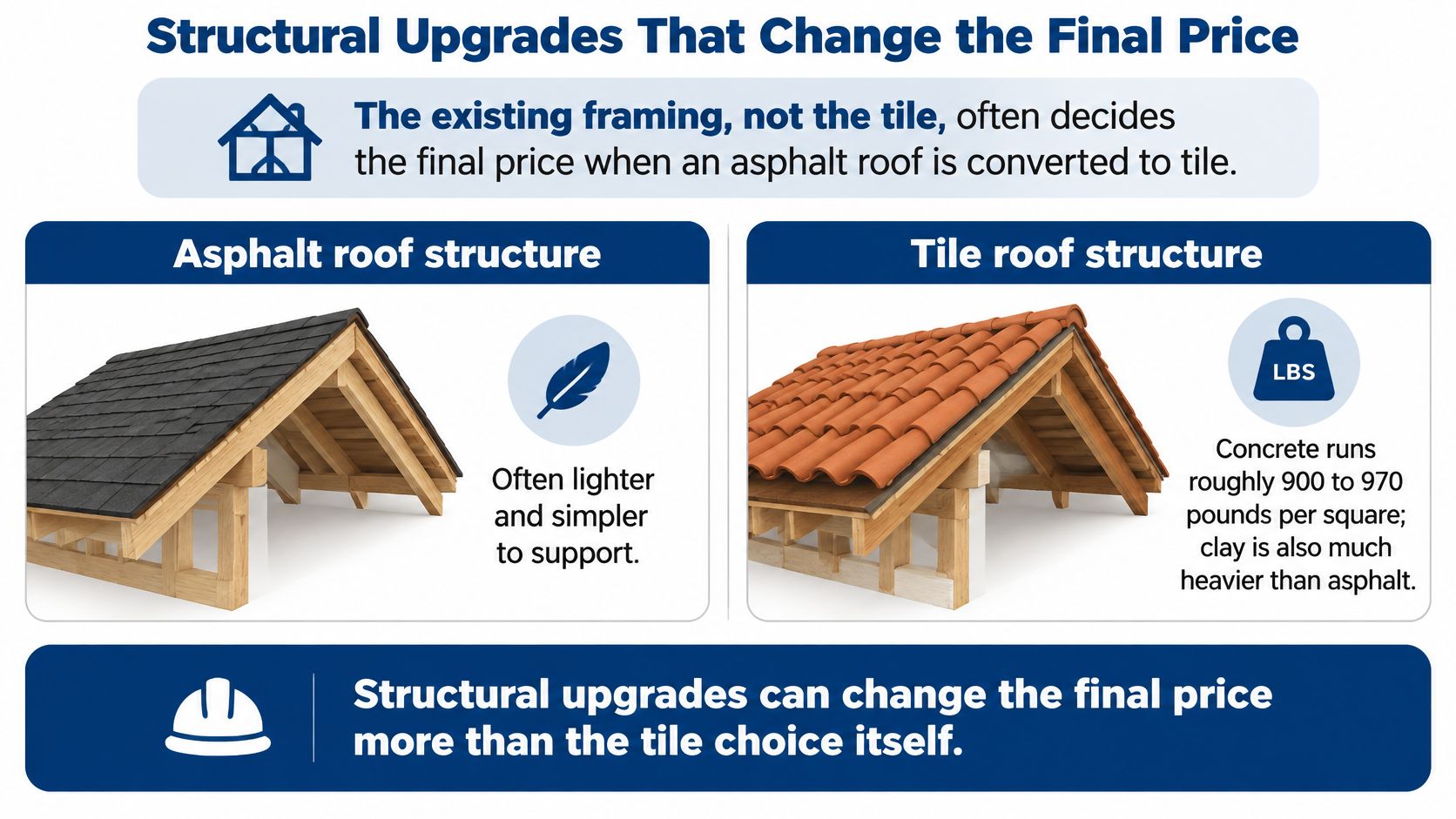
Tile can weigh several times as much as asphalt, so the framing can drive the final cost more than the tile price per square foot. Standard concrete tile weighs roughly 900 to 970 pounds per roofing square, compared with about 180 to 210 pounds per square for common architectural shingles, according to The Roofing Brief's tile-versus-shingle comparison. The comparison puts structural engineering reviews at around $300 to $800 and possible reinforcement at $2,000 to $8,000, depending on building design and jurisdiction. Those are benchmarks, not a project quote: rafters, trusses, and bearing points determine what a specific roof can carry.
| Roofing material | Weight per roofing square | Structural check needed |
|---|---|---|
| Architectural asphalt shingle | 180 to 210 lb | Confirm the existing framing and roof assembly |
| Concrete tile | 900 to 970 lb | Engineer review; reinforcement may be needed |
| Natural slate | 800 to 1,500 lb depending on thickness | Engineer review |
| Clay tile | Product-specific weight; confirm before ordering | Engineer review |
| Standing seam metal | Product-specific weight; confirm before ordering | Verify deck and fastening for the selected system |
That difference matters because the framing must support the complete roof assembly, including underlayment, battens, and mortar or foam where specified. Natural slate weighs roughly 800 to 1,500 pounds per roofing square depending on thickness, versus about 250 pounds for asphalt shingle. Clay weight varies by product and profile, so the review should use the actual tile selection rather than a generic category.
Like for Like Replacement Versus Material Conversion
Replacing tile with tile on a roof already designed for tile makes the structural question one of condition: whether rafters and decking remain sound and whether the roof has deflected or deteriorated. Converting from asphalt to tile requires a different assessment because the framing may not have been designed for that load. Complete the engineering review before ordering tile or signing a fixed-price contract.
A cheaper tile per square foot can cost more overall once structural work and code-related upgrades are included.
How the Decision Usually Plays Out
- Concrete tile on an asphalt-built home: Get an engineering review and account for possible reinforcement until the assessment establishes what the framing can carry.
- Clay tile on an asphalt-built home: Use the specific product's weight in the review because clay profiles vary.
- Lightweight tile: A lower-weight product may reduce reinforcement needs, but the engineer still needs to assess the selected assembly.
- Standing seam metal: It may be an alternative when framing cannot support tile without substantial work. Blue Lake installs standing seam metal roofing.
- Natural slate: Its weight depends on thickness, so the assessment should use the selected slate.
Compare the full conversion cost, including engineering, tear-off, framing reinforcement, underlayment, flashing, disposal, permits, and ventilation. A tile price per square foot alone does not show whether the roof needs structural work, and discovering that after tear-off can add cost when the schedule is already underway.
Slate may not require a full replacement if the stone remains sound. If flashing has failed, Blue Lake can re-flash without tearing off the field. A full slate replacement is warranted only when the stone itself is spalling across the roof.
Quote Line Items That Protect Your Budget
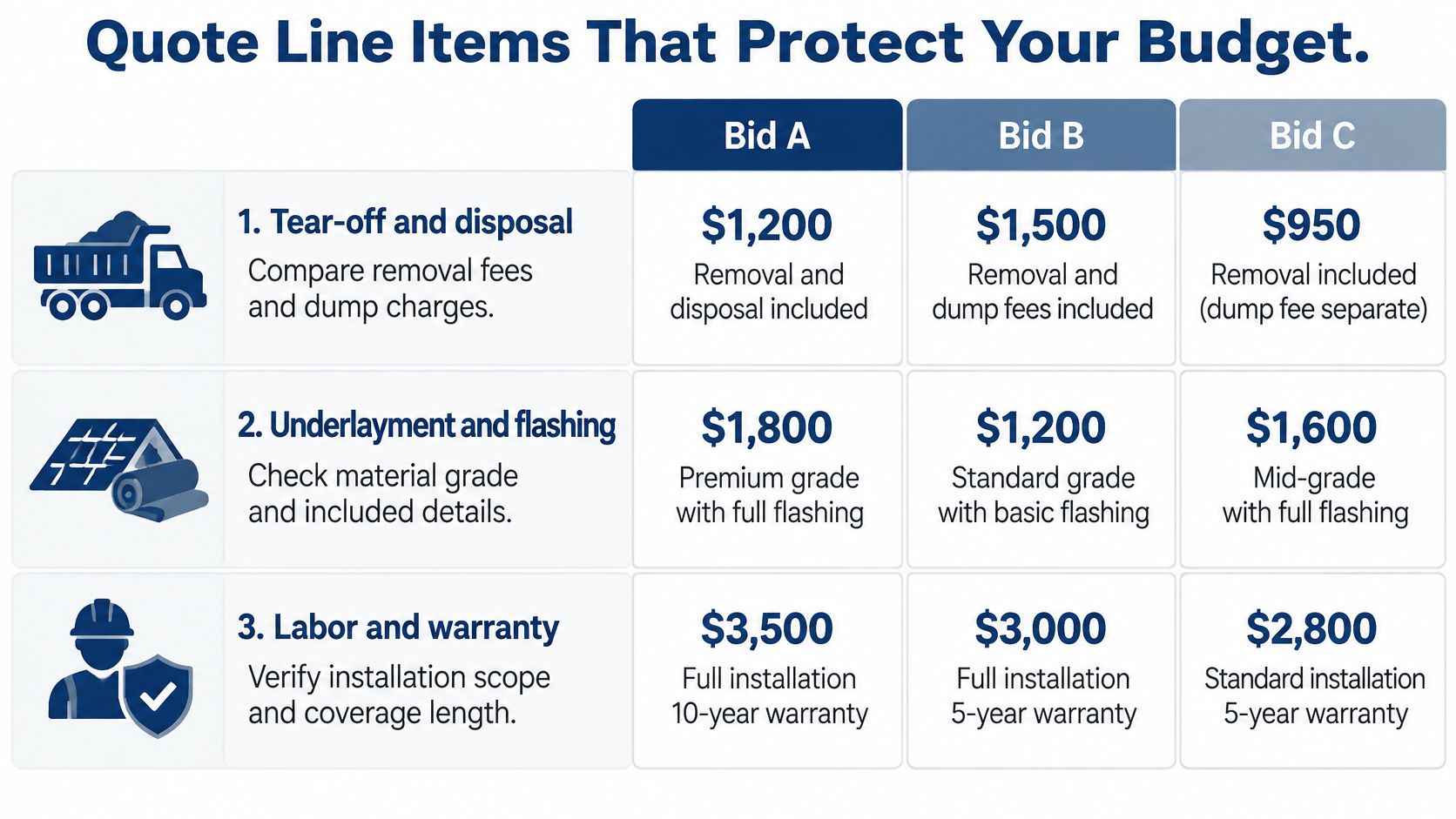
A tile quote that fits on one line protects the contractor, not you. Compare bids item by item, side by side, and treat any missing line as a cost you'll meet later as a change order.
The Checklist to Score Every Bid Against
- Engineering review: Confirms whether framing carries the selected tile, since this result can add reinforcement cost.
- Tear-off and disposal: Shows removal layers and dump fees, since old tile and multiple shingle layers cost more to haul.
- Deck repair allowance: Sets a unit price for damaged decking, since rot is only visible after tear-off.
- Underlayment: Names the product and grade, since underlayment is the primary water barrier under tile.
- Battens or direct deck attachment: Defines how tile fastens, since the method changes labor and material cost.
- Valleys and wall flashings: Details metal type and scope, since flashing failures cause most tile roof leaks.
- Eaves, rakes, vents, and ridge caps: Lists every edge and penetration detail, since these consume the most labor per foot.
- Breakage and waste allowance: States the extra tile ordered, since cuts and breakage are unavoidable.
- Permits and ventilation: Confirms code items are included, since inspectors can stop work that skips them.
- Labor and warranty terms: Separates installation hours and coverage, since a low bid often hides thin labor.
Now compare. Put Bid A, Bid B, and Bid C in columns and mark each line as included, excluded, or unclear. Call out every unclear line before you discuss price. A bid that's lower only because it excludes tear-off, disposal, or valley metal isn't lower. It's incomplete.
Price the same scope three times, or you're not comparing prices at all.
We provide a free on-site roof inspection, not a drive-by estimate, because decking, flashing condition, and framing access can't be judged from the street. Slate pricing follows the same discipline. It's given as an itemized number after an on-site assessment, never as a phone estimate. If a contractor will quote tile or slate sight unseen, ask yourself what else they're guessing about.
Sample Budgets for a 2,000 Square Foot Roof
These budgets build each row the same way, so you can see where the money enters. Base installed ranges come from the per square foot rates already covered. Each tile row adds a structural engineering review of about $300 to $800. Reinforced rows also add framing reinforcement of about $2,000 to $8,000. Those reinforced totals are computed from the stated ranges, not quoted as a single published figure.
| Scenario | Scope included | All-in budget | Expected roof life |
|---|---|---|---|
| Asphalt shingle, like for like | Tear-off, underlayment, flashing, disposal | $10,000 to $16,000 | About 20 years |
| Concrete tile, no reinforcement | Tile system plus engineering review | $14,300 to $38,800 | 50+ years |
| Concrete tile, with reinforcement | Tile system, engineering review and framing reinforcement | $16,300 to $46,800 | 50+ years |
| Clay tile, no reinforcement | Tile system plus engineering review | $22,300 to $50,800 | 50+ years |
| Clay tile, with reinforcement | Tile system, engineering review and framing reinforcement | $24,300 to $58,800 | 50+ years |
Start with the asphalt row. At $10,000 to $16,000, it's the cheapest way to get a sound, code built roof back over the house, and for many homeowners that's the correct answer. The trade-off is time. A National Association of Home Builders life expectancy study, published from research conducted in the mid-2000s and summarized in Rapid Eye Inspections' roof cost research, lists clay and concrete tile roofing among materials with an expected service life of more than 50 years, while asphalt roofing is commonly assigned an expected life of about 20 years. Slate, copper, and clay or concrete tile occupy the longest lasting category in that study.
What the Lifespan Does to the Math
Over a 50 year ownership period, an asphalt roof may require two or more replacement cycles, while a properly installed tile roof may remain within its original service life range. Run a simple scenario. Say you install asphalt at the middle of its range, then replace it twice more over five decades at future prices you can't lock in today. The cumulative spend can approach or pass a single tile installation, and you'll live through three tear-offs instead of one. Tile's case rests on that replacement cycle, not on the first invoice.
Slate extends the same logic further. A properly installed slate roof lasts 75 to 100 years or more, which is why owners of historic and premium homes accept its site quoted price. The stone outlasts the flashing and underlayment around it, so long term budgeting for slate means planning for metal and detail renewal, not a new roof.
Two Cautions Before You Bank on 50 Years
Longevity doesn't mean maintenance free. Cracked tiles, failed underlayment, flashing deterioration, storm impact, and unsuitable structural support can still create repair costs on a tile roof. Underlayment in particular may need attention before the tile does, and lifting tile to replace it is labor you should anticipate rather than discover.
Tile also doesn't protect a weak structure. If framing deflects under load, tiles crack and fasteners work loose, and your 50 year system starts failing for a reason that has nothing to do with the tile. That's why the engineering line appears in every tile row above, even the ones without reinforcement. The review is what earns the lifespan.
These totals are budgets, not bids. They assume a 2,000 square foot roof area and the stated add-ons, nothing more. Your pitch, valleys, penetrations, access, and tear-off condition will move your number inside or outside these ranges. Use them to decide which material deserves a real quote, then get that quote itemized.
Local Price Factors in Fort Worth and Nearby Cities
A lower tile price per square foot still loses if the quote skips framing, access, or city-required work. In Fort Worth and nearby cities, that missing scope is what moves the final number.
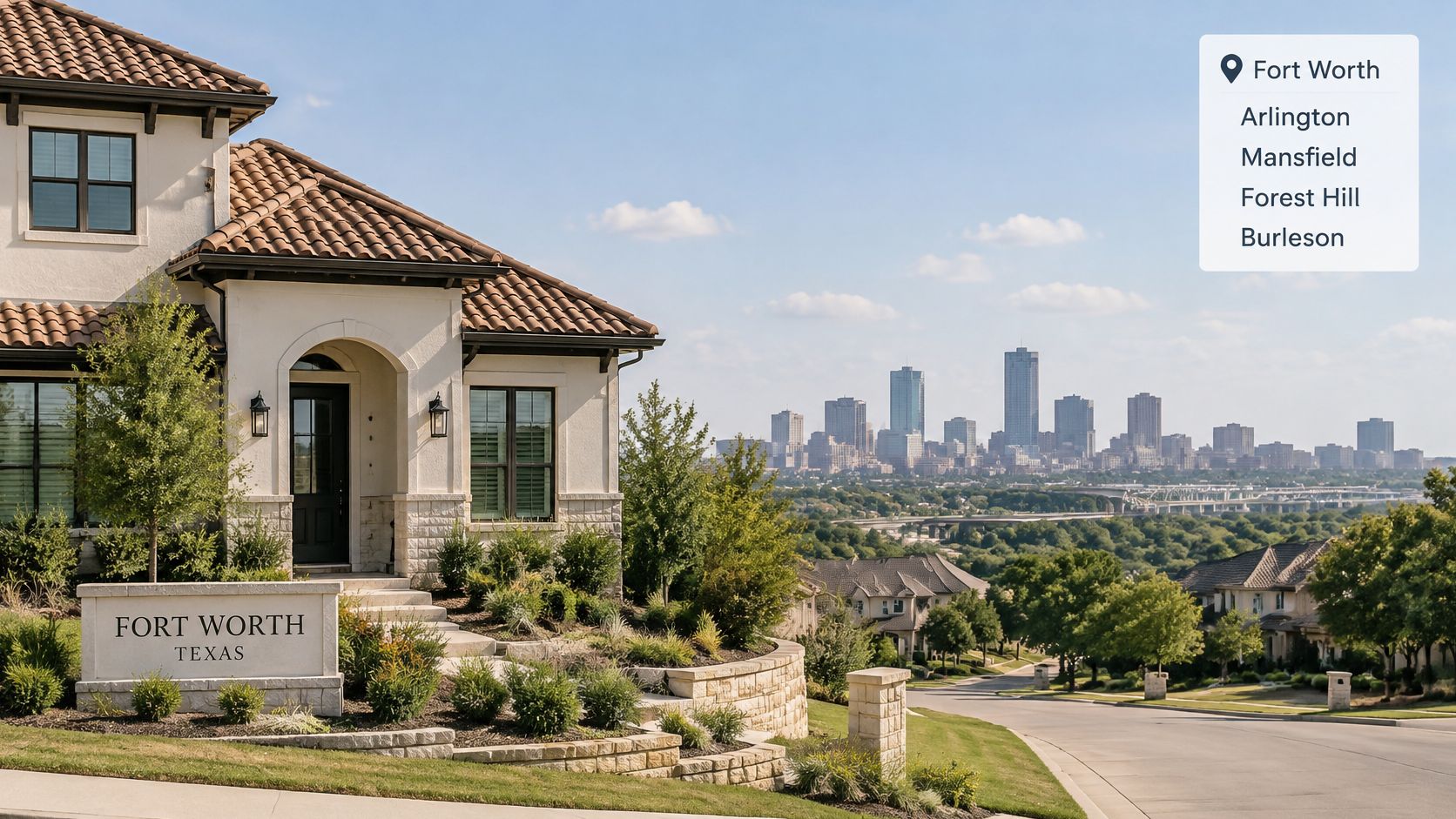
The North Central Texas Council of Governments member government list includes Fort Worth, Arlington, Forest Hill, Mansfield, Burleson, Crowley, North Richland Hills, and Saginaw in Tarrant County, as well as Dallas, Denton, Plano, Frisco, McKinney, Lewisville, and Flower Mound across Dallas, Denton, and Collin counties. Those cities are NCTCOG members. Local pricing still depends on each project's scope, permits, and access.
Document decking, framing, flashing, and tile breakage before replacement. That record separates necessary scope from optional upgrades a bid can add later. A hail-cracked tile field looks similar to foot-traffic damage from the ground, and the difference decides who pays. Put the finding in the written scope before you compare tile rates.
Code and permitting vary by city. Fort Worth, Arlington, and Plano do not run identical permit and structural requirements, so confirm your city's rules before anyone prices reinforcement or ventilation upgrades. A quote built on another city's code can change at the permit counter. That change hits your budget, not the original per square foot rate.
Insurance scope rarely matches a tile replacement on the first pass. An adjuster's estimate may price a shingle scope or miss broken tile counts, valley metal, and code items. We offer direct insurance claim assistance for storm damage, so the payout can be checked against documented findings. On a hail-damaged roof, that check uses photos, measurements, and a tile count. A drive-by look will not hold those line items in place.
Labor and access finish the local price. Steep pitches in newer Frisco and McKinney subdivisions, tight lots in older Fort Worth neighborhoods, and HOA rules on tile profile and color add crew time or limit product choice. None of that shows up in a national per square foot range. All of it shows up once the quote is itemized. I would not treat two tile bids as comparable until both list the same city requirements, access conditions, and repair scope.
Confirm Your Tile Budget Before You Sign
A lower tile price per square foot often costs more once framing work and missing line items are added. Turn the benchmarks into a firm number in this order, so the low figure has to survive the full scope.
- Measure the roof surface, including pitch. Apply the per square foot rates to measured surface area, not floor area. That first range is the only one worth comparing.
- Run an online cross-check. The website offers a Roof Cost Calculator. Treat the result as a starting point, not a bid.
- Book a structural review with a qualified engineer before choosing tile. The load result decides whether reinforcement belongs in the budget, and that decision can reorder every material option.
- Request an on-site inspection and an itemized quote. Blue Lake offers a free on-site roof inspection and a free roofing estimate. Score each bid against the full line-item checklist and flag every missing detail.
- Confirm warranties in writing. Roof replacements come with manufacturer and workmanship warranties. Compare coverage length against each option's expected roof life before you sign.
My recommendation: If the structure is unverified, hold off on ranking final prices. One missing reinforcement line can change which bid actually wins.
Pay for reinforcement only when the engineer requires it, and keep that framing work inside the signed price. The cheapest tile quote stays cheap only if the engineer's report leaves its scope intact.
Homeowners and property managers in Fort Worth, Arlington, Mansfield, Dallas, Plano, Frisco, Denton, and across Tarrant, Dallas, Denton, and Collin counties can get a free on-site roof inspection and a free roofing estimate from Blue Lake Roofing & Remodeling. Have a qualified engineer answer the structural question before tile is priced.
If you are weighing concrete or clay tile against asphalt or metal, start with that inspection and an itemized quote, then put the engineer's framing result into the budget so the number covers the whole project, not just the tile. Visit Blue Lake Roofing & Remodeling to request your free estimate and run your numbers through the Roof Cost Calculator before you sign.
