

Cost of Tile Roofing in Fort Worth and Nearby DFW Cities
For a 2,000-square-foot roof, installed tile roofing commonly benchmarks at $18,000 to $44,000, with concrete tile typically costing 30% to 45% less than clay tile. In Fort Worth, the final cost depends just as much on the roof assembly, structural capacity, underlayment, flashing, and storm-related repairs as it does on the tile itself.
You may be comparing a tile roof with architectural shingles after a hailstorm, or staring at an aging roof and wondering whether the higher upfront investment is justified. The answer isn't found in a single national average. A Fort Worth estimate needs to show what you're paying for, where the number can move, and whether the existing structure can support the selected material.
Table of Contents
- What Tile Roofing Really Costs in Fort Worth
- National and Texas Price Ranges for Tile Roofs
- Clay Tile vs Concrete Tile at a Glance
- The Line Items That Change a Fort Worth Tile Bid
- A Realistic Tile Roofing Budget for a Fort Worth Home
- Lifecycle Cost and Long-Term Value in North Texas
- Getting an Accurate Tile Roofing Estimate in Fort Worth
What Tile Roofing Really Costs in Fort Worth
A tile roof is a complete system, not a stack of tiles priced by the home's interior square footage. Estimators calculate the sloped roof surface, then account for tear-off, disposal, deck condition, underlayment, flashing, ventilation, fasteners, labor, permits, and any structural work. That distinction explains why two homes with similar living areas can receive very different bids.
For a DFW homeowner, the practical starting point is the $18,000 to $44,000 installed benchmark for a 2,000-square-foot roof, before unusual structural repairs. The range comes from installed pricing of approximately $9 to $22 per square foot, including common system components such as tear-off, underlayment, battens, ridge components, and valley flashing, as reported in this tile roofing cost comparison. A separate nationwide cost collection reported installed tile-roof prices from $8,550 to $24,650, while Texas projects ranged from approximately $5,320 to $22,000, illustrating how market, climate, labor, roof complexity, permitting, and material selection affect the result. Those figures are summarized in this national and Texas tile-roof cost data.
Why the first number feels high
Concrete tile generally offers the more accessible entry point. Clay tile carries higher material and manufacturing costs, and one industry comparison reported concrete tile costing roughly 30% to 50% less than clay tile for product and installation. The same comparison gave installed ranges of approximately $1,100 to $1,950 per roofing square for concrete and $1,450 to $2,650 per square for clay, where one roofing square equals 100 square feet. See the Eagle tile roofing comparison for the underlying material and service-life discussion.
The high cost of entry matters in Tarrant County because tile installation may expose conditions that a shingle replacement would handle differently. A roof can need deck replacement, upgraded ventilation, new flashing, storm-damage repairs, or structural verification before tile installation begins.
Practical rule: Don't compare a tile-only material price with a complete shingle replacement proposal. Compare complete roof assemblies.
Fort Worth should lead the service-area discussion, but homeowners also search for tile roofing in Arlington, Dallas, Plano, Irving, Denton, Richardson, and Grapevine. The Fort Worth and Arlington division includes Tarrant, Parker, Johnson, Hood, Somervell, and Wise counties, while the Dallas, Plano, and Irving division includes Dallas, Collin, Denton, Ellis, Hunt, Kaufman, and Rockwall counties, according to the Texas Comptroller's Metroplex regional breakdown.
National and Texas Price Ranges for Tile Roofs
National pricing is useful for orientation, but it isn't a substitute for a Fort Worth site inspection. A roof with simple planes, good access, sound decking, and limited penetrations can fall near the lower portion of a range. Multiple valleys, dormers, chimneys, skylights, steep pitches, difficult staging, and damaged deck areas push the project upward.
The following comparison uses the available installed ranges. It should be read as a budgeting framework, not a promise of what any particular Fort Worth contractor will charge.
| Material | National Installed Range | Texas Installed Range | Cost Per Square Foot Installed |
|---|---|---|---|
| Tile roofing, material varies | $8,550–$24,650 | Approximately $5,320–$22,000 | Approximately $9–$22 |
| Concrete tile | Approximately $1,100–$1,950 per square | Varies by project and market | Material-specific, included within installed range |
| Clay tile | Approximately $1,450–$2,650 per square | Varies by project and market | Material-specific, included within installed range |
The national and Texas totals come from the MyHomeQuote tile roofing cost collection, while the installed per-square-foot benchmark comes from the NearbyHunt roofing cost analysis. The concrete and clay per-square ranges come from the Eagle product comparison.
Translating the bid into roof measurements
Roofing contractors use a square, which represents 100 square feet of roof surface. A homeowner looking at a 2,000-square-foot floor plan shouldn't assume the roof contains exactly 20 squares. Roof pitch, overhangs, attached garages, porches, hips, valleys, and roof transitions all change the actual measured area.
That measurement issue is one reason material-only pricing causes confusion. A bundle or pallet price doesn't include the labor required to carry, cut, place, fasten, and detail tile. It also doesn't account for the underlayment and metal work that keep water moving through valleys and around penetrations.
Why Texas pricing doesn't match every national quote
Texas sits inside a wide national pricing curve rather than matching the highest coastal markets. The nationwide collection listed regional ranges of $11,000 to $30,000 in California, $11,000 to $23,500 in Florida, and $6,850 to $27,000 in Arizona, showing how regional labor, climate, permitting, access, and product selection affect the final cost.
For Fort Worth, the relevant comparison is a local scope with local labor, local permitting requirements, and a roof assembly appropriate for North Texas conditions. A credible proposal should identify the underlayment specification, flashing scope, ventilation work, structural review, and disposal rather than presenting an attractive material number without the supporting details.
Clay Tile vs Concrete Tile at a Glance
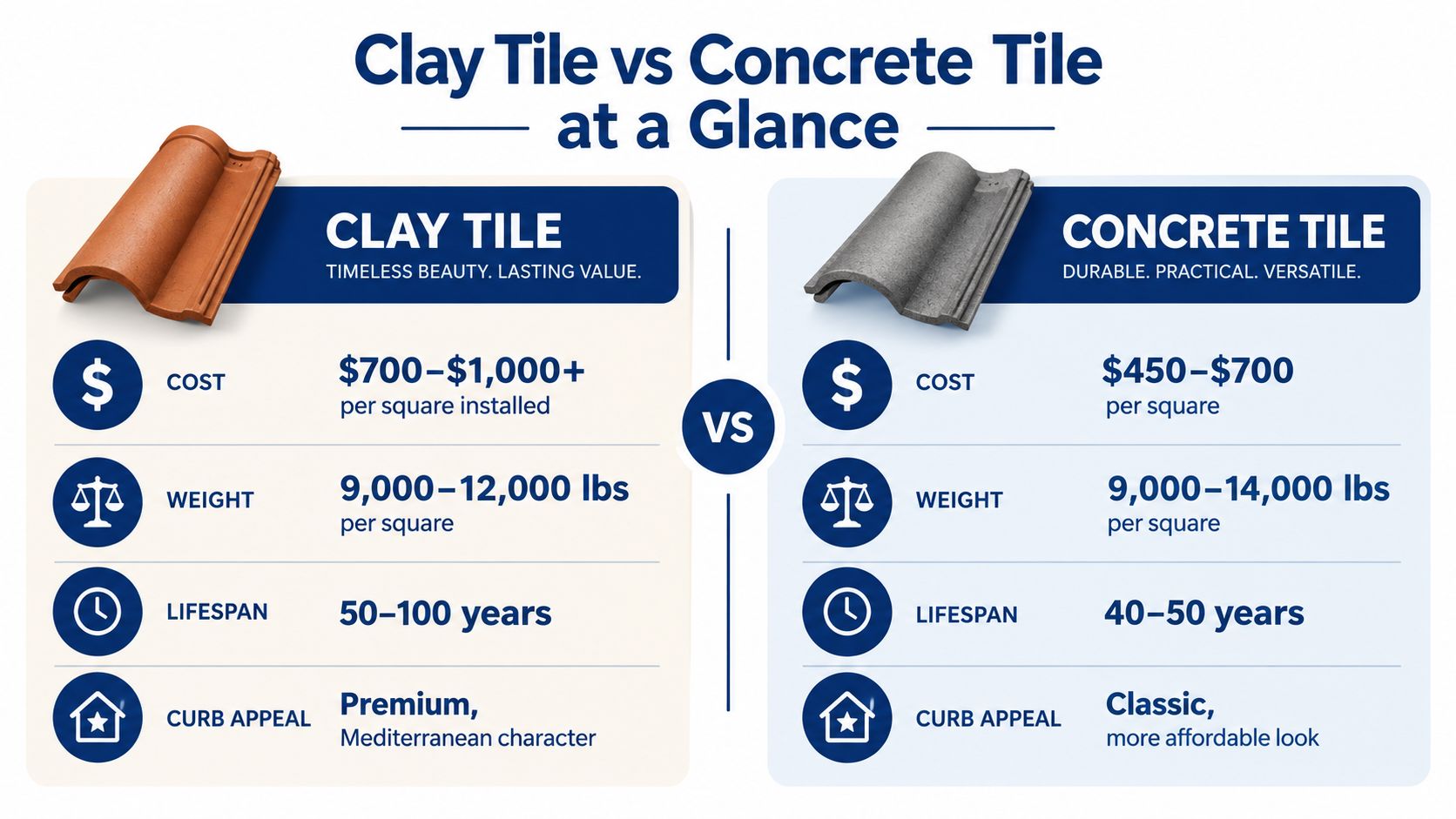
Clay and concrete tile can both create a durable, architecturally distinctive roof, but they don't make the same financial or structural choice. Clay typically commands the higher price and offers a premium appearance, while concrete gives homeowners more profile and color flexibility at a lower material cost in many applications.
Weight deserves attention before aesthetics. One industry comparison reports concrete tile at roughly 8 to 12 pounds per square foot and notes that structural verification may be needed before a retrofit. The exact dead load depends on the selected product and assembly, so an estimator shouldn't use a generic weight figure as a substitute for reviewing the framing.
| Consideration | Clay tile | Concrete tile |
|---|---|---|
| Price | Higher initial investment in many applications | Typically less expensive than clay |
| Structural demand | Requires verification for the selected assembly | Also requires verification because tile is substantially heavier than asphalt |
| Service life | Common benchmarks place it around 50–100 years | Common benchmarks place it around 40–75 years |
| Appearance | Premium character, often suited to Mediterranean or historic designs | Broad range of profiles and colors, often a more accessible design choice |
| Maintenance | Tile can last for decades, but underlayment and flashing still need attention | Same system-level maintenance issue, with individual tile replacement possible |
The service-life ranges are summarized in this roofing lifecycle cost analysis. They describe expected functional life, not a guarantee that every component will remain untouched for the same period.
Fort Worth homeowners often focus first on the color, barrel profile, or neighborhood appearance. That makes sense, especially for a custom home, but the first technical question should be different:
Can the existing framing and decking support the complete tile assembly, including the selected tile, battens or fastening system, underlayment, and accessories?
If the answer requires reinforcement, that cost belongs in the decision before anyone orders materials. The right choice depends on the budget, the architectural character you want, and the structure already built over the home.
The Line Items That Change a Fort Worth Tile Bid
A tile estimate becomes easier to judge when each layer appears separately. A low total can just mean the contractor left out work that another contractor included.
Start below the visible surface
Tear-off and disposal cover removal of the existing roofing and transport of debris. Costs rise when the roof has multiple layers, difficult access, heavy tile handling, or storm-damaged material that requires careful removal.
Deck inspection and repairs come next. Older Tarrant County homes can have soft decking around valleys, eaves, plumbing penetrations, or areas exposed to long-term leaks. No contractor can accurately price every concealed deck condition before removal, but the proposal should state the inspection method and the unit basis for approved replacement.
Underlayment is a major system decision. Synthetic products, high-temperature peel-and-stick membranes, and other tile-rated assemblies don't provide identical performance or installation requirements. The estimate should name the product or specification, identify coverage at valleys and penetrations, and explain whether battens or direct-to-deck fastening will be used.
Detail the water-shedding components
Flashing protects the transitions where tile meets walls, chimneys, skylights, valleys, and roof penetrations. Tile cuts alone don't solve those details. A bid that lists “flashing as needed” without identifying the affected areas leaves too much room for change orders.
Ventilation can include ridge ventilation, intake improvements, or mechanical equipment where appropriate. The correct solution depends on the existing attic and roof design, so a contractor shouldn't add a product just to make the estimate look complete.
| Line Item | Typical Cost Range | When It Spikes |
|---|---|---|
| Tear-off and disposal | Site-specific | Multiple layers, limited access, heavy existing materials |
| Decking | Site-specific allowance | Soft or water-damaged panels discovered during removal |
| Underlayment | Product and assembly dependent | Premium membranes, extensive valley or low-slope detailing |
| Flashing | Roof-detail dependent | Chimneys, walls, skylights, valleys, and complex transitions |
| Ventilation | Existing-attic dependent | Inadequate intake, unusual roof design, or required upgrades |
| Structural review or reinforcement | Engineering and framing dependent | Existing structure cannot support the selected tile assembly |
| Permits and site protection | Local and project dependent | Larger scopes, special access, extended disposal needs |
The most important line isn't always the largest one. A structural review can prevent a homeowner from approving a tile order before learning that reinforcement is necessary. Tile should be evaluated as a complete assembly, especially when replacing asphalt with a materially heavier system.
A written proposal should also address permit handling, dumpster placement, driveway protection, daily cleanup, and a final magnet sweep. Those details affect the homeowner's experience even when they don't change the tile color or profile.
A Realistic Tile Roofing Budget for a Fort Worth Home
A useful worked example starts with a 2,000-square-foot roof, not a 2,000-square-foot house. The cited installed ranges imply approximately $18,000 to $39,000 for concrete tile and $22,000 to $53,000 for clay tile, before unusual structural or repair conditions are added. Those calculations come from the Eagle comparison's installed per-square ranges.
For a simple Fort Worth roof with limited penetrations and sound decking, the lower and middle parts of those ranges may be more relevant. A complicated roof with several valleys, difficult access, storm damage, or structural work can move toward the upper end or beyond the basic benchmark.
| Cost Category | Concrete Tile | Clay Tile |
|---|---|---|
| Tile and accessory materials | Lower material entry point in many applications | Higher material and manufacturing cost |
| Tear-off and disposal | Depends on existing roof and access | Depends on existing roof and access |
| Underlayment | Specified tile-rated assembly | Specified tile-rated assembly |
| Flashing and valley work | Based on roof details | Based on roof details |
| Ventilation | Based on attic and code requirements | Based on attic and code requirements |
| Structural upgrades | Only where review identifies a need | Only where review identifies a need |
| Permits and site protection | Project and municipality dependent | Project and municipality dependent |
| Total budgeting range for 2,000-square-foot roof | Approximately $18,000–$39,000 before unusual conditions | Approximately $22,000–$53,000 before unusual conditions |
A two-story home generally takes more handling and staging than a single-story home. Roof pitch, valley count, penetrations, access for material delivery, and whether the framing already supports tile all influence labor and accessory quantities.
Don't accept a blended total without a scope. Every bid should give equal treatment to the roof measurement, tile product, tear-off, deck allowance, underlayment, battens or fastening system, flashing, ventilation, structural work, permits, disposal, and workmanship warranty. That is how you compare two estimates without mistaking an omission for a bargain.
Lifecycle Cost and Long-Term Value in North Texas
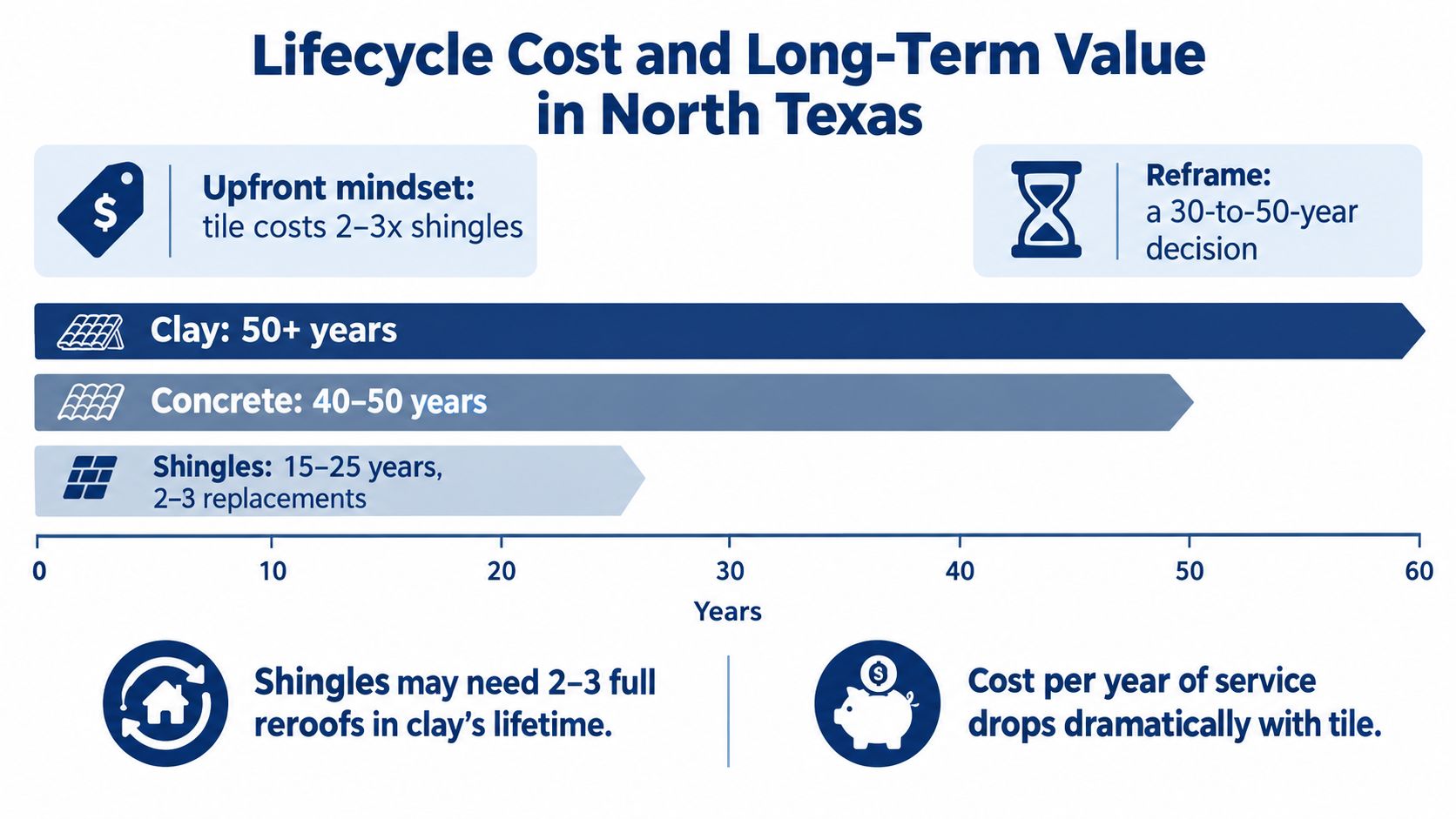
The cost of tile roofing makes more sense when you treat it as a long-term ownership decision rather than a one-time material purchase. The tile itself may remain serviceable while the underlayment, flashing, ridge details, or other water-shedding components require attention earlier.
A comparison cited by the National Association of Home Builders and Bank of America reported a 75-year life expectancy for concrete roof tile. Another analysis summarized expected functional lives of approximately 68 years for clay and 52 years for concrete, while broader benchmark ranges place concrete around 40 to 75 years and clay around 50 to 100 years. These figures describe expected service life, not a maintenance-free promise.
The layer beneath the tile matters
One industry comparison notes that tile can last 75 years or more while underlayment may degrade in roughly 30 to 40 years, depending on the system and conditions. That creates an important distinction for North Texas homeowners. A roof may not need complete tile replacement just because the underlayment needs renewal.
The visible tile can outlast the waterproofing components beneath it. A proper inspection should identify which layer failed before anyone recommends a complete reroof.
Lifecycle budgeting should include the initial installation, future underlayment work, flashing maintenance, broken-tile replacement, storm damage, financing, inflation, and the time value of money. A simple example from a roofing lifecycle calculator shows a $40,000 clay installation lasting 75 years equating to roughly $533 per year when spread without discounting. That calculation excludes maintenance and future cost changes, so it isn't a promised annual ownership cost.
Energy performance also needs careful assumptions. A life-cycle study reported 10.98% air-conditioning energy savings for concrete roof tiles with fiberglass insulation in its tested system, while another analysis modeled cooling reductions of 12% to 18% for white clay tile in hot-dry Phoenix and 7% to 11% in hot-humid Houston. Those results shouldn't be transferred automatically to every Fort Worth home because color, attic insulation, ventilation, roof assembly, and weather all affect performance. The tested tile-roof energy study supports a scenario-based discussion, not a universal payback promise.
Hail, wind, thermal cycling, and maintenance traffic can still break individual tiles or damage surrounding components. Ask your insurance carrier whether the selected assembly affects coverage or premiums, and get the answer for your specific policy rather than assuming tile automatically produces savings.
The right question isn't whether tile costs more today. Ask whether your budget prioritizes the lowest initial bid or the lowest expected annual cost over the life of the home.
Getting an Accurate Tile Roofing Estimate in Fort Worth
A serious tile estimate starts with a contractor who understands the difference between replacing shingles and rebuilding a tile assembly. That distinction matters after hail events, when storm chasers may price quickly from the street while local crews assess the roof, deck, flashing, and underlying damage in person.
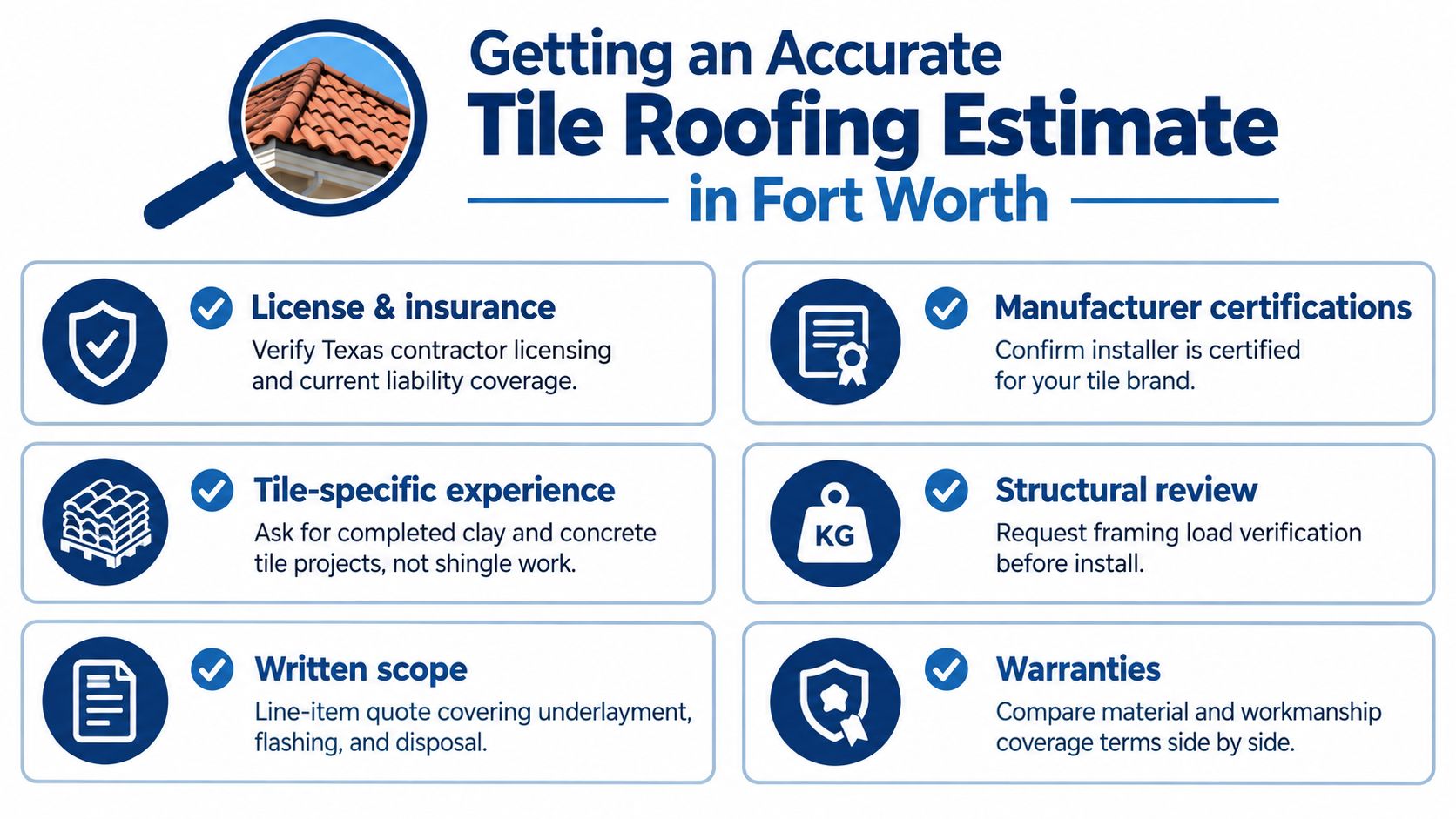
Use a tile-specific checklist
- License and insurance: Verify the contractor's current business credentials and liability coverage before work begins.
- Manufacturer certifications: Ask whether the installer is certified for the selected product. Examples homeowners may encounter include Eagle, Boral, and Ludowici.
- Tile-specific experience: Request completed clay and concrete tile addresses in Fort Worth, Arlington, Tarrant County, or nearby DFW communities. Shingle experience alone isn't enough.
- Structural review: Ask who evaluates framing capacity and what documentation you receive if reinforcement is recommended.
- Written scope: Require separate lines for tear-off, deck inspection, underlayment type, batten system, flashing, ventilation, structural reinforcement, disposal, permits, and tile-specific labor.
- Warranty paperwork: Compare manufacturer coverage with workmanship coverage, and ask who handles registration when registration is required.
Ask the estimator how the crew protects tile during installation and later maintenance. Tile can crack under careless foot traffic, and the repair may address only the visible piece while leaving an aging underlayment or flashing problem untouched. Also ask for the anticipated timeline, cleanup plan, change-order process, and the names of the people supervising the work.
A proposal built for asphalt often uses broad labels such as “roofing materials,” “flashing as needed,” or “repair decking as needed.” Those phrases aren't automatically wrong, but they don't give you enough information to compare tile systems. Get two or three estimates, place them side by side, verify references, and confirm that each contractor measured the same sloped roof surface.
Blue Lake Roofing & Remodeling provides on-site estimates for tile roofs, tile repairs, and underlayment replacement across its DFW service area. To discuss a Fort Worth or nearby North Texas project with a contractor familiar with specialty roofing and storm-damage scopes, visit Blue Lake Roofing & Remodeling and request an inspection.
