
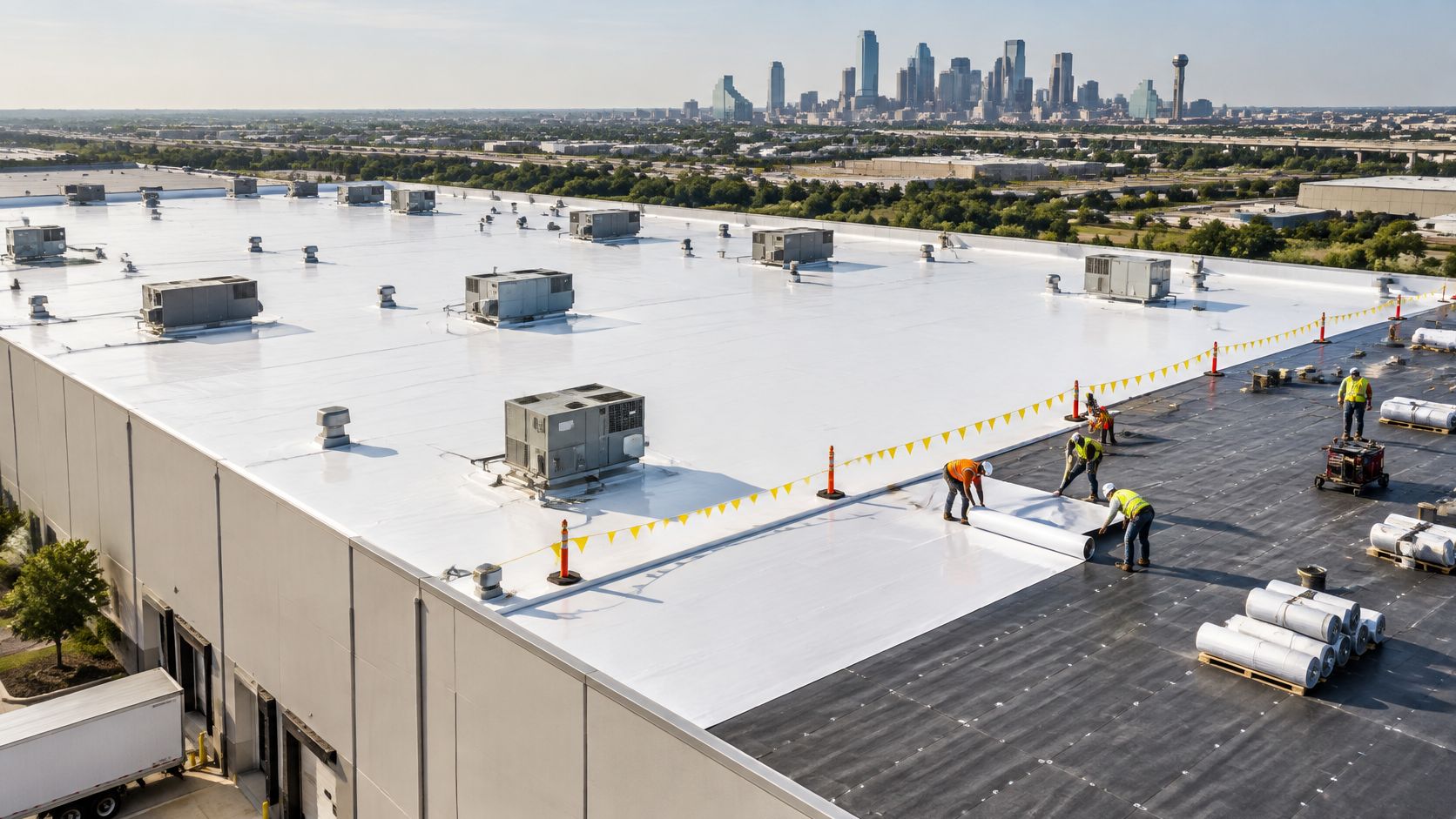
Commercial Roof Replacement in Fort Worth and DFW
The most common advice on a commercial roof replacement is to compare membranes, chase a long warranty, and take the lowest bid. That advice fails owners in Fort Worth, Arlington, and the rest of the Metroplex. A sheet of TPO, EPDM, or metal is the raincoat. Drainage, insulation, attachment, and how an occupied building stays open are the lining. Skip those, and a cheap bid becomes the expensive roof.
A 2025 Nationwide survey found that two-thirds of commercial-property stakeholders were worried about severe-weather impacts, while only 33% reported conducting building assessments. Worry without a file does not help an insurer, a lender, or a tenant who cannot take a wet ceiling. I would start with the capital path, not the product photo. Decide whether you replace, recover, repair, or phase the work, then write the drainage and continuity rules into the bid. Hail, wind, and hard rain across Tarrant County do not care which brochure looked cleanest.
Table of Contents
- Replace Recover or Repair Before You Bid in Fort Worth
- Choosing TPO EPDM or Metal for Fort Worth and Arlington
- Fort Worth Specs Drainage and Cool Roof Rules
- Fort Worth Lead Time and Inspection Booking
- How to Phase Work on Occupied Fort Worth Roofs
- Fort Worth Warranties After Hail and Ponding
Replace Recover or Repair Before You Bid in Fort Worth
A Fort Worth, Arlington, or Grand Prairie owner is not choosing a color. The choice is full replacement, recover, targeted repair, or phased replacement. Market reporting on roof-panel replacements indicates that renovation represents 57.7% of roof-panel replacement demand, and replacement work is growing faster than repair as aging buildings hit retrofit triggers. Replacing immediately is not always the best use of cash. A cheap recover is false economy when moisture, flat spots, or a coming HVAC and solar package are ignored.
| Path | When it fits | When it fails | Disruption |
|---|---|---|---|
| Full replacement | Wet insulation, failed field membrane, poor slope, or a code-deficient assembly | Only isolated flashings leak and the deck and insulation test dry | Highest; phase occupied sites |
| Recover | Dry, attached roof; code and manufacturer still allow another layer; drainage is acceptable | Concealed moisture, too many layers, ponding, or planned new penetrations | Medium if the old roof stays |
| Targeted repair | A few seams or flashings on a still-serviceable field membrane | Repeat leaks or saturated insulation | Lowest; needs a monitor plan |
| Phased replacement | Large occupied campus with mixed roof conditions | Active leaks across the whole roof that cannot wait for zones | Spread by drainage basin and tenant |
The recover that looks cheap
Full replacement tears off to a sound deck when a moisture survey finds wet insulation, the field membrane has failed, water will not leave the roof, or the build-up cannot meet current code. A recover keeps a dry, well-attached system and adds one new membrane only when cores and scans are clean and both the manufacturer and the local code still allow another layer. Targeted repair fits a handful of flashings or seams when the field is still serviceable and you have a written monitor plan. Phased replacement splits a large occupied site, such as a Grapevine warehouse or a Mansfield retail center, into zones.
The row that surprises owners is the recover. The bid is lower because tear-off and disposal stay off the page. If insulation is wet, that saving is borrowed money. Trapped moisture cooks the new sheet, blisters seams, and can void the warranty you thought you bought. The same trap hits when a solar array or new rooftop units will punch the roof next year.
Practical rule: Photos of a dry-looking surface do not prove a roof is dry enough for another layer.
Compare the four paths on leak history, wet-insulation findings, remaining life, tenant disruption, financing, energy goals, and warranty limits. Order destructive testing, cores or a scan plus a few cuts, when pictures cannot prove the assembly. Before you call bidders, write a one-page path choice. State which paths you rejected and what still must be verified: moisture, slope, layer count, and any HVAC or solar penetrations. If several property managers are calling about the same leak, keep the inquiry trail straight with call tracking options for roofing companies so the right building, not a mixed voicemail box, gets the scope.
Choosing TPO EPDM or Metal for Fort Worth and Arlington
Treat the membrane as the raincoat and the insulation plus slope as the lining. The system has to match the building, not a brochure photo. Three defaults cover most DFW commercial work, and one condition should flip each default.
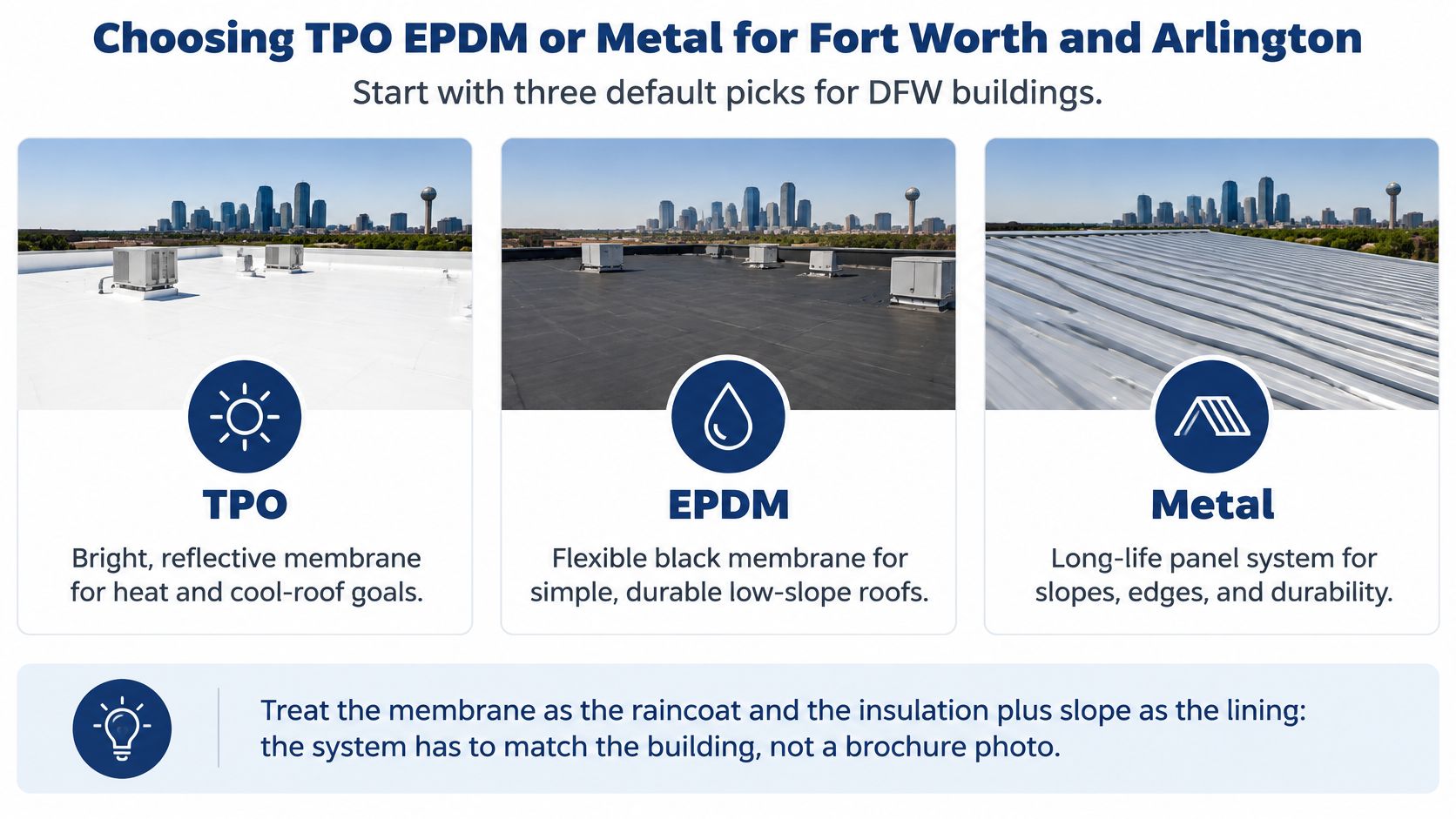
TPO, a light thermoplastic sheet with heat-welded seams, is the practical default for cooling-dominated low-slope offices, clinics, and big-box retail in Fort Worth, Arlington, and Dallas when a reflective surface is part of the spec. EPDM, a synthetic rubber sheet that is usually black, suits large simple roofs in Grand Prairie and Irving where durability matters more than a white face. It runs hotter unless you deliberately specify a reflective coating. Standing-seam metal fits sloped commercial roofs, canopies, and mixed-use buildings in Denton, Plano, and parts of Fort Worth, where mechanical seams and long service life outweigh a higher first cost.
| System | Best local fit | Heat behavior | Seams and details | Watch-outs |
|---|---|---|---|---|
| TPO | Low-slope offices, retail, and warehouses in Fort Worth, Arlington, and Dallas that want a reflective roof | Typically white or light; supports a cool-roof spec | Heat-welded field seams; flashings need skilled welding | Foot traffic and thin sheets puncture; weld quality varies by crew |
| EPDM | Large, simple low-slope roofs where a dark rubber sheet is acceptable | Usually black and hotter unless coated | Factory sheet with taped or adhered field seams | Ponding and poor seam tape show up in North Texas rain |
| Standing seam metal | Sloped roofs, canopies, and mixed-use in Denton, Plano, and Fort Worth | Light coatings can reflect; dark finishes absorb heat | Mechanical seams and fewer field welds | Higher first cost; hail can mark finishes even when the panel stays watertight |
What should switch the default
A white sheet does not set service life by itself. Before you lock a system, walk puncture and foot-traffic risk, hail cosmetics versus functional holes, grease or chemical exposure, steel versus concrete deck, and whether rooftop units come out in the same project. Switch from TPO to metal when the roof is sloped or carries heavy mechanical traffic that will chew a single-ply sheet. Choose EPDM only when a dark surface is acceptable and drainage is already verified. If the roof ponds, neither a black sheet nor a white one fixes the slope.
Membrane thickness, metal gauge, clip spacing, and finish are set job by job. Make every bidder write them down. A 45-mil sheet and a 60-mil sheet are not the same bid, and a 24-gauge panel is not a 26-gauge panel. Attachment is part of that sentence. Plates and fasteners have to match the deck and the wind exposure on the permit set. Crews ordering low-slope plates and screws can shop TRUFAST fasteners at Contractor's Den so the bucket on the roof matches the attachment pattern in the submittal, not whatever was left from the last job.
Ask for thickness, gauge, clip spacing, and fastener pattern in writing before you compare prices.
Grease over a restaurant hood will attack some sheets faster than sun will. A concrete deck in an Irving warehouse fastens differently than a steel deck in Arlington. Name those conditions in the scope so the default stays a default, not a guess.
Fort Worth Specs Drainage and Cool Roof Rules
A reflective roof can help control cooling costs, but color is a poor substitute for a sound roof assembly. The Department of Energy's cool roof fact sheet says cool roofs can reduce annual air-conditioning energy use by up to 15% in some cooling-dominated buildings. Reported commercial savings can reach about $0.20 per square foot a year when reflectance, insulation, utility rates, and HVAC efficiency align. Light-colored roofs absorb less solar heat than dark roofs. High solar reflectance rejects more sunlight, while high thermal emittance helps release absorbed heat. White coating over a thin, leaking assembly will not fix its insulation or drainage.
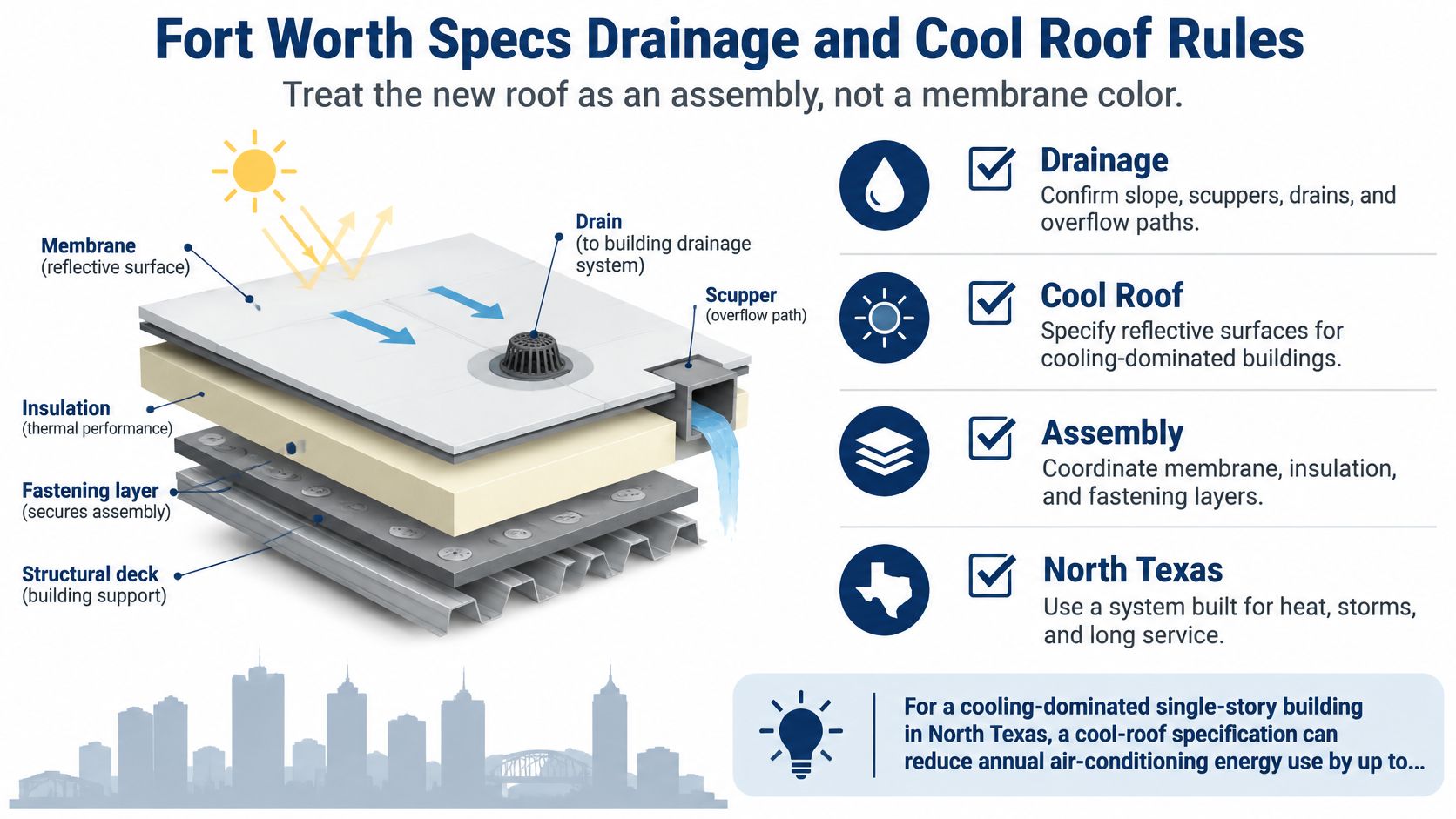
Hand this checklist to every bidder
Specify the roof assembly, not just the membrane color. Record aged solar reflectance, thermal emittance, or Solar Reflectance Index. Compare expected cooling savings with any winter heating penalty before choosing TPO, coated metal, or another reflective system. Savings are most relevant when the building is cooling-dominated and the project also improves insulation or air leakage.
- Positive drainage: Water must leave the roof. Where the deck ponds, price tapered insulation and show how it will direct water to drains or scuppers.
- Secondary drainage: Include overflow scuppers or a second drain path where the applicable city code requires it. A clogged primary drain should not send water into the building.
- New flashings: Rebuild flashings at every curb, pipe, and wall. Reusing brittle metal leaves a known failure point in the new assembly.
- Wind attachment: Specify perimeter securement, edge metal, and fastener or adhesive patterns for the building's exposure, height, and deck.
- Energy-code insulation: Set the R-value to the energy code in force when the permit is issued, rather than matching the roof being removed.
- Hail and rain: Put impact resistance and seam quality in the specification for roofs across Tarrant, Denton, and Collin counties. A product label does not prevent a claim or replace a properly welded or locked seam.
Itemize the price drivers so bids cover the same work: deck-repair allowance per square, taper plan, membrane thickness, attachment method, flashing count, edge metal, and cool-roof documentation. If one bid includes tapered insulation and another prices a flat recover, the difference is not just price. It is a different drainage plan and a different ownership risk.
Fort Worth Lead Time and Inspection Booking
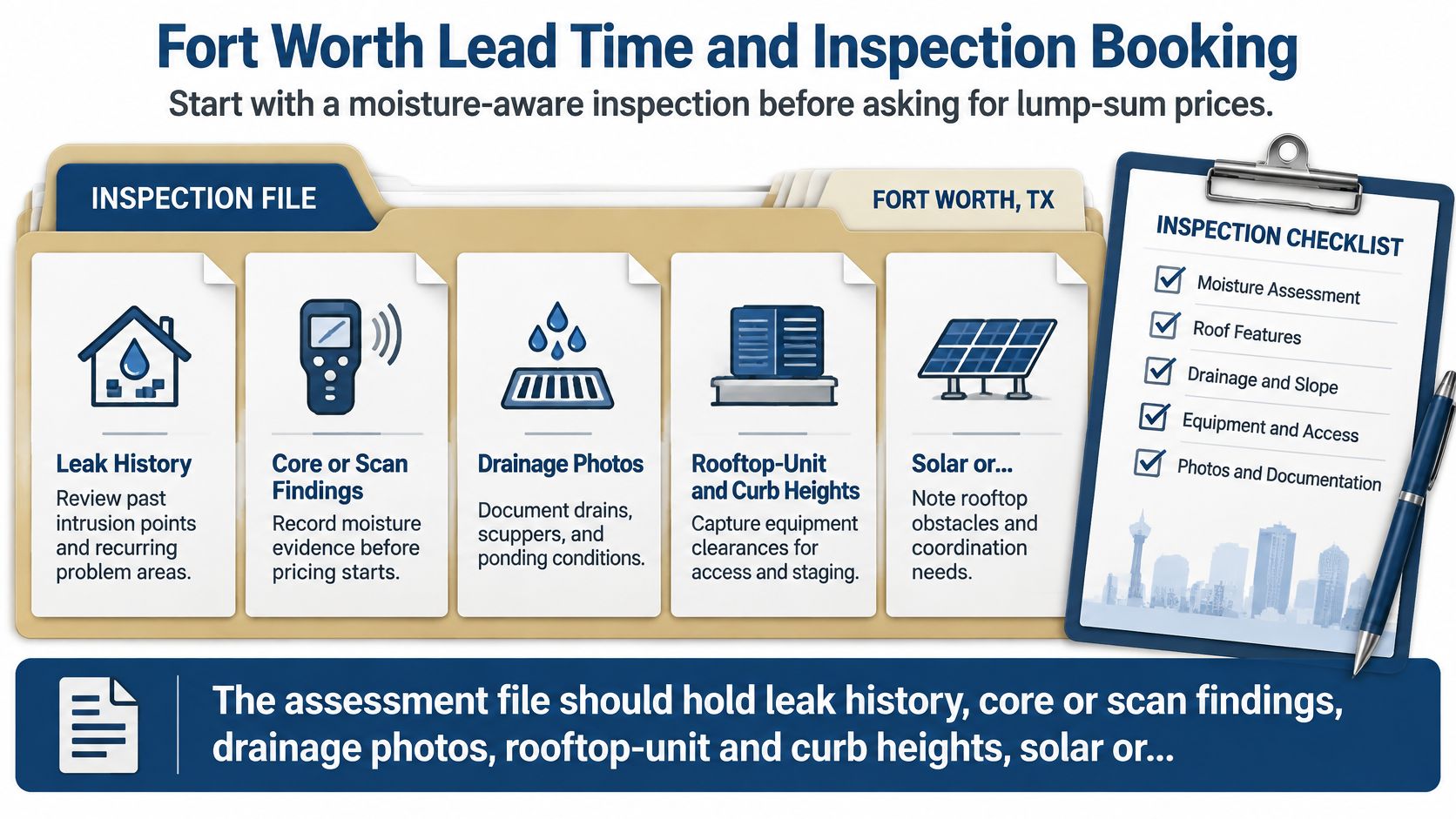
A roof bid is only as reliable as the inspection behind it. Before requesting a lump-sum price, assemble leak history, core or scan findings, drainage photos, rooftop-unit and curb heights, solar or grease plans, and a written recommendation to replace, recover, or repair. Pull as-built drawings if available, and confirm which city will issue the permit. Fort Worth, Arlington, Mansfield, Euless, and Grapevine are in Tarrant County, while Dallas, Denton, Plano, and Irving have their own review requirements.
The Dallas–Fort Worth metropolitan area includes Collin, Dallas, Denton, Ellis, Hood, Hunt, Johnson, Kaufman, Parker, Rockwall, Tarrant, and Wise counties. Keep one consistent set of roof photos for the project scope, insurance carrier, and lender. Photos taken after bidding can create disputes about what the original scope included.
Book the calendar before the storm does
In its fourth-quarter 2023 market-index survey, the National Roofing Contractors Association reported that 37% of roofing contractors had one to two months of work booked, 27% had three to four months, and 20% had five months or more. The survey covered reroofing contractors, consultants, and manufacturers in the United States and Canada. Treat it as an activity signal, not a count of available Fort Worth crews. Waiting until an active leak forces the schedule can leave fewer qualified crews available.
- This month, assess. Review core or scan results, interior stains, and drain photos before comparing prices.
- Next, design and permit. Show the taper, attachment, and edge metal on drawings for city review.
- Then, book installation around the weather. After a hailstorm, emergency work can crowd out planned projects. Set the phasing before crews arrive.
Bring the tenant calendar, inventory peaks, and access rules to the roof visit. If a Grapevine dock cannot close on Thursdays, put that restriction in the schedule. Ask for zoned phasing notes and written manufacturer and workmanship terms before signing.
Do not sign a membrane-only bid until drainage, wet insulation, attachment, and downtime are addressed in the scope.
A thin inspection file makes every price less dependable. Get the findings and recommendation in writing before choosing whether to replace, recover, repair, or phase the work.
How to Phase Work on Occupied Fort Worth Roofs
Three buildings show why phasing is a construction sequence, not a slogan. A Fort Worth distribution warehouse cannot close a dock. An Arlington retail strip has to keep storefronts open. A Denton or Dallas multifamily building keeps residents in place. The roof still has to be watertight every night.
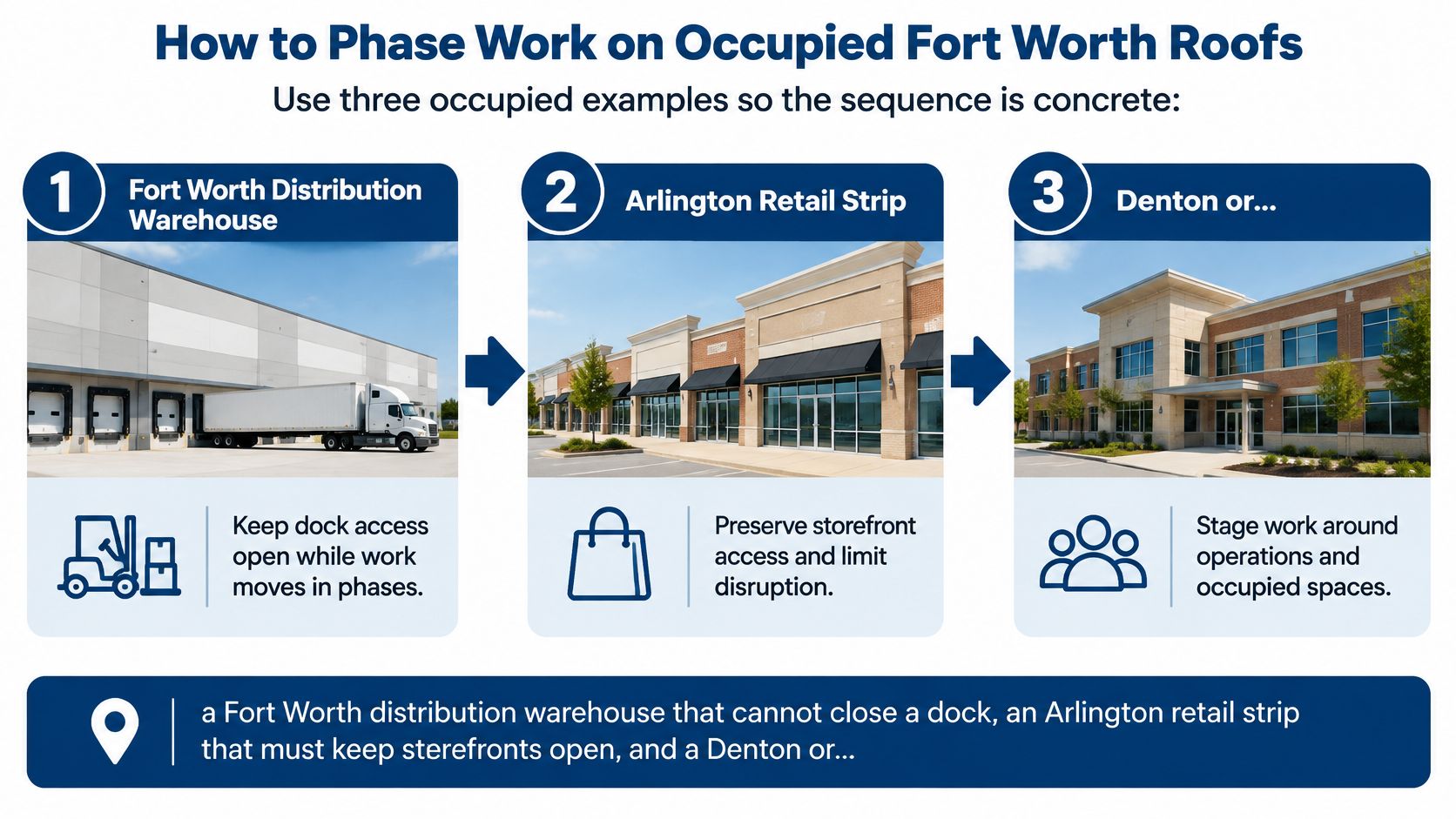
Six steps that keep the building open
- Split by basin, leak, and hours. On the Fort Worth warehouse, start at the dock bay that already stains inventory, and stop the cut line at a drainage basin, not at a convenient column line. Match noise and blocked access to the hours that tenant can tolerate.
- Set a weather window and a same-day dry-in rule. North Texas storms build fast. No zone stays open overnight. If the forecast breaks, the crew stops tearing, not the dry-in.
- Protect stock and keep access usable. Route ladders, chutes, and dumpsters so docks, entries, and fire lanes in Grapevine, Mansfield, or Euless stay open. The Arlington strip still needs a customer path to each door.
- Tear off only what you can finish that day. Insulate, taper, and membrane that zone, then flash curbs before anyone moves on. A Denton resident should not hear open deck over a bedroom after dark.
- Set HVAC curbs, supports, and solar-ready blocking before the membrane. Later trades should not cut a new warranty to hang a unit that was already on the capital plan.
- Photograph each finished zone. Note overnight tie-ins and keep a punch list for ponding after the first hard rain. A tie-in photo is what you show a tenant when a ceiling stain appears the next morning.
A deck-repair allowance that adds a day is normal. A crew that opens more roof than it can dry in is a danger sign. Stop that pattern the hour you see it.
One-week sample, two zones. Monday is protection, access, and the first basin layout. Tuesday and Wednesday are tear-off, taper, membrane, and curb flashings on zone one, with dry-in each afternoon. Thursday is the tie-in and the start of zone two. Friday is membrane completion, edge metal, photos, and a rain-watch punch list. Weekend work only happens if a storm already opened the roof. Otherwise you leave a closed, walked roof and a tenant who can still receive freight.
Fort Worth Warranties After Hail and Ponding
A 20-year warranty does not promise 20 years without leaks. Canadian roofing research reports effective roof-system service lives of roughly 10–25 years, and membranes often fall short of their nominal design life. Heat aging, roof traffic, slope, and skipped maintenance all affect performance. In Fort Worth, warranty terms matter most when the roof's drainage and maintenance are documented.
| Coverage | What it usually covers | Limits to confirm |
|---|---|---|
| Manufacturer warranty | Material defects for a stated term | Leak coverage depends on approved assembly, thickness, and installer |
| Workmanship warranty | Installation errors for a stated term | Confirm who responds in Tarrant, Dallas, Denton, and Collin counties |
| Hail on standing-seam metal | Cosmetic finish marks | Confirm whether coverage excludes dents unless a panel is punctured |
| Ponding and traffic damage | Usually not a material defect | Confirm drainage requirements and maintenance-log terms |
What the paper will not do
A manufacturer warranty may cover material defects for a stated term. Leak coverage depends on the manufacturer approving the assembly, membrane thickness, and installer. A contractor workmanship warranty covers installation errors for its stated term. Check who handles service calls in your county and what conditions could void coverage.
Ponding puts water against seams for longer, while repeated foot traffic can damage insulation. Poorly flashed curbs create leak paths that can become points of dispute with the warranty provider or insurance carrier. During replacement, require a taper plan, new or reinforced flashings, a penetration schedule, and walk pads at equipment technicians will visit. Keep wind-uplift and attachment paperwork with the project records for lenders or carriers.
For standing-seam metal, check how the warranty treats cosmetic hail marks. A dent in the finish is different from a punctured panel that allows water into the building. Confirm the distinction in writing before signing.
Ask five questions before you commit: Who is covered? For how long? What voids the warranty? Who handles repairs locally? What maintenance records are required? Get specific answers in the warranty documents, not only in a brochure.
Blue Lake Roofing & Remodeling, based in Forest Hill and serving Tarrant, Collin, Denton, and Dallas counties since 1995, handles commercial tear-off, deck repair, and TPO, EPDM, and standing-seam metal projects. Its inspection files support insurance and permitting. If you are weighing replacement, recovery, or phased commercial roof replacement in Fort Worth or a surrounding city, start with an assessment of the existing roof and its moisture conditions. Visit Blue Lake Roofing & Remodeling to request an on-site assessment and a scope for bidding.
