
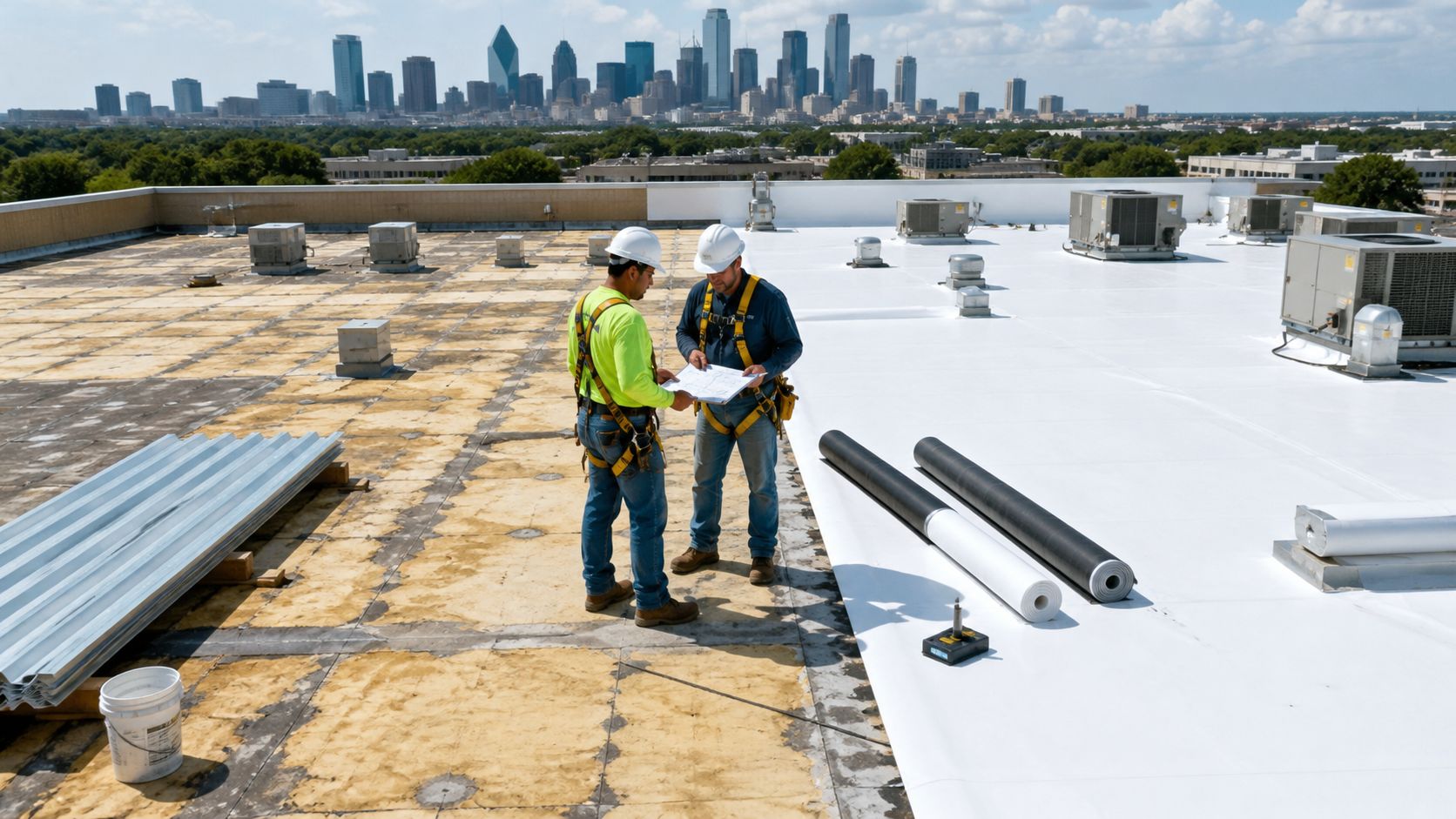
Commercial Roof Replacement in DFW: 2026 Guide
Over 2.5 billion square feet of commercial low-slope roofing is replaced or re-covered every year on existing U.S. buildings, so commercial roof replacement is a recurring capital-maintenance decision, not a rare emergency. Done right, code-compliant replacement can cut whole-building energy use by 5.7%, save about $12 billion over ten years, and avoid more than 100 million metric tons of carbon-dioxide emissions over that period (California Energy Commission technical document).
Most owners still ask the wrong first question. They ask what the membrane costs, when the better question is what the roof failure will do to tenants, inventory, equipment, and operations across Fort Worth, Arlington, Grapevine, Dallas, Plano, Irving, Denton, and the rest of the Metroplex.
Table of Contents
- Why Commercial Roof Replacement Is a Business Decision
- Evaluating Your Current Roof Condition
- Choosing Between TPO, EPDM, and Metal Systems
- Tear-Off Versus Overlay and Permitting Requirements
- Staging and Scheduling to Minimize Disruption
- Practical Tips from DFW Commercial Roofing Experience
- Verifying Completion and Securing Your Warranty
Why Commercial Roof Replacement Is a Business Decision
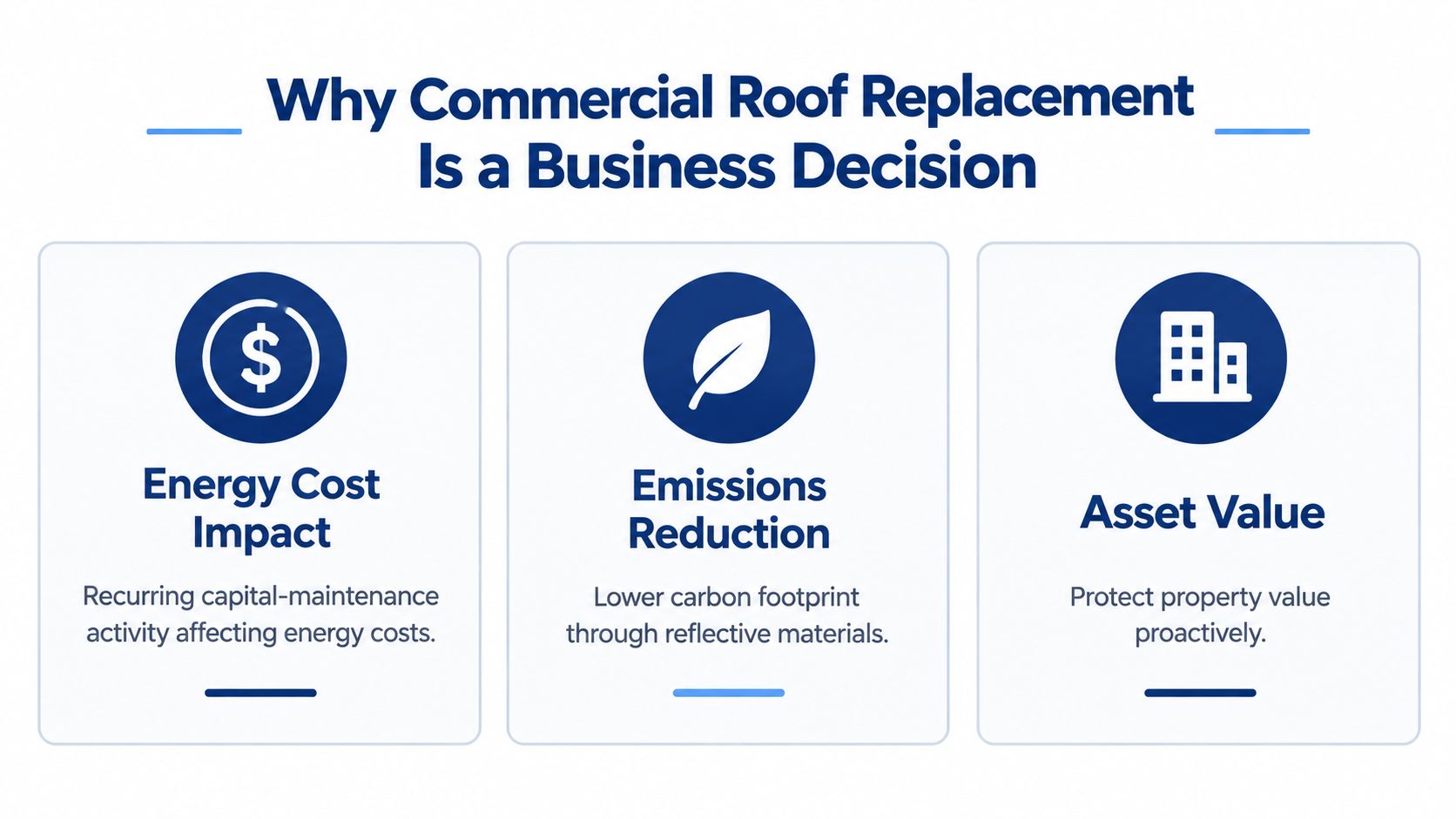
A commercial roof is part of the building's operating system. It affects heat gain, moisture intrusion, insurance exposure, and the timing of future capital work, so price per square foot never tells the whole story.
The common mistake is treating replacement like a simple leak fix. The roof assembly also affects insulation performance, heating and cooling demand, compliance, and long-term operating costs. A roof that looks serviceable on the surface can still be draining money and creating risk inside the building.
Practical rule: if the roof work interrupts loading, production, or customer access, the actual cost includes far more than materials and labor.
What owners should price into the decision
The contract matters, but the surrounding costs matter too.
- Downtime exposure: tear-off noise, odor, access limits, and temporary closures can affect tenants and employees.
- Secondary water damage: a leak during the project can hit ceilings, stock, IT gear, and finishes.
- Claim documentation: photos, timelines, and records matter when insurance gets involved.
- Long-term operating cost: under-insulated roofs keep draining money after the crew leaves.
A lower bid can still be the more expensive choice if it forces rushed work, poor staging, or repeated callbacks. Commercial roof replacement is risk management first and procurement second. In Fort Worth, Dallas, and the surrounding DFW cities, one bad decision can ripple through tenants, shift schedules, and delivery windows in a single day.
Evaluating Your Current Roof Condition
Before anyone talks tear-off or recover, the roof needs to be evaluated as a working assembly, not a sheet of material. A quick walk with binoculars and a sales pitch is not enough.
Start with the whole assembly
A documented assessment should cover the membrane, insulation, deck, flashings, penetrations, drainage, and rooftop mechanical equipment. The question is not whether it leaks today. It is what is already failing, and what can still be kept in service.
A roof with wet insulation can look serviceable from the top and still be a bad candidate for repair below the surface.
Moisture verification changes the project scope fast. If insulation is wet or the substrate is compromised, a recover can become a short path to another failure. If the deck is corroded, damaged, or unstable, patching over it only hides a larger problem. On a Fort Worth warehouse I inspected, what looked like a straightforward membrane replacement turned into a bigger scope after core cuts showed saturated insulation around a bank of rooftop units. That meant more tear-off, more disposal, and a different schedule for the tenant below.
Read the failure pattern, not just the age
Field work often reveals where the main risk sits. Available industry material notes that many commercial leaks are tied to flashing or poorly sealed penetrations, which is why curbs, drains, pipe boots, and perimeter transitions deserve more attention than a random sweep of the membrane field (DOE guidance).
Photos and written notes matter here. A good report should show what was observed, where it was found, and whether the issue is isolated or systemic. If a proposal does not separate membrane wear from detail failure, ask for a clearer scope. Too many building owners approve a repair or replacement based on a vague “roof is aging” comment that explains little and helps nobody plan operations.
Use moisture and substrate checks before tear-off
Moisture surveys, core cuts, and targeted probing answer three basic questions. Is the insulation dry, is the substrate sound, and is the deck fit for new work? If any answer is no, the scope usually grows.
That extra finding can change more than materials. It can affect staging, crane time, tenant access, and whether sections of the building stay open while the work moves across the roof. The point is not to force replacement. The point is to avoid paying twice for the same problem.
Choosing Between TPO, EPDM, and Metal Systems
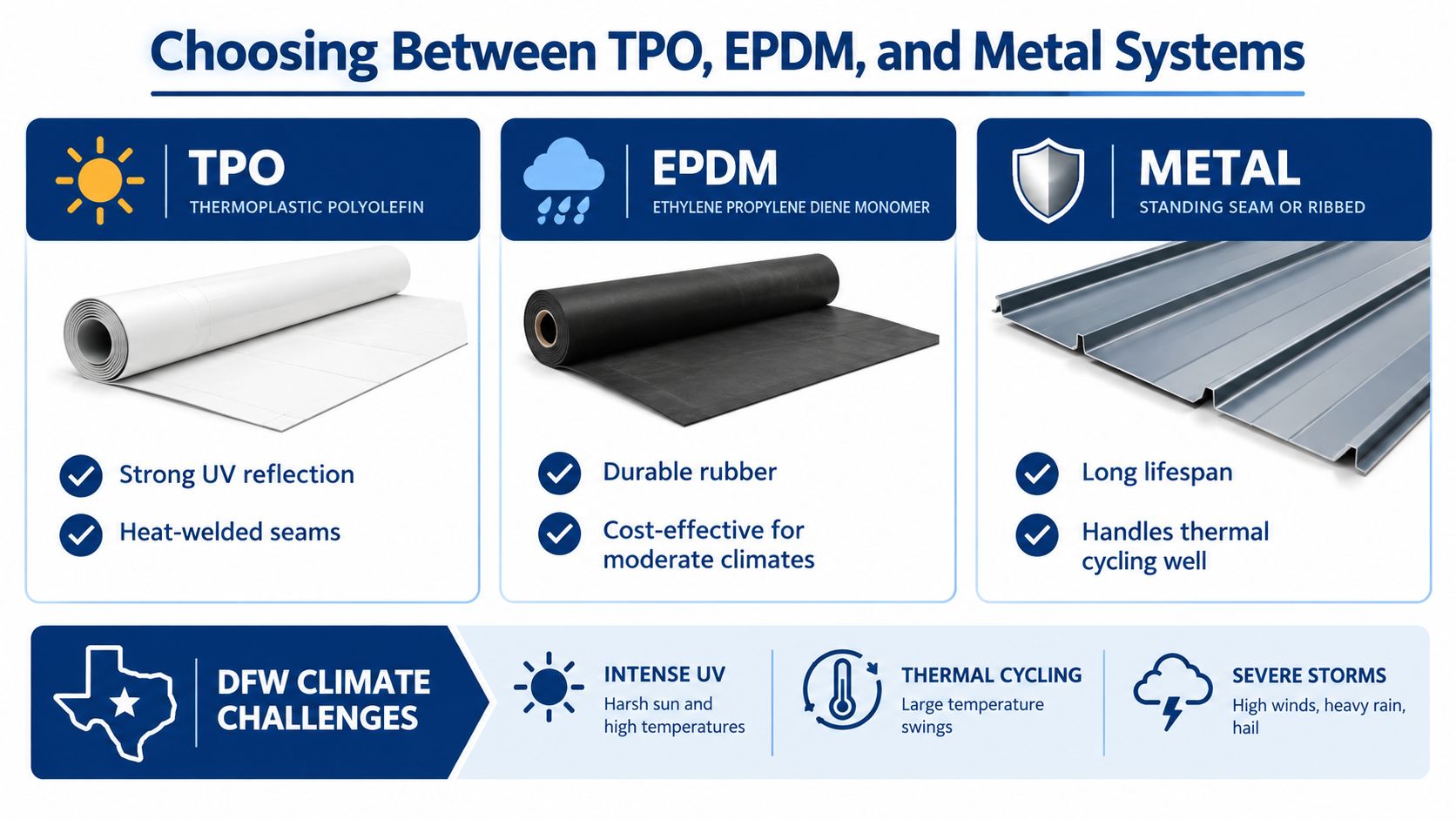
DFW roofs don't live an easy life. UV exposure is brutal, temperature swings are real, and storms can punish seams and edges. The right system depends on the building, the occupants below it, and how much maintenance the owner is willing to keep up with.
TPO versus EPDM
TPO works well when reflectivity and heat-welded seams are high priorities. Its value is strongest on low-slope buildings where the owner wants a modern single-ply system with a clean installation path and strong solar reflectance.
EPDM brings a different advantage. It's a time-tested rubber membrane with a simpler material profile and a long track record in commercial roofing. On the right building, especially one with moderate demands and a careful maintenance program, it can be a practical option.
| System | Strong points | Trade-offs |
|---|---|---|
| TPO | Reflective surface, heat-welded seams | Detail quality still matters |
| EPDM | Durable, flexible, familiar to crews | Seams and transitions need disciplined workmanship |
| Standing seam metal | Longevity, recyclability, strong thermal cycling performance | Penetrations and edges require precise detailing |
Where metal fits
Standing seam metal belongs in the conversation when the owner is looking for a long-service system and can support the higher level of detailing it demands. It handles thermal movement well, but the roof still lives or dies at the penetrations, curbs, and edge metal. That's where bad workmanship shows up first.
A nationwide Canadian durability and lifecycle-cost survey reported effective service lives for common low-slope roof systems of about 10 to 25 years and average removal and replacement costs of about $4 to $8 per square foot (National Research Council survey). That doesn't make one product automatically better, it just proves why lifecycle planning matters more than buying on the cheapest day-one number.
For crews that need overhead inspection support during large commercial projects, commercial drone operator resources from Ace Aviation Aerospace Academy can be useful when reviewing aerial workflow, inspection planning, and project monitoring around active sites.
Tear-Off Versus Overlay and Permitting Requirements
The biggest decision on many projects is whether to remove the old roof or recover over it. That choice affects cost, hidden moisture, code compliance, and what the building team inherits five years later.
When tear-off makes sense
Full removal is the better answer when insulation is wet, detail failures are widespread, or the existing assembly is too compromised to trust. It also gives the owner a chance to correct drainage, upgrade thermal performance, and verify what is happening at the deck.
Overlay can work when the structure is sound, the existing membrane is stable enough, and the local code allows it. But an overlay is only a real solution if the old roof isn't trapping moisture or hiding failures that will resurface under the new system.
Permits are part of the job
Fort Worth sits in the Fort Worth–Arlington metropolitan division, while Dallas, Plano, Irving, and Denton fall within the Dallas–Plano–Irving division of the Dallas–Fort Worth–Arlington MSA (TXDOT metroplex map). That matters because permitting and inspection requirements vary by city and county.
A clean project file should include the scope of work, code-related product data, and documentation that matches local expectations. If a contractor tells you permits can be skipped because “it's just a roof,” that's a red flag. Claims, resale, and warranty enforcement all get harder when the paper trail is weak.
Practical rule: if the project might be reviewed by an insurer, buyer, or city inspector later, do the paperwork now while the roof is open and the evidence is still available.
For owners who are weighing whether to renovate or rebuild around an aging asset, compare rebuild loan options from LendingXpress can be a useful financial reference point when the broader capital plan needs a reality check.
Staging and Scheduling to Minimize Disruption
Roof replacement becomes expensive when it disrupts operations badly enough to create secondary losses. That's why the schedule matters as much as the system choice.
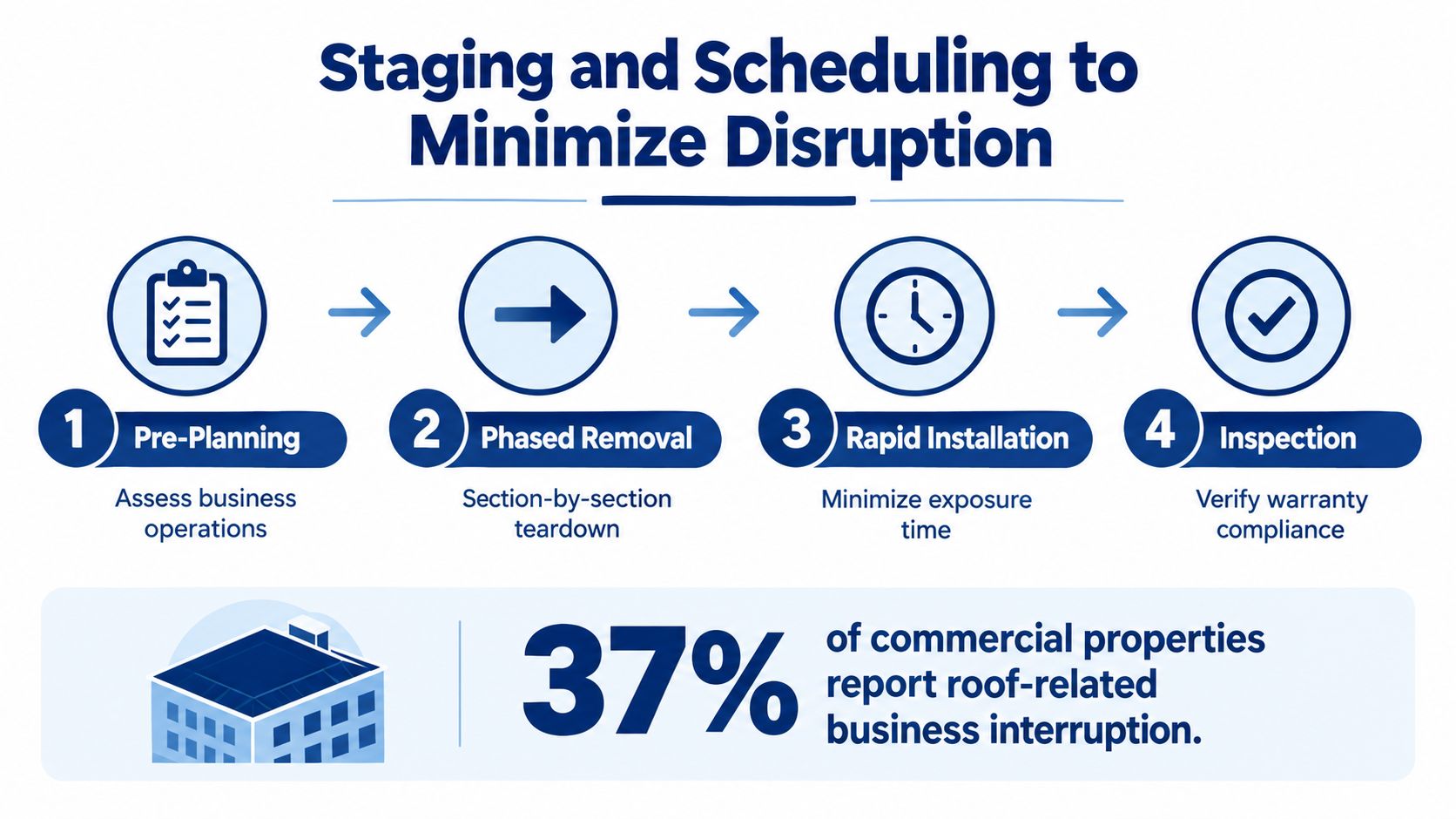
Commercial property claims show how often roof problems spill into business interruption. In one survey, 37% of commercial property customers reported roof damage, 37% reported business interruption, and 32% reported water intrusion or flood damage (Insurance Journal).
Build the project around operations
A good preconstruction plan starts with what lives below the roof. Retail floors, server rooms, warehouse inventory, classrooms, patient areas, and office spaces all need different protection. Once that's mapped, the work can be staged in zones so the building stays weather-tight overnight and the most disruptive tasks happen when fewer people are present.
Phased removal beats chaotic removal. It lets the crew isolate areas, control the exposure window, and keep temporary protection in place where the risk is highest. That doesn't eliminate disruption, but it keeps disruption from turning into damage.
Compare bids by total exposure
The cheapest contract can be the costliest project if it ignores business interruption, tenant concessions, damaged contents, or emergency cleanup. A higher bid with better staging, faster sequencing, or stronger temporary protection can reduce total loss.
Here's the lens I use on occupied buildings:
- Critical operations: what absolutely cannot stop?
- Access control: which entrances, docks, or parking areas need protection?
- Noise and odor: which tasks must be done after hours?
- Waterproofing continuity: how will the building stay dry between shifts?
The answer to those questions tells you more than a square-foot price ever will. That's especially true for schools, medical properties, warehouses, and multi-tenant buildings where one mistake affects many people at once.
Practical Tips from DFW Commercial Roofing Experience
The jobs that go smoothly in Fort Worth, Arlington, Grapevine, Dallas, Plano, Irving, and Denton usually have one thing in common. Someone paid attention to the details before the crew showed up, not after the first leak call.
The small mistakes cause the big callbacks
Rooftop HVAC work is a classic trouble spot. If other trades come back after installation and cut, mount, or drop tools on the new roof, the owner may inherit punctures that didn't exist during closeout. I've seen more problems from careless post-installation service work than from the membrane itself.
Adhesive systems need temperature discipline too. If membrane or substrate conditions don't meet the manufacturer's minimum bonding requirements, the roof can look finished while the bond is still weak. That's the kind of hidden defect that shows up later as seam issues or delamination.
Maintenance and warranty discipline matter
Practical rule: a workmanship warranty and a material warranty are not the same thing, and owners should read both before final payment.
Workmanship warranties commonly run only one or two years, while material warranties can extend for decades. That's why acceptance testing, written records, and photo documentation matter so much. If the closeout packet is thin, enforcement gets harder when something fails.
A reasonable maintenance rhythm is formal inspection at least twice yearly, usually spring and autumn, plus after major weather events. That's when blocked drains, loose edge metal, or small punctures are easiest to catch before they become building-wide problems.
The patterns I see most often are predictable:
- Wet insulation left in place because someone wanted to save tear-off cost.
- Ponding ignored because the leak didn't show up immediately.
- Perimeter fastening skipped even though the edges take the abuse.
- Incomplete closeout records that make warranty claims harder later.
Blue Lake Roofing & Remodeling handles commercial roof replacement, repair, storm restoration, and insurance-ready documentation in the DFW Metroplex, including projects where scheduling and code compliance have to be coordinated around business operations.
Verifying Completion and Securing Your Warranty
A roof replacement isn't finished when the last membrane sheet goes down. It's finished when the closeout package, inspection results, and warranty documents all line up with the installed work.
Check the closeout package line by line
The handoff should include as-built information, product data, warranty requirements, maintenance procedures, and repair records. If anything is missing, the owner should ask for it before final payment, not after a leak test fails and everyone starts hunting for paperwork.
Inspection and acceptance should cover seam probing or equivalent testing, fastener verification, drainage checks, and photographs of critical details. Perimeter and corner zones need extra attention because wind-uplift design depends on those areas being executed exactly as specified.
Verify the details that matter later
Penetrations, edge metal, curbs, and drains should be sealed and documented clearly. If the building has rooftop equipment, the owner should make sure future service paths are identified so later trades don't punch holes into the new work.
A useful closeout review is simple:
- Match the installed system to the approved specification.
- Confirm documentation for products, fasteners, and warranty terms.
- Check drainage and details where failures usually start.
- Store the records where facilities staff can find them fast.
Keep the photos, shop drawings, and maintenance notes together. If a future issue comes up, that file may be the difference between a clean warranty claim and a long argument.
For Fort Worth and surrounding DFW cities, the best roof is the one that protects the building's operating schedule as well as the structure itself. If you're planning a commercial roof replacement and want a contractor that can inspect, replace, document, and coordinate the work around real-world business needs, visit Blue Lake Roofing & Remodeling to discuss the next step for your property.
