
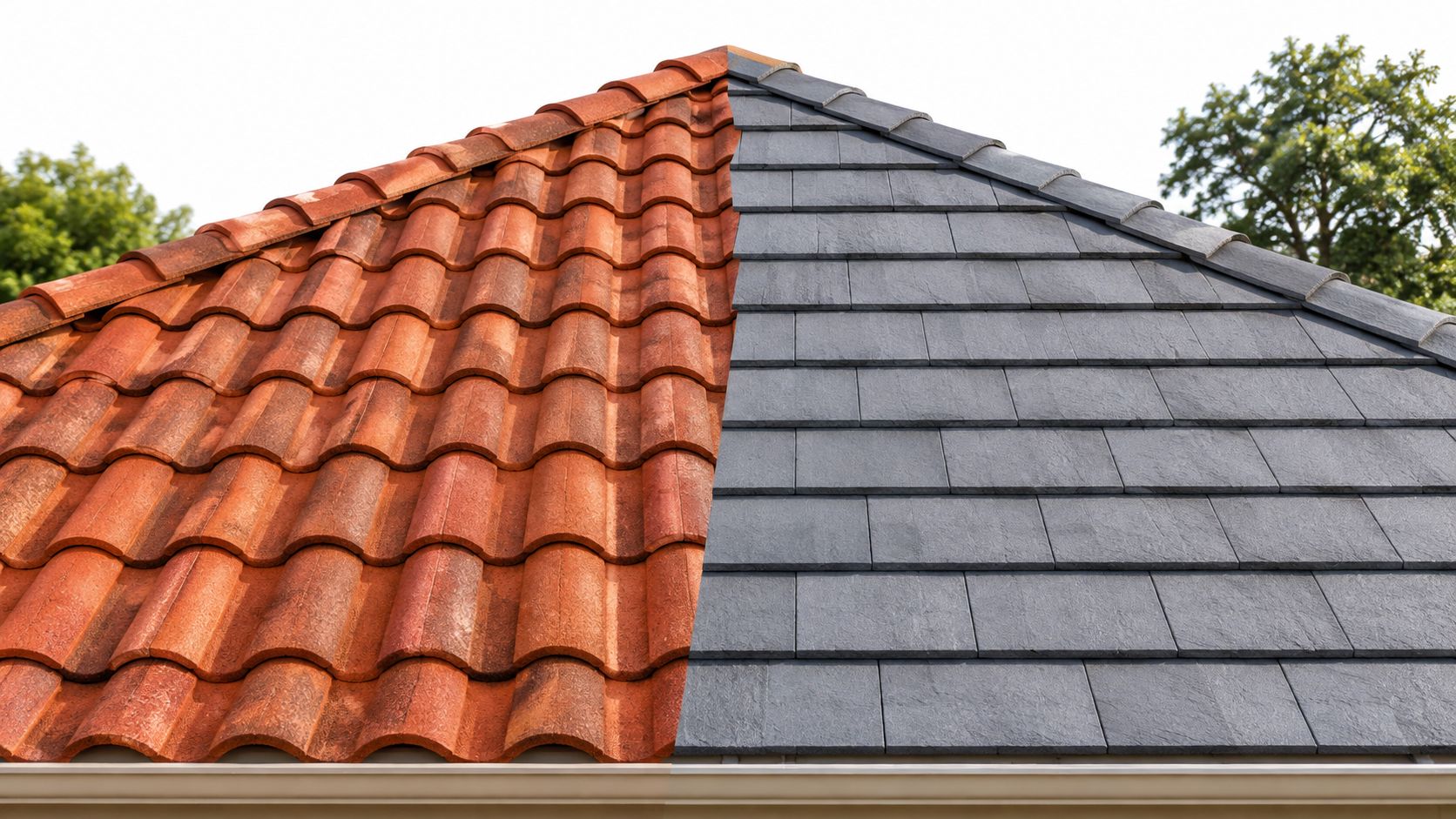
Clay Tiles vs Concrete Tiles for Texas Roofs
A hailstorm has just moved through Fort Worth, and you're looking at a roof scattered with cracked or displaced tiles. The contractor gives you two options, clay or concrete, but the material label doesn't answer the questions that matter. Can the framing carry the new roof? Is the deck sound? Will the underlayment and flashing be replaced? How easily can someone repair individual tiles after the next storm?
Those questions apply across Fort Worth, Arlington, Dallas, Plano, Irving, Denton, Richardson, and Grapevine, as well as properties throughout Tarrant, Dallas, Denton, and Collin counties. Having specified and repaired both systems in the Dallas-Fort Worth area since 1995, I treat clay tiles vs concrete tiles as an assembly decision, not a beauty contest.
Table of Contents
- Why Tile Choice in DFW Starts With the Roof, Not the Material
- Clay vs Concrete at a Glance for Texas Roofs
- Durability Standards and What Absorption Really Means
- Heat Performance and What Actually Keeps the Attic Cool
- Cost, Service Life, and How Each Tile Behaves After DFW Hail
- Storm and Structural Decision Tree for Fort Worth Roofs
- Which Tile Wins for Your Specific DFW Property
Why Tile Choice in DFW Starts With the Roof, Not the Material
A Fort Worth homeowner with hail damage may prefer the warm variation of clay or the broader color selection of concrete. That preference matters, especially on a visible front elevation, but it comes after the roof has been evaluated. A tile roof is a layered system made up of framing, decking, underlayment, flashing, ventilation, battens or fasteners, and the tile itself.
A beautiful clay tile installed over a weak deck can fail. So can a concrete tile system installed without confirming dead-load capacity, drainage details, or attachment requirements. The tile isn't the only component exposed to Texas weather, and it isn't the only component responsible for keeping the structure dry.
Four questions decide the outcome
Structural capacity comes first. Clay and concrete tile systems can place more demand on framing than a lightweight roof covering. Before recommending either material, a contractor should inspect the framing and determine whether reinforcement is needed. A material change isn't a simple one-for-one substitution.
The water-shedding layers need equal attention. Underlayment, valleys, wall flashings, pipe penetrations, hips, ridges, and fasteners protect the deck when wind-driven rain gets beneath the tile. If the visible tile is replaced while aged underlayment remains, the project may look new without solving the roof's most important water-management weaknesses.
Hail repair needs a plan. Individual clay and concrete tiles can often be replaced without tearing off the entire roof. That only works when matching pieces are available, the surrounding tiles can be handled safely, and the underlayment and attachment system remain serviceable. A roof with no documented product information or spare pieces can become harder to repair after a storm.
Heat performance depends on the assembly. Profile, ventilation, insulation, roof color, and radiant-barrier details affect attic conditions. Clay doesn't automatically outperform concrete because it was fired in a kiln.
The Dallas–Fort Worth–Arlington MSA is the dominant metropolitan area within the broader Metroplex, while the wider region includes 19 counties and more than 15,000 square miles, according to the Texas Comptroller's Metroplex regional profile. That geographic spread matters because local roof conditions, building styles, storm exposure, permitting, and delivery logistics vary from an older Fort Worth neighborhood to a newer Plano subdivision.
Blue Lake Roofing & Remodeling begins a tile consultation with a structural and deck review rather than a material pitch. That approach is useful whether the property is in Fort Worth, Arlington, Dallas, Plano, Irving, Denton, Richardson, or Grapevine. The right question isn't “Which tile is superior?” It's “Which complete system can this roof support, drain, ventilate, and repair?”
Clay vs Concrete at a Glance for Texas Roofs
The table below is a practical screening tool, not a substitute for a site inspection. Installed pricing, weight, service life, and repair scope vary by product, roof geometry, access, structural work, and regional labor conditions. Because no verified local price schedule is available here, cost is shown qualitatively rather than as an invented dollar range.
Clay vs Concrete Tile Comparison for Texas Roofs
| Criterion | Clay Tile | Concrete Tile |
|---|---|---|
| Structural demand | Often requires careful load review because profiles and construction can be substantial | Also requires a load review, with product density and profile affecting the completed system |
| Service life | Long-lasting when properly selected, installed, and maintained | Long-lasting when properly selected, installed, and maintained |
| Installed cost | Usually positioned as the higher-cost specialty option | Often offers a more cost-conscious installation path |
| Color and appearance | Natural variation, enduring architectural character, strong fit for Spanish, Mediterranean, and historic designs | Broad profile and color choices, with styles suited to many contemporary and traditional homes |
| Hail behavior | Individual units can crack and require careful matching and handling | Individual units can crack and are often practical to replace piece by piece when matching material is available |
| Repairability | Depends heavily on matching supply, safe access, and underlayment condition | Depends heavily on matching supply, safe access, and underlayment condition |
| Thermal behavior | Performs as part of a ventilated tile assembly, not as an isolated material | Performs as part of a ventilated tile assembly, not as an isolated material |
| Sustainability comparison | Results change with manufacturing, transport, service life, repairs, and disposal | Results change with cement production, transport, service life, repairs, and disposal |
A 2,000-square-foot roof in Tarrant or Collin County still can't be priced responsibly from roof area alone. Valleys, hips, penetrations, pitch, tear-off access, framing corrections, underlayment, flashing, and tile availability can change the scope substantially. Ask each contractor to separate the tile, structural work, water-shedding layers, ventilation, disposal, and repair allowances in the proposal.
Clay and concrete can both provide attractive, fire-resistant roof coverings when the selected product and installation system are appropriate. The meaningful differences usually appear in structural compatibility, appearance, supply, handling, and post-storm repair logistics, not in a simplistic claim that one material always lasts or performs better.
Before signing a contract, also check the contractor's insurance documentation and understand roofing liability cover limits as part of your broader vendor review. That information doesn't choose the tile, but it helps you evaluate the company responsible for installing and repairing the assembly.
The repairability question: If hail cracks a small group of tiles next year, can the contractor identify the product, source matching pieces, replace them safely, and confirm that the underlayment below is still reliable?
Durability Standards and What Absorption Really Means
Water absorption is one of the most useful durability signals in a tile specification, especially where a roof experiences repeated wetting, drying, and storm exposure. It isn't a complete product guarantee, but it tells you more than a box label that says “premium” or “weather resistant.”
What ASTM C1167 tests for clay
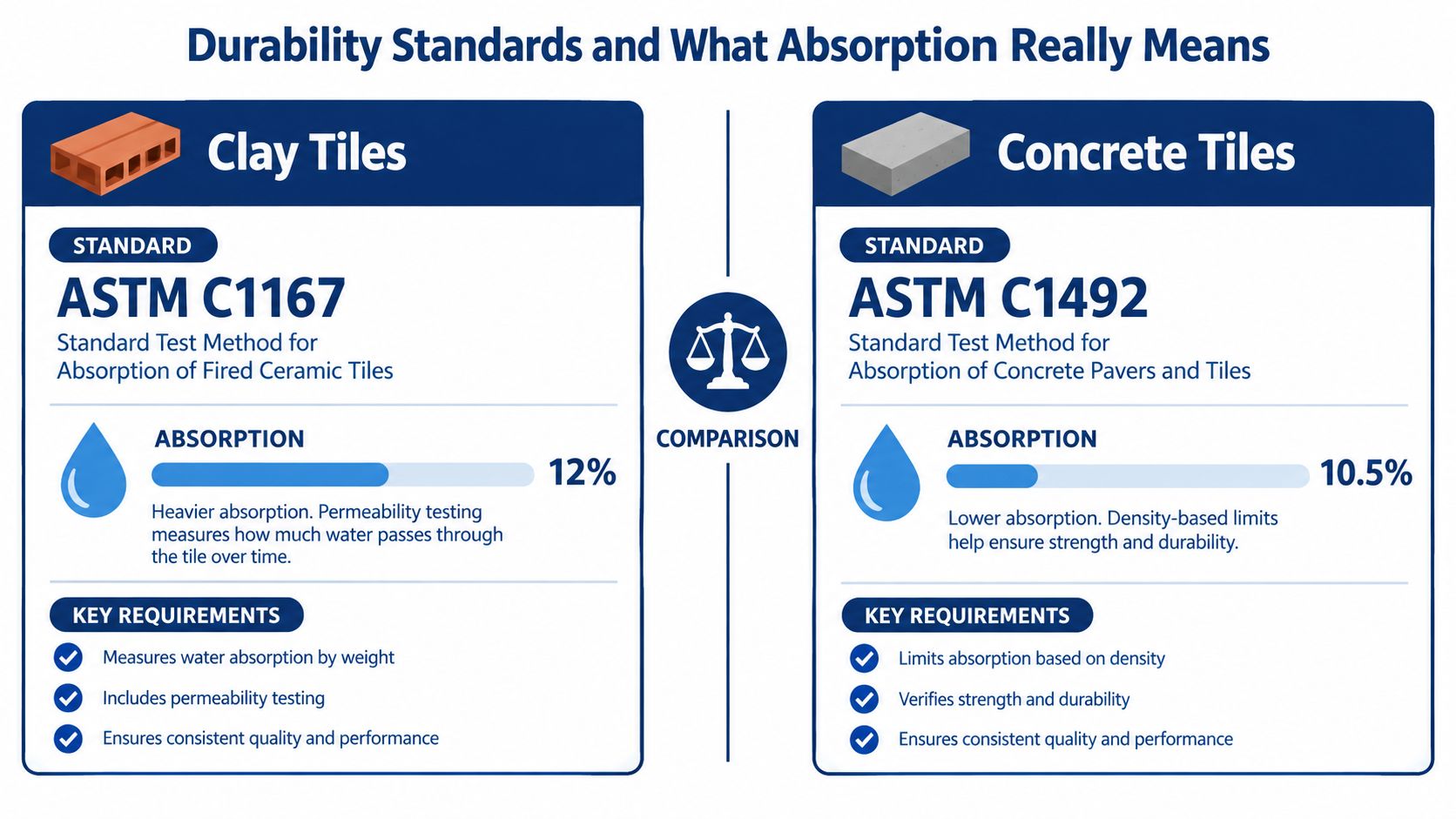
ASTM C1167 evaluates clay tiles through several durability measures, including durability grade, cold-water absorption, saturation coefficient, permeability, transverse breaking strength, and freeze-thaw performance. The standard also allows higher weathering grades to substitute for lower grades.
Permeability gives the specification practical meaning. Under the cited criterion, no water droplets should fall from the underside of the tile after 24 hours. On a DFW roof, that doesn't mean the tile alone manages every leak risk. Water can still enter at laps, penetrations, valleys, flashings, damaged underlayment, or improperly installed fasteners.
What ASTM C1492 means for concrete
ASTM C1492 classifies concrete tiles by density. For normal-weight products, the standard sets an average absorption limit of 10.5%, with no individual unit above 12.5%. Medium-weight products have limits of 14.5% average and 16.5% individual, while lightweight products rise to 18% average and 20% individual, according to the ASTM C1167 reference document, which also provides context for tile durability requirements.
Those figures aren't interchangeable guarantees between products. Absorption depends on formulation, firing or curing, density, profile, and surface treatment. A contractor should identify the proposed product's ASTM classification and provide the manufacturer's tested data rather than making a broad claim about all clay or all concrete tiles.
DFW homeowners should also interpret the standards in local context. Freeze-thaw testing remains relevant to durability classification, but many local projects face more concern from hail, intense sun, wind-driven rain, and repeated wet-dry cycling. Lower absorption can support durability, but it doesn't make a tile hailproof. A cracked tile still needs replacement, and a sound tile over failed underlayment can still leave the roof vulnerable.
Ask three direct questions before approving the material:
- Which standard applies? Is the proposed clay tile documented under ASTM C1167, or is the concrete product classified under ASTM C1492?
- What was tested? Ask for the product-specific absorption, permeability, strength, and weathering information.
- What gets installed below it? Confirm the underlayment, flashing, fastening, and ventilation system in writing.
Heat Performance and What Actually Keeps the Attic Cool
Texas attic comfort depends on how the complete roof assembly moves heat. The tile's material matters, but the air space beneath a profiled tile, ventilation path, insulation level, roof color, and radiant-barrier details can matter more than whether the tile is clay or concrete.
Instrumented steep-slope testing of clay and concrete tile assemblies found substantially lower heat flow through the roof deck than direct-nailed asphalt shingles. One reported test showed approximately a 70% reduction in peak deck heat flow, while a hot-day comparison for a clay-tile assembly reached about 90% lower noon heat flow than the shingle control, according to the IIBEC testing discussion.
The air space does much of the work
Profiled tiles can create a ventilated cavity below the roof covering. As the tile heats, air movement through that space can carry heat away before it reaches the deck. Thermal mass also slows heat transfer, which helps explain why tile assemblies can perform differently from directly attached coverings.
The same testing reported exposed clay and concrete tile thermal emittance at approximately 0.85 after two years of outdoor exposure, indicating similar long-wave radiative behavior in that test. That doesn't prove every product or installation performs identically. It shows why the material label alone is a poor way to predict attic conditions.
A contractor should compare the proposed assembly details, including:
- Installation method: Batten-mounted and direct-deck systems create different ventilation conditions.
- Profile: The shape and height of the tile affect the under-tile air space.
- Roof color: Surface color influences solar response.
- Insulation: Attic insulation changes how much roof-deck heat reaches occupied rooms.
- Radiant control: A radiant barrier can alter the assembly's heat-transfer behavior.
- Ventilation: Intake and exhaust paths need to work together rather than relying on tile gaps alone.
If attic comfort is part of the project, compare the roof assembly with the home's cooling equipment and duct layout. A homeowner reviewing options can also compare efficient cooling systems to understand how roof changes fit into the larger heat-management plan. A cooler roof won't correct undersized equipment, poor duct insulation, or blocked attic ventilation.
Cost, Service Life, and How Each Tile Behaves After DFW Hail
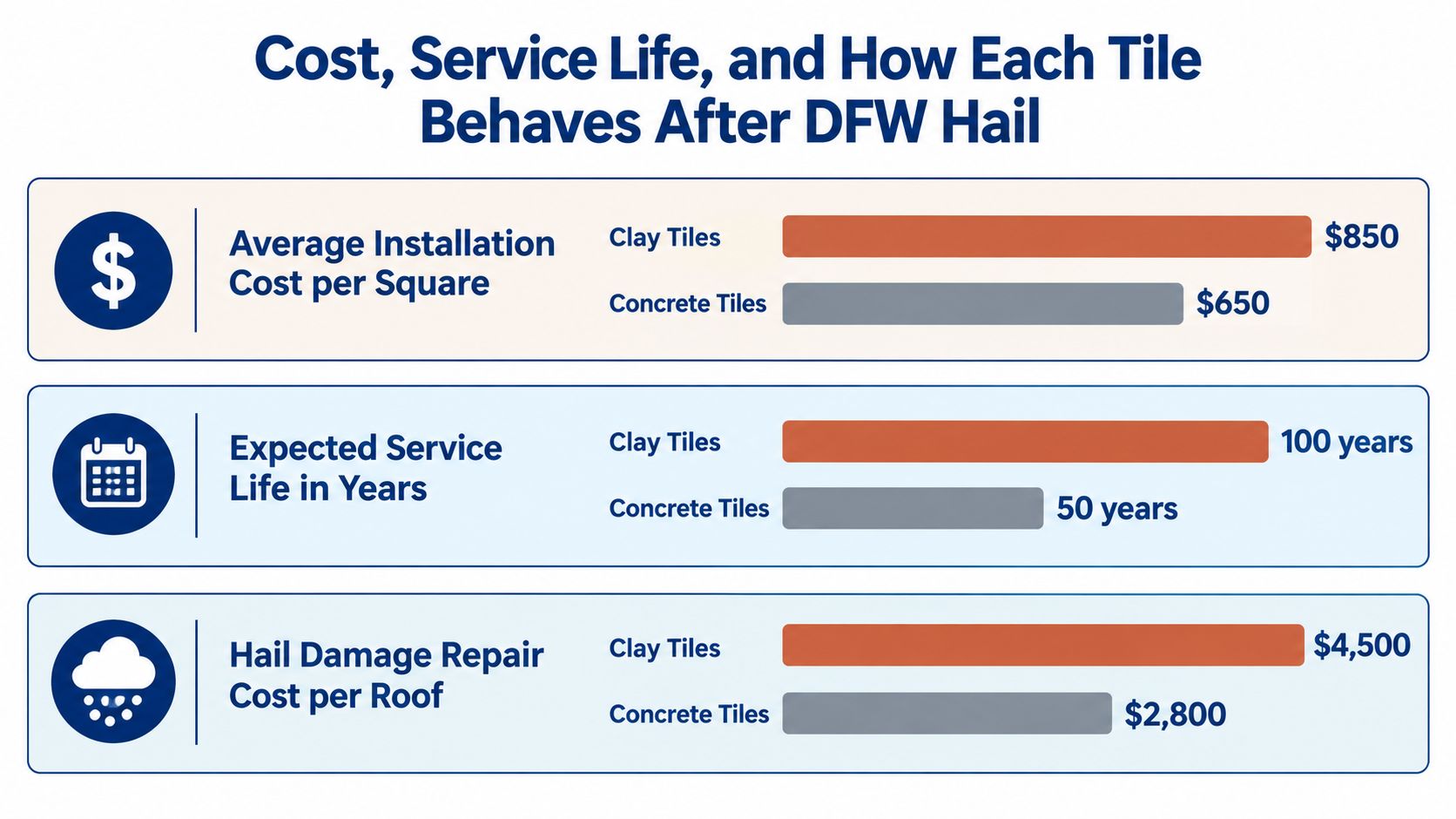
Clay usually carries a higher installed price in the Metroplex because specialty profiles, handling, structural requirements, matching pieces, and installation time can increase the scope. Concrete often gives homeowners a more predictable material path, particularly when the existing framing and roof geometry suit the selected product.
Concrete represented approximately 47.05% of the global roofing-tile market in 2025, while clay was projected to grow at 6.74% annually, according to Mordor Intelligence's roofing-tile market overview. Those market figures explain why concrete is widely available and why clay continues to appeal to premium, heritage, and Mediterranean-style projects. They don't determine which material belongs on a specific DFW home.
Where the long-term calculation changes
Both materials can deliver a long service life when the structure, underlayment, flashing, fastening, drainage, and maintenance are handled correctly. The tile may remain usable while the layers beneath it age, which creates a difficult decision. Removing and relaying tile to replace underlayment can require careful staging, sorting, breakage control, and matching replacements.
The expensive surprise: A roof can still have serviceable tiles while its underlayment, flashings, and fasteners have reached the end of their practical life.
Hail damage creates a separate calculation. A tile can crack from impact, while the underlayment below may remain intact. Or the storm can disturb tiles, expose fasteners, damage flashing, and create water entry that isn't visible from the ground. A responsible inspection documents both the visible units and the assembly beneath them.
Piece-by-piece repair is possible, not automatic
For either material, a proper repair usually involves more than swapping a broken piece:
- Identify the tile profile, size, color, and manufacturer if possible.
- Check surrounding tiles for concealed cracks or displacement.
- Remove and replace the damaged unit without damaging adjacent pieces.
- Inspect the underlayment and attachment point.
- Verify flashings, valleys, ridges, and penetrations nearby.
- Photograph the completed repair for maintenance and insurance records.
Clay can be more difficult to match where natural variation, discontinued profiles, or specialty finishes are involved. Concrete can also become difficult to match when a profile or color has been discontinued. Keeping spare tiles and project photographs can shorten future repair work for either system.
Lifecycle sustainability requires the same honesty. One lifecycle assessment reported clay at approximately 4.4 tonnes of CO₂-equivalent and 52.7 MJ of embodied energy per 100 square meters, while concrete required approximately 83 MJ of embodied energy. Another assessment cited lower whole-life greenhouse-gas emissions for concrete than clay. The conflicting results, discussed in the lifecycle assessment source, show why transport distance, production, weight, replacement frequency, repairability, and disposal route must be evaluated for the actual property.
Storm and Structural Decision Tree for Fort Worth Roofs
A tile proposal should read like an engineering and repair plan, not just a color selection. Use the following sequence whether the property is in Fort Worth, Arlington, Dallas, Plano, Irving, Denton, Richardson, or Grapevine.
Start with the structure
Step one, verify the roof framing. Ask for a load review before choosing a tile profile. The inspection should identify framing size and spacing, visible deflection, prior alterations, and any reinforcement required for the proposed completed assembly.
Step two, inspect the deck. Hail, leaks, ventilation problems, and previous repairs can weaken or stain decking. Tile replacement over compromised deck material transfers the problem into the new roof.
Step three, specify the water-shedding layers. The proposal should name the underlayment, valley treatment, wall flashing, pipe flashing, ridge details, and manufacturer-approved installation method. “Install new underlayment” is less useful than identifying the actual system and locations.
Step four, review attachment and wind requirements. Fasteners, clips, battens, mortar details, and the tile manufacturer's instructions should match the roof pitch and local requirements. Don't accept a generic fastening statement when the contractor is proposing a specialty tile system.
Step five, document the storm condition. Photograph cracked tiles, displaced units, damaged flashings, exposed underlayment, interior stains, and nearby tree or hail impact evidence. Keep the inspection record with the original product information.
Pre-Installation Decision Tree for a Texas Tile Roof
| Step | What to Verify | Why It Matters |
|---|---|---|
| 1 | Roof framing and completed tile-system load | Prevents a material choice the structure cannot safely carry |
| 2 | Deck condition and prior water entry | Gives the new roof a sound surface and identifies hidden storm damage |
| 3 | Underlayment, valleys, and flashing specification | Controls water management when moisture moves below the tile |
| 4 | Fasteners, clips, battens, and wind requirements | Helps keep the system attached during severe weather |
| 5 | Matching pieces and repair procedure | Reduces the chance that isolated hail damage becomes a full replacement discussion |
The Dallas Federal Reserve's Fort Worth division profile identifies the Fort Worth–Arlington–Grapevine metropolitan division as covering Johnson, Parker, Tarrant, and Wise counties. That western Metroplex footprint includes a wide range of roof ages and construction types, so a checklist is more useful than assuming every Fort Worth-area property can use the same tile assembly.
Which Tile Wins for Your Specific DFW Property
A 1970s ranch in Arlington with standard framing often points toward a concrete tile system after the deck and underlayment are upgraded, provided the proposed product fits the structure. Concrete can offer practical availability and a broad range of profiles without forcing the homeowner into a highly specialized appearance.
A custom or historic property in an older Fort Worth neighborhood may lean toward clay when color variation, profile, and architectural character are central to the project. The same can apply to premium subdivisions in Plano or heritage properties in Grapevine, where a replacement that looks too uniform or contemporary can diminish the building's character.
Commercial and HOA properties across the Metroplex often prioritize predictable procurement, repeatable installation details, and repair logistics. Concrete may fit that objective, but the decision still depends on structural capacity, product documentation, underlayment, flashing, and the availability of matching units. A facility manager should also document the roof assembly so future storm repairs don't begin from zero.
Sustainability should be handled with a project worksheet rather than a universal “greenest” claim. Record roof area, structural reinforcement, delivery distance, expected service life, repairability, replacement frequency, and disposal route. A lighter factory footprint can lose its advantage if transport, breakage, or premature replacement changes the whole-life result.
The practical answer is rarely just clay or concrete. It is the tile, framing, deck, underlayment, flashing, ventilation, attachment method, and repair plan working together.
A local inspection should confirm the roof's actual condition before any material is ordered. The western Metroplex includes Fort Worth, Arlington, and Grapevine, while the broader service decision may involve Dallas, Plano, Irving, Denton, Richardson, Tarrant County, Collin County, Denton County, or Dallas County. The roof should be evaluated where it stands, not selected from a showroom sample alone.
Blue Lake Roofing & Remodeling offers structural reviews, clay and concrete tile repair or replacement, storm-damage documentation, insurance-claims assistance, and specialty roofing inspections across Tarrant, Collin, Denton, and Dallas counties. Visit Blue Lake Roofing & Remodeling to request a free on-site inspection and determine which complete tile assembly your DFW property can safely carry.
